

A German submarine slipped into Britain’s most important naval anchorage and sank a battleship at anchor, killing 835 men. The barriers built afterwards to seal the gap were raised by Italian prisoners of war — the same men who, in their spare time, turned two military huts into one of the most loved buildings in Orkney.
At a glance
Scapa Flow, the sheltered anchorage in the Orkney Islands, was the Royal Navy’s principal home fleet base in both world wars, protected by more than sixty deliberately sunk blockships in its access channels. On the night of 13–14 October 1939, the German submarine U-47 found a gap the blockships did not close, sank the battleship HMS Royal Oak at anchor, and got away. The Churchill Barriers built in response, and the Italian prisoners of war who built them, left Orkney with two very different monuments: a causeway system still in daily use, and a tiny chapel built from salvaged materials that its builders’ descendants still return to see.
Key facts
- HMS Royal Oak: sunk 14 October 1939, 01:04–01:29, by three torpedoes from U-47 under Kapitänleutnant Günther Prien, who penetrated Scapa Flow via Kirk Sound between the blockships Seriano and Numidian; around 835 of 1,234 crew died, including 134 boy sailors under 18 — the Royal Navy’s greatest single loss of life in one action
- Churchill Barriers: four causeways, 2.3 km total, built May 1940 – September 1944 (officially opened 12 May 1945), using 66,000 concrete blocks on gabions and 250,000 tonnes of rock, connecting Mainland to South Ronaldsay via Lamb Holm, Glimps Holm and Burray
- Workforce: over 2,000 workers at peak, including more than 1,300 Italian prisoners of war captured in North Africa, housed in three camps
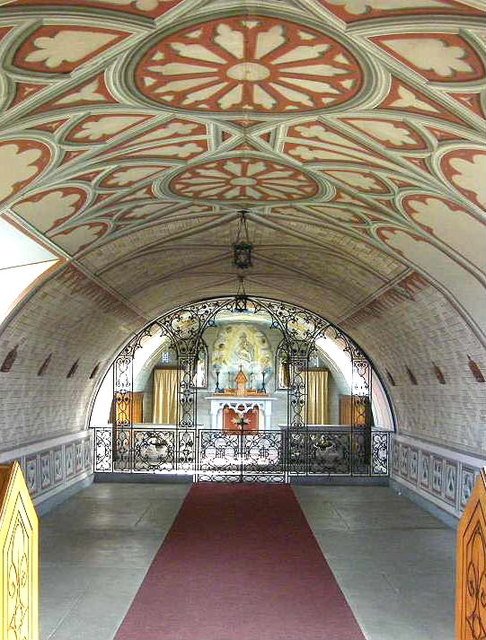
- The Italian Chapel: built 1943–44 by prisoners of Camp 60 on Lamb Holm, from two Nissen huts joined together; concrete left over from the Barriers went into the altar, corned-beef tins became candle-holders, an exhaust pipe clad in cement became the font. Principal artist: Domenico Chiocchetti, of Moena, Trentino
- After the war: prisoners were repatriated, but Chiocchetti stayed on voluntarily to finish the newly consecrated chapel’s decoration before leaving; he returned in 1960 to restore it, and an Italian Chapel Preservation Committee, founded by Orcadians in 1958, has maintained it since
- Coordinates: 58.8899° N, 2.8894° W (Italian Chapel, Lamb Holm)
How the base failed, and how it was fixed
Scapa Flow was considered close to impregnable to submarine attack: more than sixty blockships had been sunk deliberately across its access channels specifically to keep U-boats out. Prien’s approach through Kirk Sound found the one gap that assessment had not accounted for — his boat briefly ran aground on a mooring cable in the passage before working free and firing on the anchored fleet. Churchill, then First Lord of the Admiralty, called the raid «a remarkable exploit of professional skill and daring»; a subsequent Admiralty inquiry criticised the defences directly, and the officer commanding Scapa Flow was removed from his post.
The Barriers that followed answered the failure permanently: solid causeways, not sunken hulks, sealing the eastern approaches for good. Building them at that scale, in wartime, needed a workforce Britain did not have to spare from its armed forces — which is how more than 1,300 Italian prisoners of war, captured fighting for the other side in North Africa, ended up building a key piece of British home-front infrastructure.
What the same hands built next
The Geneva Convention did not require the prisoners to build fortifications, and the Barriers were officially justified to them as a causeway project rather than a military work — a formality that let the labour continue. What the same men built without any order to do so was the chapel: two huts from Camp 60, joined and plastered, painted by Chiocchetti with a Madonna and Child copied from a prayer card he had carried from home, decorated by prisoners with whatever the camp and the Barriers’ construction materials could supply. It was consecrated only shortly before the camp closed and the prisoners were sent home.
Who tells it, and where the accounts diverge
Two structures, built by the same hands in the same years on the same small island, tell almost opposite stories about what captivity produced. The Barriers are infrastructure: engineered, inspected, opened by ceremony, still carrying traffic today, built because Britain needed them and Italian labour was available to build them. The chapel is the opposite of required — nobody ordered it, no military purpose justified it, and its materials were whatever scraps a prisoner-of-war camp could spare. That the same workforce produced both, and that Orcadians founded a preservation committee for the chapel while the men who built it were still, technically, former enemies, is not really a divergence between competing accounts. It is a single record straightforward enough that no reconciliation is needed: forced labour building what was demanded of it, and free choice building something nobody demanded at all, in the same camp, in the same two years.
What you see today
- The Italian Chapel on Lamb Holm, open to visitors, still an active place of worship with seasonal services.
- The four Churchill Barriers, in daily use as road causeways linking Orkney’s southern islands to the Mainland.
- A memorial to HMS Royal Oak in St Magnus Cathedral, Kirkwall; the wreck itself remains a designated war grave in Scapa Flow.
Getting there
The Italian Chapel and the Churchill Barriers lie along the A961 south of Kirkwall, Orkney Mainland, linking to Burray and South Ronaldsay.
Nearby
- Kirkwall and St Magnus Cathedral, with the Royal Oak memorial
- The Scapa Flow Museum at Lyness, on Hoy, covering the wider naval history of the anchorage
Sources
- Wikipedia, HMS Royal Oak (08), Scapa Flow, Churchill Barriers and Italian Chapel — sinking, casualty figures, Barrier construction, chapel history, cross-checked between entries.
Find it on the map
See this place and what’s around it →📷 Become a Cultural Heritage Online photographer
Share your photos of places: they stay published under your name as the author. The more they're seen, the more you get noticed — and soon a contest will reward the most appreciated photos.
Log in or sign up free to add a photo