
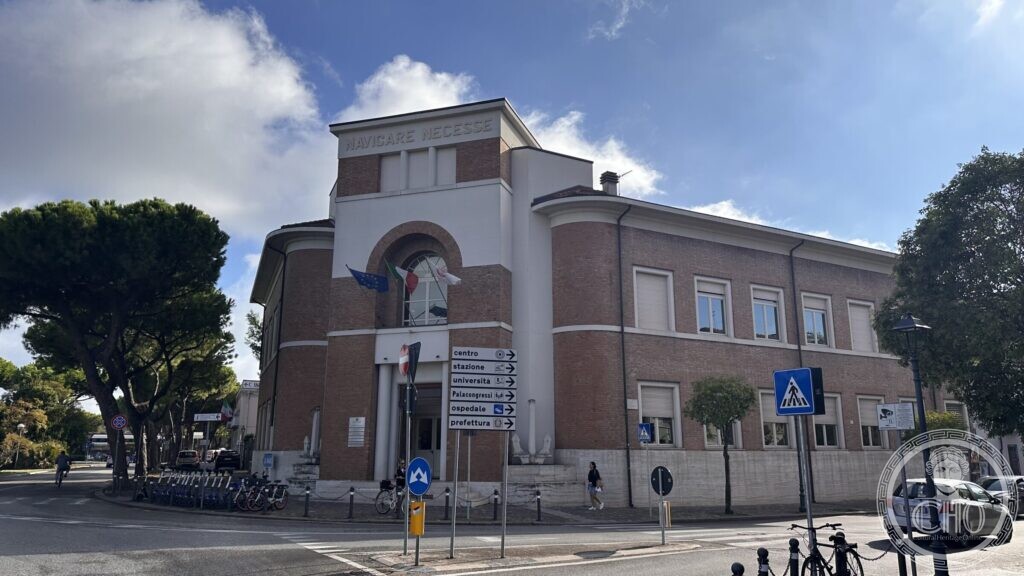
Two words cut across the top of a brick corner in San Giuliano are all that is left in public of a school that taught Rimini’s men to go to sea for 140 years.
At a glance
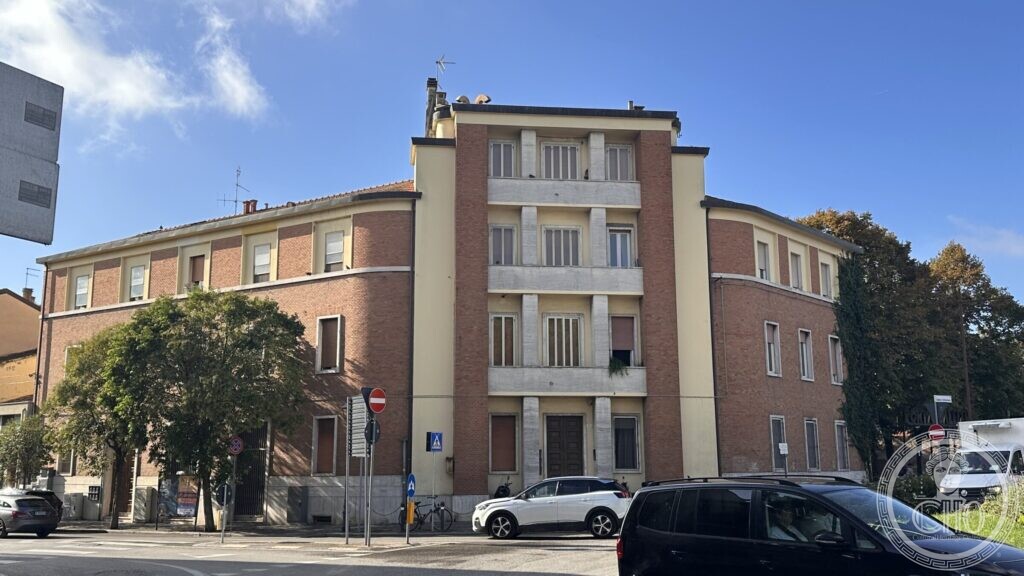
At the seaward end of via dei Mille, where San Giuliano meets the road to the port, stands a brick and render building of the late 1930s with a squared corner tower. Across the top of the tower, in raised Roman capitals, are the words NAVICARE NECESSE. This was the last home of Rimini’s maritime school: built for the Ente Nazionale per l’Educazione Marinara and occupied in 1938, it gathered under one roof a line of teaching that began under the Papal government in 1827. The school closed in the 1960s; the building went on to hold primary classes, then the junior forms of the classical lyceum, and then the university.
Key facts
- Built for: ENEM, the Ente Nazionale per l’Educazione Marinara; occupied in 1938
- Known as: the Scuole Marittime
- Where: the corner of via dei Mille and via Savonarola, San Giuliano, Rimini
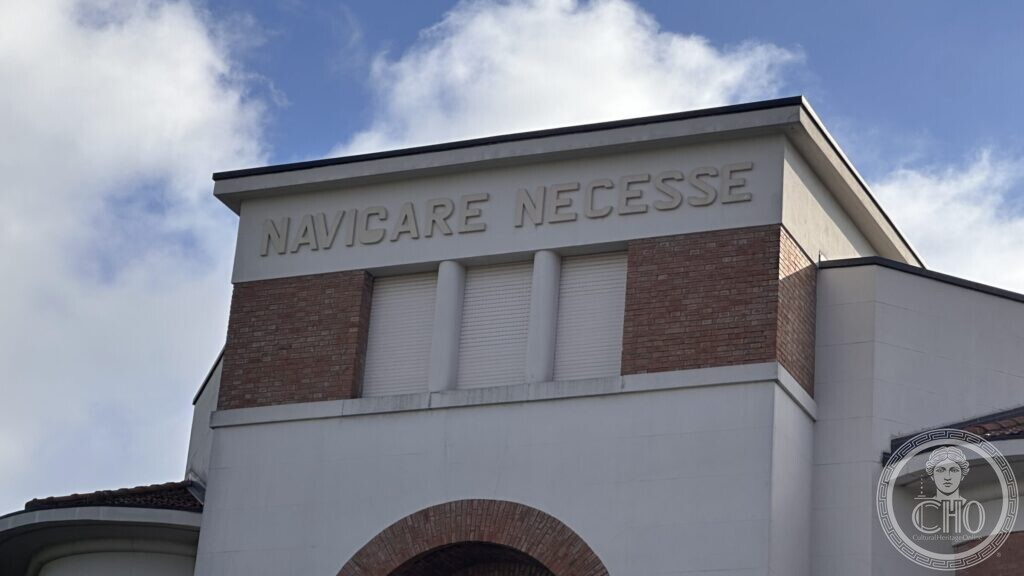
- Motto on the building: NAVICARE NECESSE, carved in raised capitals across the tower
- The line of schools before it: Scuola Nautica (1827), Scuola Nautica Comunale, Istituto Nautico, Istituto Nautico «G.B. Ramusio», Scuola Popolare Marittima, ENEM
- Courses here: coastal skippers and second-class marine engine men (three years each), and after the war shipboard radio-telegraphists (two years)
- Closed: in the 1960s, for lack of pupils
- Coordinates: 44.064950, 12.567880 — Google Maps
History
Rimini taught navigation long before it taught tourism. The first nautical school opened in 1827 at the expense of the Papal government, with a single master and two sections: masters of long coastal trade, and shipbuilders. In March 1860, days before the plebiscite on joining the Kingdom of Italy, the governor of Emilia Carlo Luigi Farini came to Rimini and promised to do something for the school if the vote went his way. It did; in 1861 a second master was appointed and a royal decree put the school on a level with those of the Kingdom’s principal ports. The measure of what that meant then: the port of Ravenna was administratively dependent on Rimini’s, and not the other way round. In 1866 another royal decree, cutting the number of nautical schools in Italy to a handful, closed it.
Teaching went on in other forms and under other names — the municipal nautical school, the Istituto Nautico, later named for the geographer Giovanni Battista Ramusio, then the popular maritime school — and it went on in borrowed rooms. The old seat in via Castelfidardo was shelled in the First World War and never reopened. By the late 1920s classes were being held in parish lodgings, in the offices of the municipal welfare board, in rooms behind the little fountain in the Contrada Piccola, a quarter that no longer exists because the bombing took it.
In 1938 all of it came together in a purpose-built house: the new seat of ENEM, the national body for maritime education, at the corner of via dei Mille and via Savonarola, known to the city as the Scuole Marittime. At last there was a proper vocational school, entered with an elementary-school certificate. Two courses opened first, for paroni marittimi — coastal skippers — and for second-class marine engine men, three years each; after the war a two-year course for shipboard radio-telegraphists was added. The subjects were naval construction, maritime law, engines, ship’s gear and seamanship, and one classroom was fitted out as a workshop with lathes. ENEM could issue a licence, but a licence only became a working ticket by examination: skippers and engine men sat theirs at the Capitaneria down the road, while the radio operators had to travel to Rome, to the Ministry of Posts and Telecommunications.
The Second World War bombing damaged the school badly, and while the building was repaired the classes moved to the Ferrari schools. Its directors from 1918 to the end were Dr Nascioli and then Commander Lorenzo Piccinini, a merchant-navy officer invalided out with wounds, who was not from Rimini and who pushed hard to get the school back on its feet. Around 1960 enrolments fell year after year until the ministry closed it for good.
The building did not go empty. It became a detached seat of the Decio Raggi elementary schools, whose catchment in this quarter had swollen; then of the Liceo Classico Giulio Cesare, for the junior forms; and then it passed into the university’s estate, which is what it still serves. The Italian and European flags fly over the door.
What you see
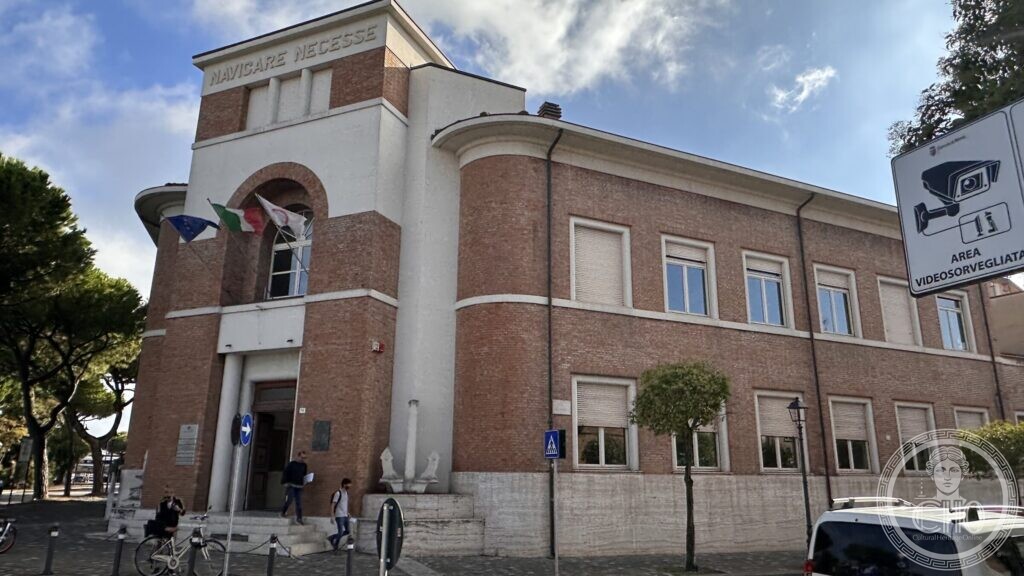
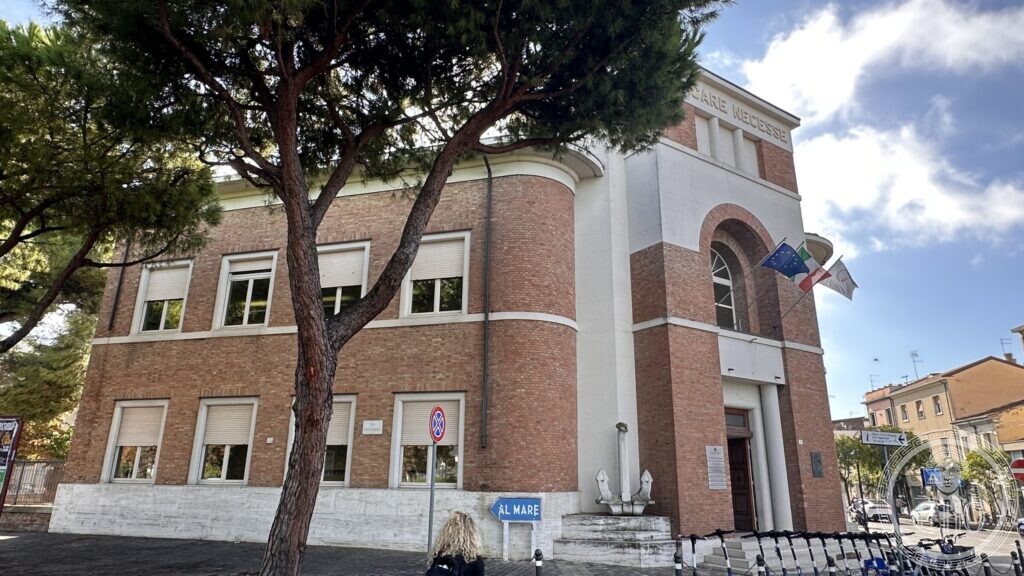
Two storeys of exposed brick over a plinth of pale render, with plain rendered bands framing the windows: the sober, unshowy manner of Italian public building in the late 1930s, with none of the marble rhetoric of the period’s bigger commissions. The corner is turned as a rounded drum, and where the two wings meet a squared tower rises one storey higher, with a tall round-headed arch over the entrance and, above it, the raised letters.
They read NAVICARE NECESSE — carved with a C, the archaic spelling, rather than the navigare of the familiar phrase. It is the line Plutarch gives to Pompey, ordering his frightened crews to sail in a storm: sailing is necessary, living is not. Over a school of skippers and engine men it is less a flourish than a job description.
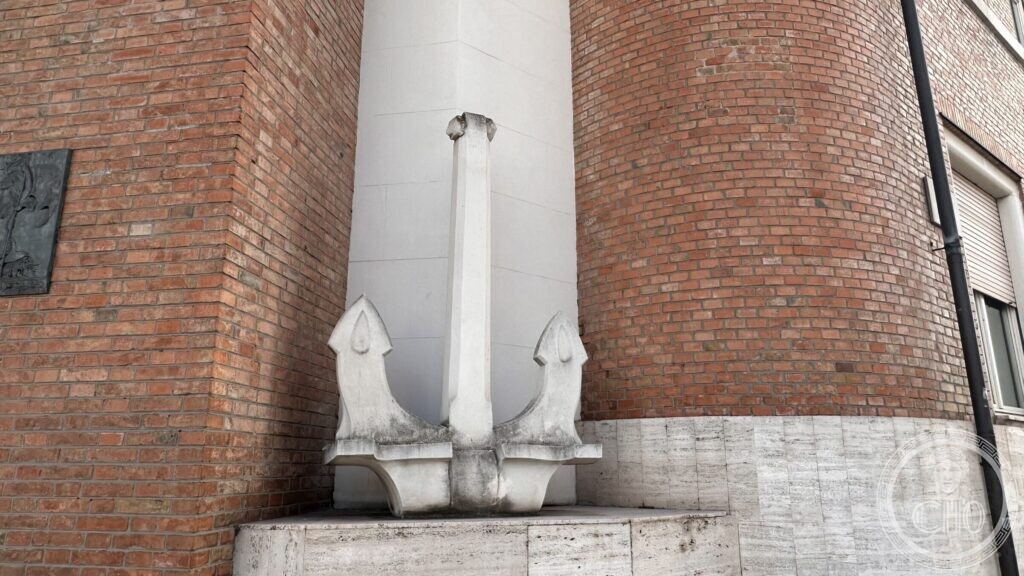
At the foot of the rounded corner, on a low travertine plinth, stands a stone anchor, upright and stylised, its flukes turned up like leaves. A bronze relief is set into the brick beside it. Together with the motto they are the whole of the building’s decoration.
The building today

Practical information
- The building is in institutional use and is not open to visitors; the motto, the anchor and the fronts are all read from the public pavement.
- It stands on a busy junction. The best view of the tower is from the pines on the seaward side, across the road.
- We have not been able to establish who designed the building, nor to identify the two blocks of the same years a short way along via dei Mille that appear in the last photograph. If you know, or hold documents about the Scuole Marittime, please write to us.
Getting there
San Giuliano is the quarter across the Marecchia from the historic centre, ten minutes on foot from the Ponte di Tiberio and about fifteen from Rimini station. Buses along via dei Mille run between the centre and the port.
Nearby
- The Ponte di Tiberio and the Borgo San Giuliano, five minutes away
- The port canal of Rimini and the Capitaneria di Porto, where the school’s pupils sat their examinations
- Piazza Cavour and the Teatro Amintore Galli, across the bridge
Sources
- Associazione Rimini Sparita, La Scuola Nautica di Rimini — a local history association’s account of the school from 1827 to its closure, including the identification of this building as its last seat, consulted 12 September 2026. It is a local-history source, not an institutional one, and the dates for the building itself rest on it alone.
- The inscription, the anchor and the fronts, read and photographed on site, 11 September 2026. Note that the building is cut NAVICARE, while the Rimini Sparita caption transcribes the motto as «Navigare Necesse».
- Location and street confirmed by the GPS in the photographs and by OpenStreetMap.
Find it on the map
See this place and what’s around it →Record researched and written by Luigi De Marchi for Cultural Heritage Online, 2026.
📷 Become a Cultural Heritage Online photographer
Share your photos of places: they stay published under your name as the author. The more they're seen, the more you get noticed — and soon a contest will reward the most appreciated photos.
Log in or sign up free to add a photoIs this page about you?
This page is read by travellers and heritage enthusiasts who find it on Google. Tell us how you are connected to this place and we will take it from there.