
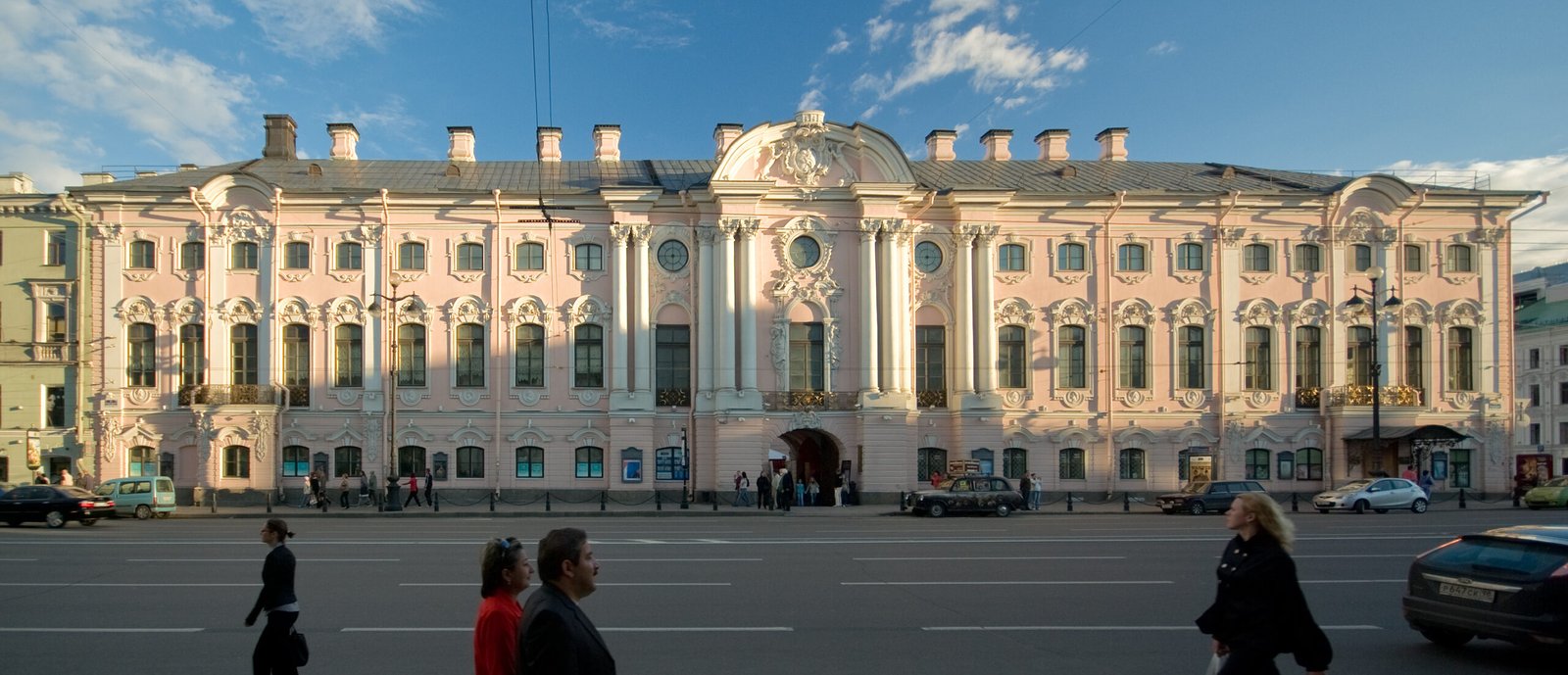
A pink Baroque townhouse where Nevsky Prospect meets the Moika, built by Bartolomeo Rastrelli for the wealthiest family in imperial Russia.
At a glance
The Stroganov Palace occupies the corner where Nevsky Prospect crosses the Moika River. Francesco Bartolomeo Rastrelli designed it for Baron Sergei Grigoriyevich Stroganov, with construction dated to 1753–1754. It stands among the few Baroque buildings on the avenue to retain something close to its original appearance. Today it operates as a branch of the Russian Museum.
History
Earlier houses occupied the site before Rastrelli’s palace. A modest one-storey building went up in the 1720s. Mikhail Zemtsov replaced it with a two-storey house in the 1740s. Then, in 1752, Sergei Stroganov commissioned Rastrelli, already busy extending the Catherine Palace. As kin of the Empress by marriage, the Stroganovs were not a family the architect could refuse. Around 1800, Andrei Voronikhin reworked the interiors in Neoclassical taste. Rumor held that Voronikhin, son of a Stroganov serf, was in fact Alexander Stroganov’s own child. Ownership passed through an entail established by Pavel Stroganov after his only son died at Craonne. Carlo Rossi decorated an apartment for Aglaida Pavlovna Stroganov in 1820; almost none of it survives. The last count sold his rights to the entail in 1919, two years after the Revolution ended Stroganov ownership outright. Soviet authorities opened a nobility-lifestyle museum here, then closed it in 1929 and dispersed treasures to the Hermitage. A botanical institute, then the Ministry of Shipbuilding, occupied the building for decades. The Russian Museum took charge in 1988, and restoration has continued since 1991.
What you see
The main façade fronts Nevsky Prospect directly. Rastrelli declined the French cour d’honneur he had used at the Vorontsov Palace nearby. Instead, ornament thickens toward the center, a technique he favored for concentrating visual force on one point. An entrance arch, held up by paired Corinthian columns, carries a pediment bearing the Stroganov coat of arms. Below the windows, carved male profiles appear along the facade. Some say the face is Baron Stroganov himself. Others insist Rastrelli left his own likeness as a quiet signature. Restorers have returned the walls to the pale pink Rastrelli intended, replacing the dark green applied by the mid-20th century.
Cultural significance
Few Baroque façades on Nevsky Prospect survive unaltered; this one does. It documents the tastes of the Stroganovs, among the richest and best-connected families in Russia, across two centuries of design change from Rastrelli’s Baroque to Voronikhin’s Neoclassicism. Its later fate as museum, botanical office, and ministry building mirrors the wider institutional churn of Soviet Leningrad. The palace’s supposed architectural counterpart, the Beloselsky-Belozersky Palace, was later built at the opposite end of Nevsky Prospect, extending its visual dialogue down the avenue.
Key facts
- Architect: Francesco Bartolomeo Rastrelli, with later interior work by Andrei Voronikhin and Carlo Rossi
- Built: 1753–1754
- Style: Russian Baroque
- Location: Junction of Nevsky Prospect and the Moika River, St. Petersburg
- Current use: Branch of the State Russian Museum
- Heritage status: Listed heritage site
Practical information & getting there
The palace sits at one of the busiest intersections on Nevsky Prospect, easily reached on foot from the city center. As a Russian Museum branch, it hosts rotating exhibitions rather than a fixed permanent display. Check the museum’s site before visiting, since hours and exhibits change. The exterior alone rewards a stop, especially the carved entrance arch facing the avenue.
Sources & resources
Find it on the map
See this place and what’s around it →📷 Become a Cultural Heritage Online photographer
Share your photos of places: they stay published under your name as the author. The more they're seen, the more you get noticed — and soon a contest will reward the most appreciated photos.
Log in or sign up free to add a photoIs this page about you?
This page is read by travellers and heritage enthusiasts who find it on Google. Tell us how you are connected to this place and we will take it from there.