
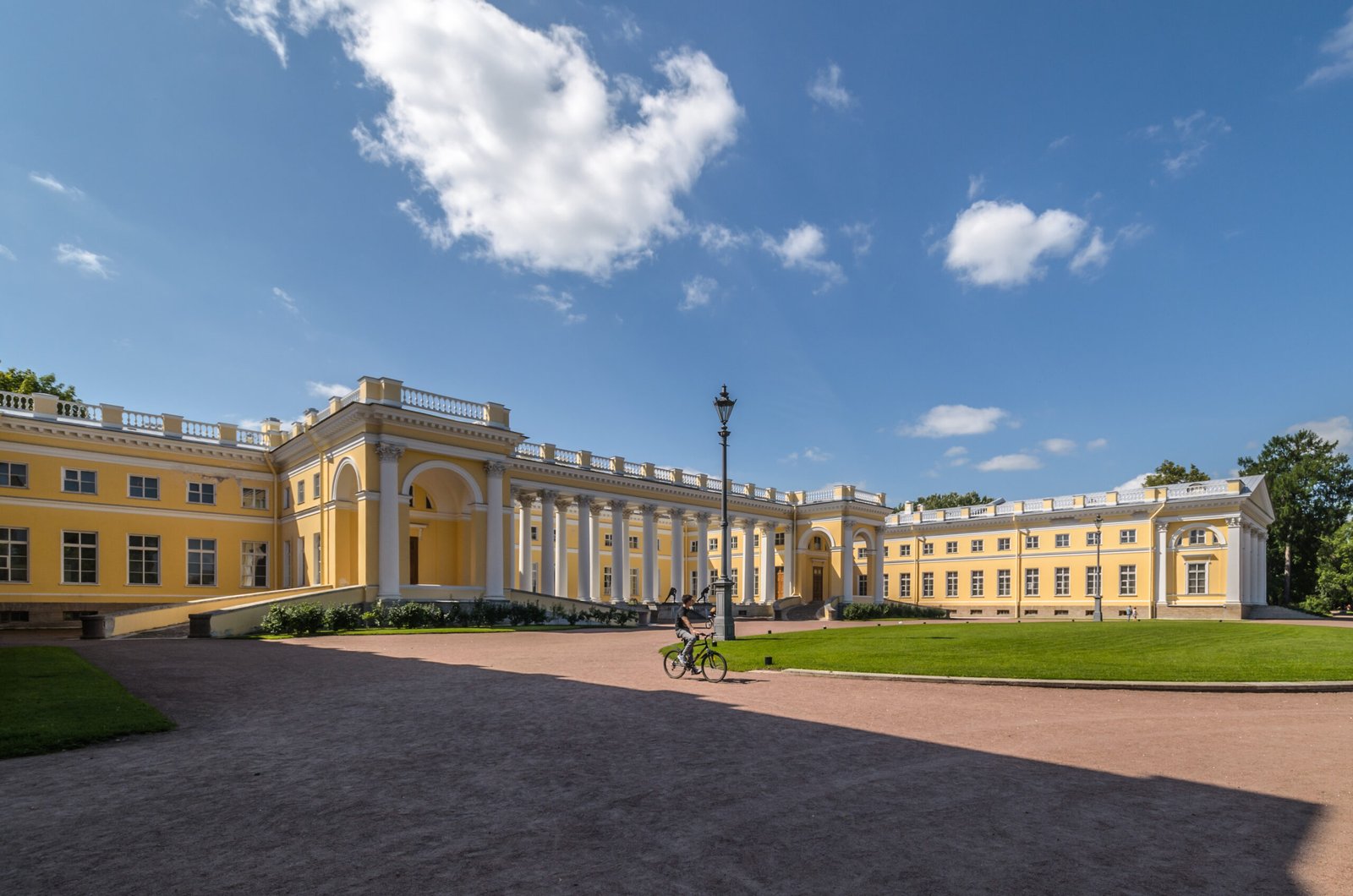
Commissioned by Catherine the Great as a wedding gift, the Alexander Palace became the last home of imperial Russia before it turned into a prison for the family that once favored it.
At a glance
Built between 1792 and 1796 to designs by Giacomo Quarenghi, the palace stands in Alexander Park near Tsarskoye Selo, about 30 miles south of Saint Petersburg. Its restrained Neoclassical facade masks a history far stormier than its symmetry suggests. Today it operates as a state museum, reopened to visitors in 2021 after extensive restoration.
History
Catherine II ordered the palace for her grandson Grand Duke Alexander Pavlovich, the future Alexander I, to mark his 1793 marriage. Quarenghi delivered a design praised even by his own son as a model of simplicity married to elegance. Alexander used it only as a summer retreat, preferring the grander Catherine Palace once he became tsar. His brother Nicholas I inherited it instead, and from 1830 to 1850 a team of architects reworked its interiors, adding the Mountain Hall with its slide for imperial children. Deaths and births marked the rooms too: Grand Duchess Alexandra died there in 1844, Empress Alexandra Feodorovna in 1860. Alexander III’s son, the future Nicholas II, was born within its walls. It was Nicholas II, though, who made the palace truly his own, retreating there permanently after the violence of Bloody Sunday made the Winter Palace feel unsafe.
What you see
Quarenghi’s Classicism favors proportion over spectacle. The main facade is long, calm, and columned, its dignity intentional. Inside, that restraint gives way to contradiction. Empress Alexandra Feodorovna and her architect Meltzer introduced Jugendstil, or Art Nouveau, interiors that scandalized a court expecting imperial grandeur. The Mauve Room remains the most cited example of this shift. Elsewhere, technology intruded quietly on tradition: electric wiring, a telephone system, a hydraulic lift installed in 1899, even a cinema screening booth built into the Semicircular Hall.
Cultural significance
Few buildings compress Russian imperial history so tightly into one address. The palace witnessed births, deaths, celebrations, and finally captivity. After Nicholas II abdicated in March 1917, he returned here not as emperor but, in his own words, as “Colonel Romanov.” Guards with fixed bayonets replaced court ceremony. Tutor Pierre Gilliard’s memoirs describe a family clearing snow and chopping firewood in the park where they once walked freely, a domestic detail that still unsettles historians.
Key facts
- Architect: Giacomo Quarenghi
- Style: Classicism
- Constructed: 1792–1796; commissioned 1793
- Location: Alexander Park, Tsarskoye Selo, near Saint Petersburg
- Heritage status: Listed
- Current use: State museum, reopened 2021
Practical information & getting there
The palace sits within Alexander Park, a short distance from the larger Catherine Palace and Catherine Park, making both easily combined in a single day. Tsarskoye Selo is reachable from Saint Petersburg by suburban train or organized tour. Check the official museum site before visiting, since restoration work and seasonal hours can affect access to specific rooms.
Sources & resources
Find it on the map
See this place and what’s around it →📷 Become a Cultural Heritage Online photographer
Share your photos of places: they stay published under your name as the author. The more they're seen, the more you get noticed — and soon a contest will reward the most appreciated photos.
Log in or sign up free to add a photoIs this page about you?
This page is read by travellers and heritage enthusiasts who find it on Google. Tell us how you are connected to this place and we will take it from there.