
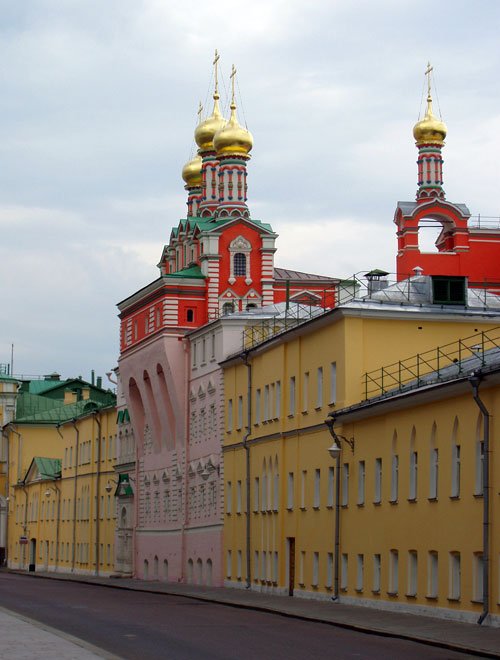
Tucked against the Kremlin’s western wall, this seventeenth-century mansion has been a nobleman’s residence, a royal theatre, a police headquarters and, briefly, Stalin’s home.
At a glance
The Amusement Palace stands between the Trinity and Commandant Towers, inside the Kremlin’s fortified perimeter. It was built around 1651–1652 for Ilya Miloslavsky, father-in-law of Tsar Alexei Mikhailovich. The building later passed to the state and took on a string of different functions, from court theatre to government office to private residence. Today it is a protected heritage site, restored in the early 2000s.
History
Miloslavsky commissioned the palace as a private house within the Kremlin walls, a mark of his standing at court. After his death it reverted to state ownership. Its most memorable role came next: as a theatre where performances entertained the tsar’s family and courtiers. That amusement gave the building its name. Under Peter the Great, the palace changed character again, housing the Police Department. By the 19th century it served as the official residence of the Commandant of Moscow. In the Soviet era it briefly became Joseph Stalin’s home. There, in 1932, his wife Nadezhda Alliluyeva died by suicide, a tragedy that still shadows the building’s history.
What you see
The palace’s façade retains décor recovered during restoration between 2002 and 2004. Among the recovered features is the Church of Our Lady’s Glorification, part of the original ensemble. The building’s position, wedged tightly between two Kremlin towers, gives it a compact, almost domestic scale rare inside the fortress. Little of the interior is publicly documented. What survives above ground speaks to layers of use rather than a single unified design.
Cultural significance
Few Kremlin buildings carry such a mixed civic biography. The Amusement Palace moved from private luxury to court entertainment, then to policing, then to political tragedy. Each phase left its mark on how the building is remembered. Its survival, and its careful restoration, makes it a rare physical link to Moscow’s pre-Petrine noble households still standing within the Kremlin walls.
Key facts
- Location: Kremlin’s western wall, between the Trinity and Commandant Towers, Moscow, Russia
- Built: circa 1651–1652, for Ilya Miloslavsky
- Later uses: theatre, Police Department, residence of the Commandant of Moscow, Stalin’s residence
- Restoration: 2002–2004, including façade décor and the Church of Our Lady’s Glorification
- Heritage status: listed heritage site
Practical information & getting there
The Amusement Palace sits inside the working Kremlin complex, near Trinity Tower, one of the main visitor entrances. Access to the building’s interior is not part of standard Kremlin museum routes, so you should check current Kremlin visiting arrangements before planning a trip. The surrounding Kremlin grounds are reached via central Moscow metro stations serving Alexander Garden and Red Square.
Sources & resources
Find it on the map
See this place and what’s around it →📷 Become a Cultural Heritage Online photographer
Share your photos of places: they stay published under your name as the author. The more they're seen, the more you get noticed — and soon a contest will reward the most appreciated photos.
Log in or sign up free to add a photoIs this page about you?
This page is read by travellers and heritage enthusiasts who find it on Google. Tell us how you are connected to this place and we will take it from there.