
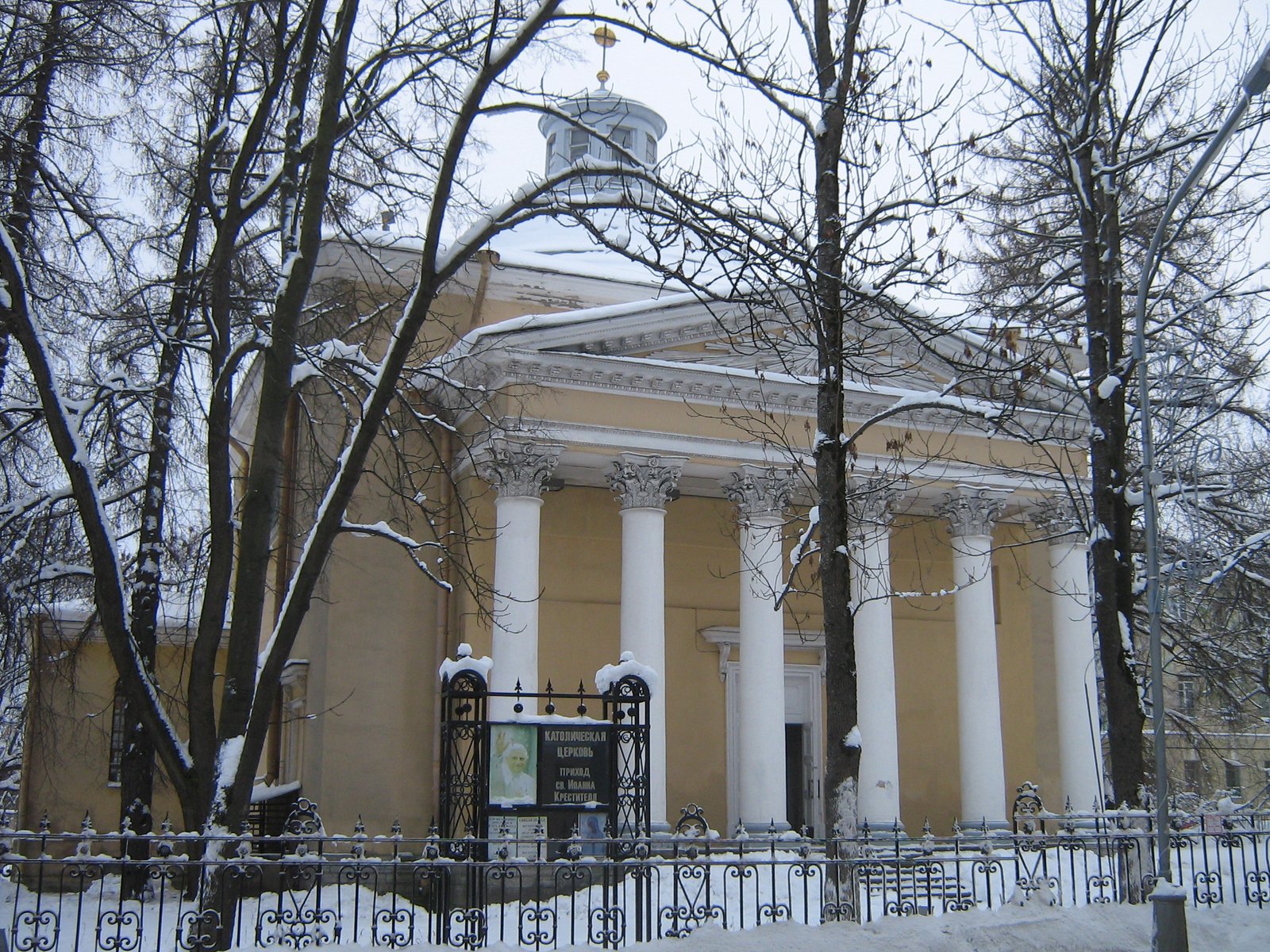
A neoclassical Catholic church raised on imperial land at Tsarskoye Selo, its history bound to court favor, Soviet closure, and wartime damage before a fragile return to worship.
At a glance
St. John the Baptist Church stands in Pushkin, the former Tsarskoye Selo, now administratively part of Saint Petersburg. It belongs to the Roman Catholic Archdiocese of Moscow, within its northwestern deanery. Built between 1823 and 1825, the church replaced an earlier, inadequate chapel and today shares its building with a state museum.
History
Catholics at Tsarskoye Selo first worshipped in a church built in 1811 on the property of court ceremoniemeister Commander Mezonyaev. It soon proved too small. Emperor Alexander I intervened, donating land for a larger church. Construction ran from 1823 to 1825, and the foundation stone was blessed on 6 July 1825, the feast of the Nativity of Saint John the Baptist, with the Minister of Education present. Bishop Matvey Lipsky of Minsk consecrated the finished building on 4 December 1826. The church functioned for over a century until Soviet authorities closed it in April 1938, converting it into a gymnasium. Bodies interred in its crypt were moved to the Our Lady of Kazan cemetery in Pushkin. War brought further harm: German occupation during the siege of Leningrad damaged the structure. Decades passed before Catholic life returned. The first Mass in the restored building took place on 17 March 1991, attended by just seven parishioners. Full restitution to the parish came on 1 October 1997, under an agreement allowing joint use with the Tsarskoye Selo State Museum of Fine Arts.
What you see
The church was designed in the neoclassical style by Leone and Domenico Adamini, with assistance from Vasily Stasov, a leading architect of imperial Saint Petersburg. Its proportions and restraint reflect the era’s taste for classical order over ornament. The building’s later conversion to a gym and its wartime damage left visible marks on the fabric, some addressed during restoration, others still part of its layered surface. Visitors today encounter a space shared with museum functions, a rare arrangement that shapes how the interior is used and experienced.
Cultural significance
The church embodies the presence of a small Catholic minority within the heart of Russian imperial ceremony. Its founding by direct grant from Alexander I ties it to the wider history of Tsarskoye Selo as a residence of state. Its closure, reuse, and damage mirror the broader fate of religious buildings under Soviet rule and wartime occupation. The 1991 Mass, held before a handful of worshippers, marks a quiet but significant moment of religious continuity. Today the parish is served by two Spanish priests, a detail that speaks to the international character of Catholic ministry in post-Soviet Russia.
Key facts
- Location: Pushkin (Tsarskoye Selo), Saint Petersburg, Russia
- Built: 1823–1825; consecrated 4 December 1826
- Architects: Leone and Domenico Adamini, with Vasily Stasov
- Style: Neoclassical
- Closed as a church: 1938–1991
- Returned to the parish: 1 October 1997
- Heritage-listed status: yes
- Affiliation: Roman Catholic Archdiocese of Moscow, northwestern deanery
Practical information & getting there
The church sits in Pushkin, easily reached from central Saint Petersburg by suburban train or bus toward Tsarskoye Selo. You should expect the building to share space with museum operations, so visiting hours may follow both parish and museum schedules. Checking current Mass times locally is advisable before planning a visit.
Sources & resources
Find it on the map
See this place and what’s around it →📷 Become a Cultural Heritage Online photographer
Share your photos of places: they stay published under your name as the author. The more they're seen, the more you get noticed — and soon a contest will reward the most appreciated photos.
Log in or sign up free to add a photoIs this page about you?
This page is read by travellers and heritage enthusiasts who find it on Google. Tell us how you are connected to this place and we will take it from there.