

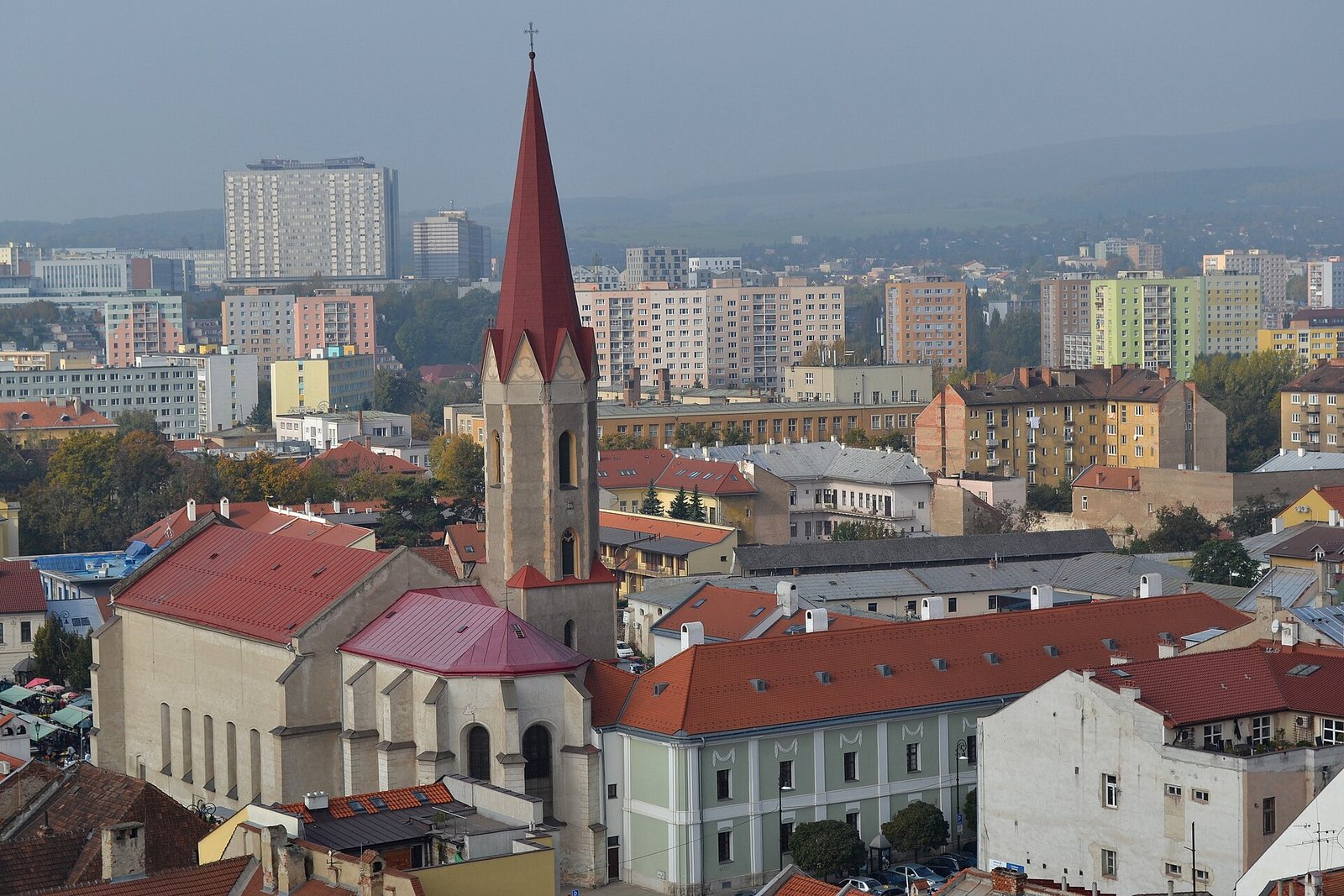
The oldest building still standing in Košice was raised by friars who, by the rule of their order, had to build against the walls rather than on the square — and who later put their tower nine metres higher than the cathedral’s.
At a glance
The Church of the Assumption of the Virgin Mary, known to everyone in Košice as the Dominican church, went up around 1290 and appears in writing by 1303. It is the oldest preserved building in the city and its oldest church. Where other orders withdrew to the countryside, the Dominicans were preachers and settled in towns — but as a mendicant order they built at the edge, near the walls, not on the central square. Fire, confiscation and four centuries of rebuilding have left a Romanesque nave inside a Baroque shell, under a tower that in 1903 was deliberately raised above the skyline of St Elizabeth’s.
Key facts
- Founded: c. 1290 by the Dominican order
- First written mention: 1303
- Dedication: the Assumption of the Virgin Mary
- Status: oldest preserved building and oldest church in Košice
- Oldest fabric: the Romanesque nave; capitals of the buttresses that carried the medieval vault
- Tower: raised to 68 m in 1903 — nine metres above the north tower of the Cathedral of St Elizabeth
- Reconsecrated: 4 August 1741, after the Baroque rebuilding
- Location: Dominikánske námestie, Staré Mesto, Košice
History
The Dominicans came to Košice as an urban order. Their houses went up inside towns because their work was preaching, and they lived on alms — but they were not entitled to the best ground, so the convent took a plot at the edge, close to the walls. The church that stands there was begun around 1290 and is first named in a document of 1303. Beside it came a monastery, and in the fourteenth century a school and an illuminators’ workshop whose work travelled well beyond Hungary.
The friars once owned much of what is now Dominikánske námestie. In 1336 they signed an agreement with the town: they gave up three paces along the eastern side of the square and received in exchange six hundred cartloads of stone and a hundred of sand. Part of that material, historians think, went into the church’s tower.
On 13 April 1556 fire destroyed three-quarters of Košice. The townspeople who normally supported the friars had lost everything, the order’s own funds were not enough, and the Dominicans withdrew to Trnava, leaving their property to the town magistrate. The burnt-out convent filled with the city’s homeless; the roof was patched and the church turned into a municipal food store. A long dispute between the order and the town followed, settled unexpectedly by another fire in 1674.
On 16 December 1697 Emperor Leopold I ordered the Dominicans back to Košice — a reward for the part the order had played in the Counter-Reformation. The property was settled in 1699 and rebuilding began: the Gothic vault gave way to a Baroque one, the sacristy was connected to the convent, an oratory was added. Forty years of work ended with the reconsecration on 4 August 1741. A new monastery on Mäsiarska street was completed in 1767.
Trouble kept arriving. In 1846 a fire that began on the far side of the city sent burning shingles onto the roof in a gale, damaging the tower, three bells and a great many rare books. During the revolution of 1848–49 Russian troops seized the church and used it, once again, as a food store. In 1903 the tower was raised to sixty-eight metres, and in 1929 the Trinity column was moved here from the Pest road.
What you see
From the square the church reads as Baroque, and the eighteenth-century rebuilding is genuine enough. But the oldest part of the building is the Romanesque nave beneath it. Its windows were once narrow slits; the Baroque work widened them to the shape they have now. Look at the capitals of the buttresses and you are looking at the supports of the medieval vault that the Baroque one replaced.
The tower stands where mendicant rule required it — at the northern junction of nave and sanctuary, not over a west front. Its present height is a nineteenth-century statement: at sixty-eight metres it clears the north tower of the Cathedral of St Elizabeth by nine.
Inside, the main altar is dedicated to the Virgin, with four side altars around it; most of the furnishing dates from the nineteenth century. There is one detail conservators enjoy telling visitors. Cracks were noticed in the ceiling in the 1970s, and scaffolding went up in 1982 — at which point some of the cracks turned out to be painted on, put there to make the church look older than it was. It is the oldest sacred building in Košice already.
Practical information
- Where: Dominikánske námestie, Košice Old Town, a few minutes’ walk from Hlavná
- Exterior: free to see at any time
- Interior and underground: the crypt levels are not normally open; they are shown on guided walks
- Guided visits: MiC Košice — Potulky mestom runs a themed walk of the church, the convent and its underground spaces, including the sacristy, which is otherwise closed to the public
- Time needed: 15 minutes for the exterior; about an hour with a guided visit
Getting there
Dominikánske námestie lies just west of Hlavná, the long central street of Košice, and everything in the old town is within a few minutes on foot. Košice has an international airport with connections through Vienna, Prague and Warsaw, and direct trains link the city with Bratislava, Prague and Budapest. Trams and trolleybuses serve the centre; the old town itself is walked.
Nearby
- Cathedral of St Elizabeth (Dóm svätej Alžbety) — the largest church in Slovakia, five minutes away
- State Theatre Košice, on the main square
- Jakab’s Palace, at the southern edge of the old town
- The Seminary (Franciscan) Church of St Anthony of Padua, on Hlavná
Sources
- Dominikánsky kostol (Košice) — Slovak Wikipedia
- Wikidata Q3585911 (location, dedication)
- MiC Košice — Potulky mestom, programme notes for the Dominican church and monastery walk
- Hero image — Wikimedia Commons (Ľuboš Repta, CC BY-SA 4.0)
Find it on the map
See this place and what’s around it →Events here — now on & upcoming
- The Dominican Church, its Convent and its Underground29 Oct 2026 — 02 Nov 2026See the event →
📷 Become a Cultural Heritage Online photographer
Share your photos of places: they stay published under your name as the author. The more they're seen, the more you get noticed — and soon a contest will reward the most appreciated photos.
Log in or sign up free to add a photo