
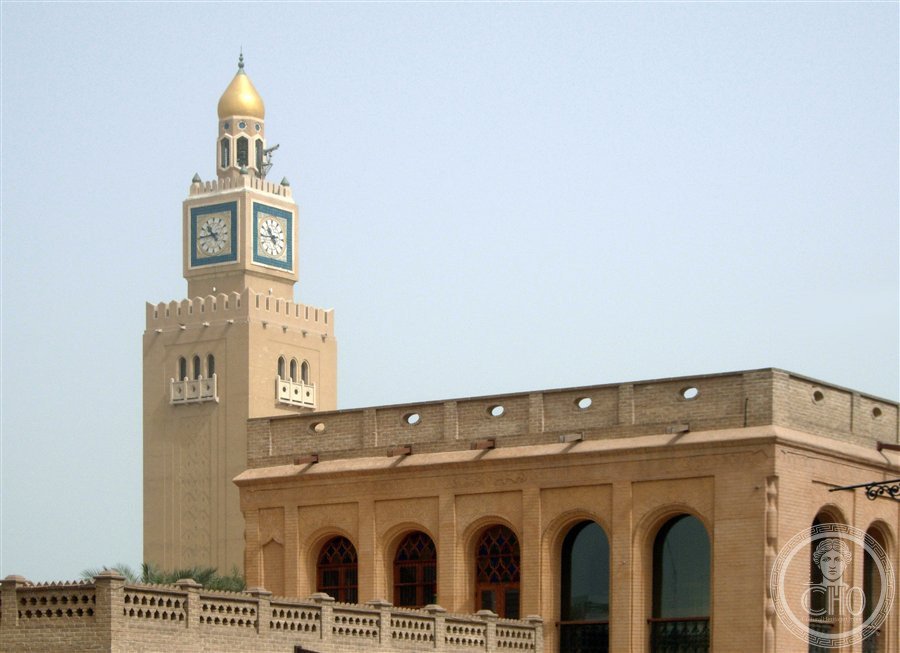
The watch-tower palace on the old harbour – seat of Kuwait’s rulers for a century, its blue-tiled clocktower the emblem of the emirate.
At a glance
- Type
- Seat of the Amiri Diwan
- Period
- 1917 (extended 1960s-2000s)
- Style
- Gulf Islamic
- Location
- Arabian Gulf Street, Kuwait City, Kuwait
- Coordinates
- 29.3863, 47.9665
- Patron
- Sheikh Jaber II Al-Sabah and successors
Overview
The Seif Palace – Qasr al-Seif, the Palace of the Shore – faces the old harbour where Kuwait’s dhow fleets once anchored, its 1917 core the oldest substantial building in the city. The landmark clocktower, sheathed in blue faience and roofed in gold, presides over courtyards of Islamic arcades, carved teak doors from the dhow-building yards, and the offices of the Amiri Diwan, the ruler’s court.
History
Built under Sheikh Jaber II when Kuwait was a pearling and trading port under British protection, the palace witnessed the oil transformation, independence in 1961, and the Iraqi invasion of 1990, when it was looted and damaged in the fighting – the liberation of the Seif in February 1991 marked the war’s end in the capital. Restored and vastly extended, it remains the ceremonial seat of the Emir’s government.
Architecture and Design
The historic wing shows Gulf architecture at its most refined: coral-stone and gypsum walls, recessed pointed arches, wind-catcher remnants, and Indian teak joinery from the maritime trade. The post-1960s extensions repeat the language at palace scale along the corniche, with the original tower kept as the centrepiece.
Cultural significance
The Seif is Kuwait’s continuity in stone – the link between the dhow port and the petro-state, between the Al-Sabah compact of the 18th century and the constitutional emirate. The clocktower appears in the national iconography beside the Kuwait Towers down the shore.
Visiting today
As the working seat of the Diwan the palace is viewed from outside; the corniche walk passes the gates, the Grand Mosque opposite, and continues to the National Museum and the dhow harbour where heritage boats are moored.
Getting there
The palace stands on Arabian Gulf Street in the historic core; taxis reach it easily, and the souq Mubarakiya – the surviving old market – is a ten-minute walk inland.
Sources and resources
Find it on the map
See this place and what’s around it →📷 Become a Cultural Heritage Online photographer
Share your photos of places: they stay published under your name as the author. The more they're seen, the more you get noticed — and soon a contest will reward the most appreciated photos.
Log in or sign up free to add a photoIs this page about you?
This page is read by travellers and heritage enthusiasts who find it on Google. Tell us how you are connected to this place and we will take it from there.