
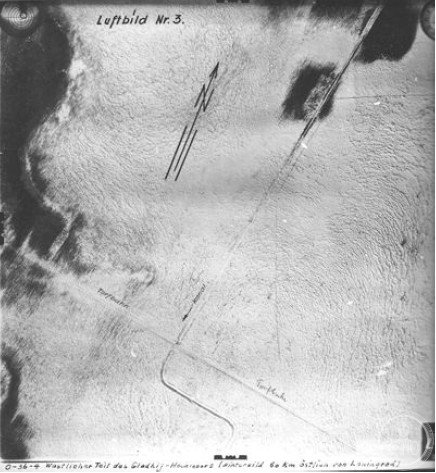
An ice road across Lake Ladoga that kept Leningrad alive during a brutal 900-day siege, evacuating over a million civilians and sustaining Soviet resistance against German encirclement.
At a glance
The Road of Life comprised winter transport routes across the frozen surface of Lake Ladoga, serving as Leningrad’s sole lifeline during the Second World War. Trucks, sleighs, and supply convoys moved constantly across the ice in punishing conditions, under relentless German bombardment. The routes operated during two critical winters before Soviet forces broke the encirclement in January 1943.
History
When German Army Group North under Feldmarschall Wilhelm Ritter von Leeb surrounded Leningrad, the city faced starvation. Land routes were cut off; the only escape lay across Lake Ladoga’s winter ice. The ice roads operated during the winters of 1941–1942 and 1942–1943, when the lake froze solid enough for vehicles to traverse.
Construction and operation proceeded under constant German artillery and aerial bombardment. In January 1943, the Soviet Operation Iskra broke the siege’s back. After that breakthrough, the ice roads continued in use alongside newly liberated land routes for the remainder of winter.
What you see
Nothing remains of the roads themselves—they were temporary ice routes that melted each spring. Today, the lake itself stands as memorial and marker, its surface once scarred by the tracks of thousands of vehicles and the footprints of evacuees.
Cultural significance
The Road of Life represents one of history’s most desperate supply operations and one of its most successful evacuation efforts. Over 1.3 million people—primarily women, children, and the elderly—were transported to safety across the ice. Wounded soldiers, industrial equipment, and cultural treasures also crossed the lake.
The routes became legendary in Soviet memory as a symbol of collective survival against overwhelming odds. The operation sustained not only human life but also Leningrad’s capacity to resist and eventually liberate itself.
Key facts
- Location: Lake Ladoga, Russia (coordinates: 59.93°N, 30.33°E)
- Years of operation: winters of 1941–1942 and 1942–1943
- Evacuees transported: over 1.3 million people
- UNESCO World Heritage Site status: yes
Practical information & getting there
The Road of Life exists as historical memory rather than a physical site. Visitors to Leningrad (St. Petersburg) can explore museums and monuments dedicated to the siege, including exhibits on the ice road supply operation. Lake Ladoga remains accessible for those wishing to stand where history’s desperate lifeline once lay frozen.
Sources & resources
Find it on the map
See this place and what’s around it →📷 Become a Cultural Heritage Online photographer
Share your photos of places: they stay published under your name as the author. The more they're seen, the more you get noticed — and soon a contest will reward the most appreciated photos.
Log in or sign up free to add a photoIs this page about you?
This page is read by travellers and heritage enthusiasts who find it on Google. Tell us how you are connected to this place and we will take it from there.