
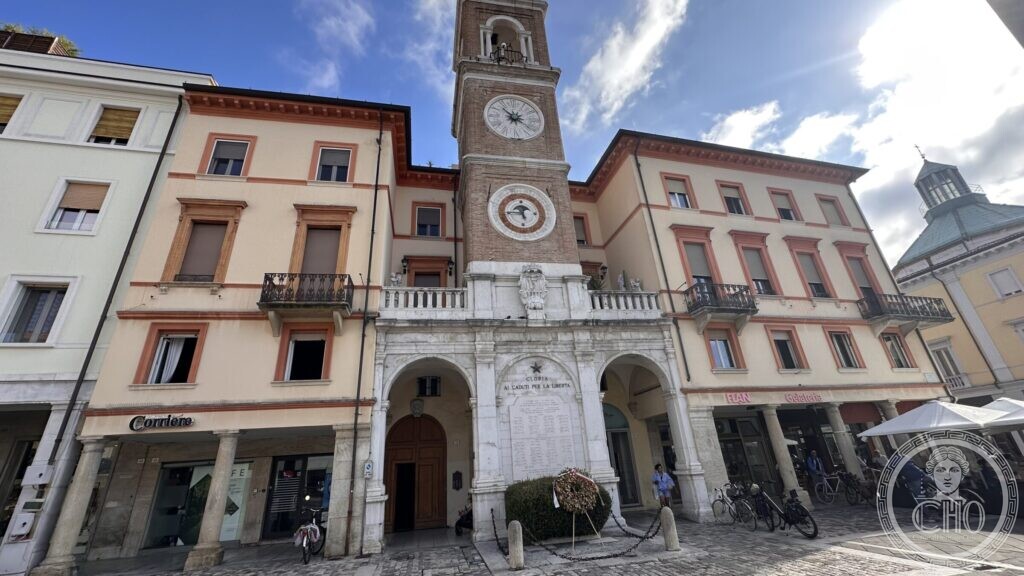
The forum of Ariminum, the square that bore Caesar’s name for centuries — and then took the names of three young men hanged here on 16 August 1944.
At a glance
This is the oldest public space in Rimini: the forum of the Roman colony of Ariminum, founded in 268 BC, at the crossing of the cardo and the decumanus. Its Roman paving is still there, visible through fenced openings in the modern surface. For centuries it was the market square and it carried Julius Caesar’s name, from the tradition that he addressed his legions here after crossing the Rubicon. On 16 August 1944 three young partisans were hanged in the middle of it, and the city renamed the square for them. Both names are on the street sign: Piazza Tre Martiri — già Giulio Cesare.
Key facts
- Origin: part of the forum of Ariminum, Roman colony founded 268 BC
- Former name: Piazza Giulio Cesare
- Renamed for: Mario Capelli, Luigi Nicolò and Adelio Pagliarani, hanged here on 16 August 1944
- Clock tower block: built 1547, giving the square its present shape; tower remade in 1759 to a design by Francesco Buonamici; upper part demolished after the earthquake of 1875
- The clock: carries a dial with calendar, zodiac and lunar phases since 1750
- Tempietto di Sant’Antonio: early sixteenth century, rebuilt in the seventeenth
- Present paving and lighting: the urban design carried out in 2000
- Coordinates: 44.059493, 12.568263 — Google Maps
History
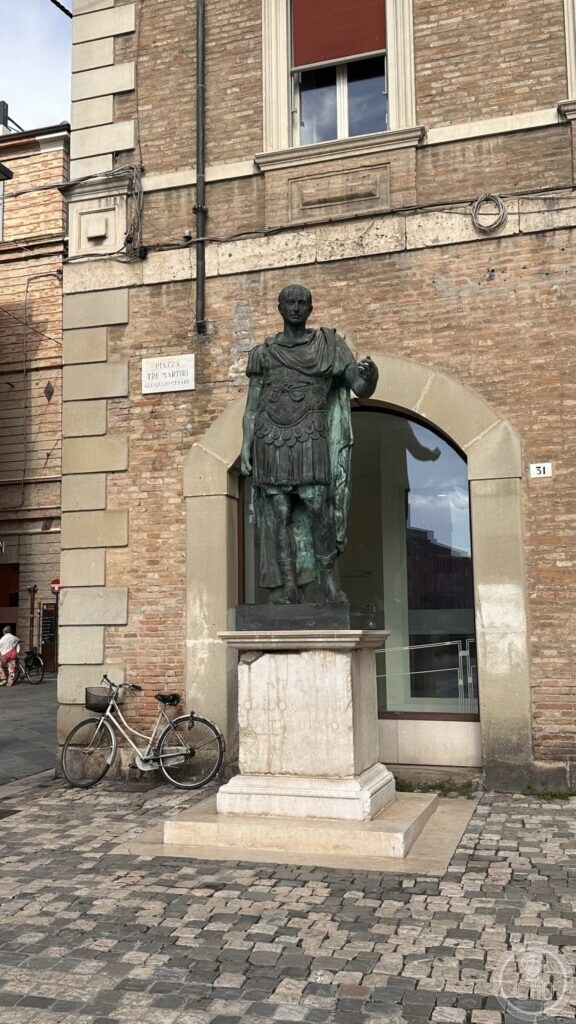
Ariminum was founded in 268 BC, and its forum stood where this square is now — larger than the square, running as far as today’s via San Michelino in Foro, and paved with big rectangular stones. Honorary statues and fine buildings framed it; a stone base at the eastern end probably carried an arch that marked the entrance to the forum and may have closed it to carts. A sixteenth-century cippus records the speech Caesar is said to have made to his legions here after crossing the Rubicon, and in his memory the square — which once bore his name — holds a bronze statue, a copy of a Roman original. On the seaward side, from late antiquity, stood the churches of San Michele, Sant’Innocenza and San Giorgio, all now gone.
In the Middle Ages, with civic government moved to Piazza Cavour, this became the market. Produce came in from the countryside through via dei Magnani — now via Garibaldi — under an arch cut through the line of houses. Under the porticoes were the beccherie, the butchers’ shops. The square also held jousts and tournaments, public ceremonies of the Malatesta, and the finish of the annual palio of San Giuliano.
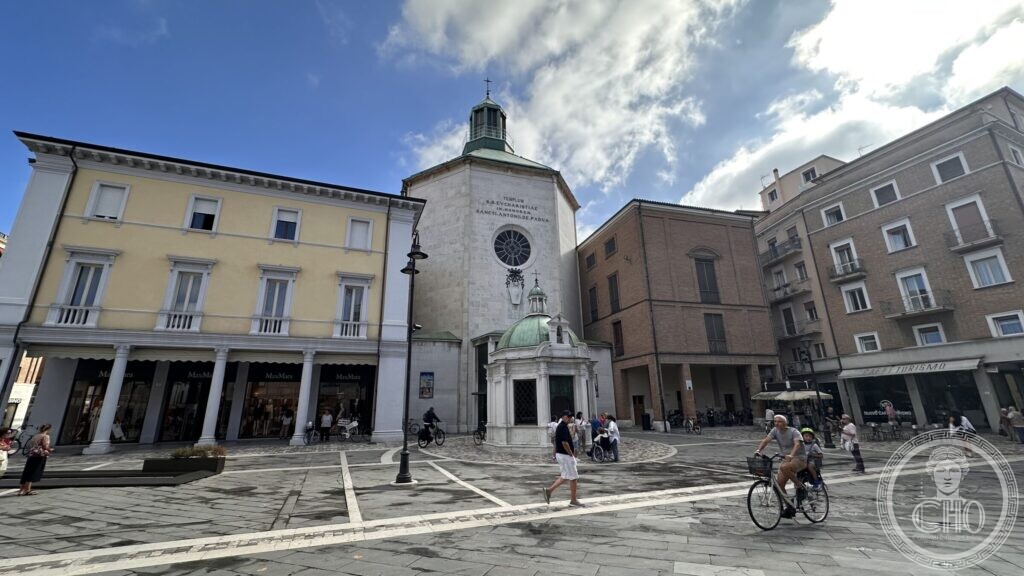
At the beginning of the sixteenth century the little temple of Sant’Antonio da Padova was built in memory of the thirteenth-century miracle in which a mule knelt to the consecrated host; it was rebuilt in the seventeenth century and altered again by later restorations. Behind it, in the early 1600s, the Minims of St Francis of Paola founded a church, rebuilt in 1729; since 1963 the church of the Paolotti has stood on the site. In 1547 the block containing the clock tower went up, replacing the butchers’ shops with porticoed buildings and giving the square the shape and size it still has. The tower was remade in 1759 to a design by Francesco Buonamici, and its upper part was taken down after the earthquake of 1875; Rimini Turismo records a further restoration in 1933. Since 1750 it has carried, below the clock, a dial with a calendar, the zodiac and the phases of the moon. The Magnani arch was demolished in 1921, breaking the line of buildings on the south side.
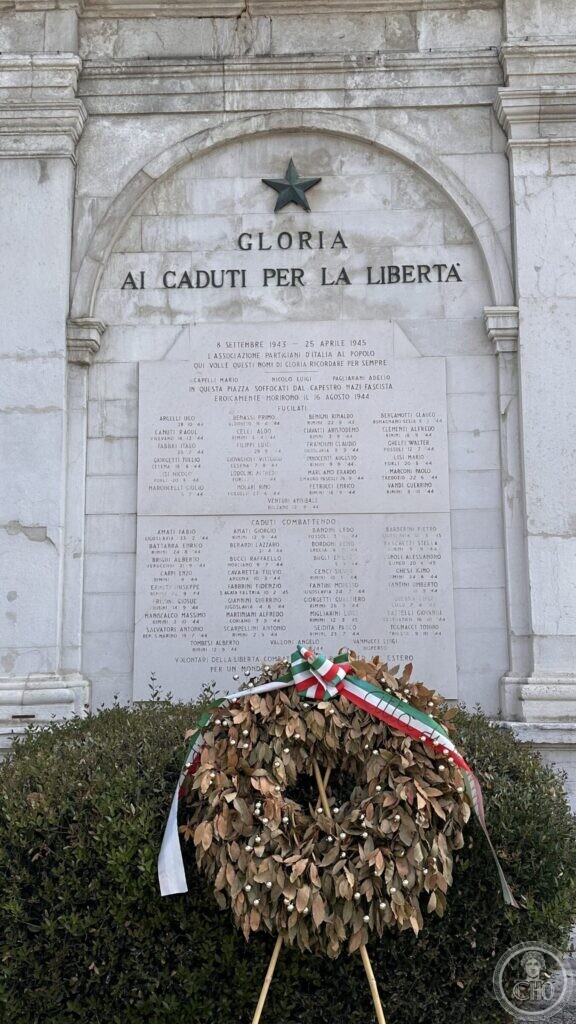
At dawn on 16 August 1944 three young partisans — Mario Capelli, Luigi Nicolò and Adelio Pagliarani — were hanged in this square, then still called Piazza Giulio Cesare. The plaque beneath the clock tower, set up by the partisans’ association, names them and says plainly what happened: in questa piazza soffocati dal capestro nazi-fascista eroicamente morirono il 16 agosto 1944. The square took their name. A marble insert marks the exact spot; the monument there dates from the early 1990s, two bands of travertine and stone blocks with three spotlights set where the gallows stood. For the eightieth anniversary in 2024 the municipality framed it so that vehicles and passers-by no longer cross it, and added a lectern explaining what it is.
What you see
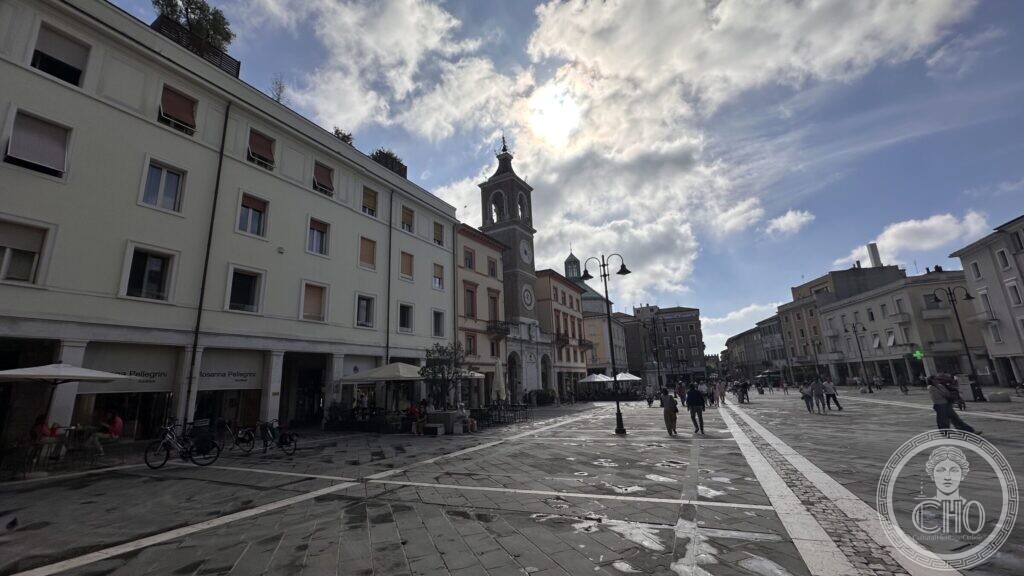
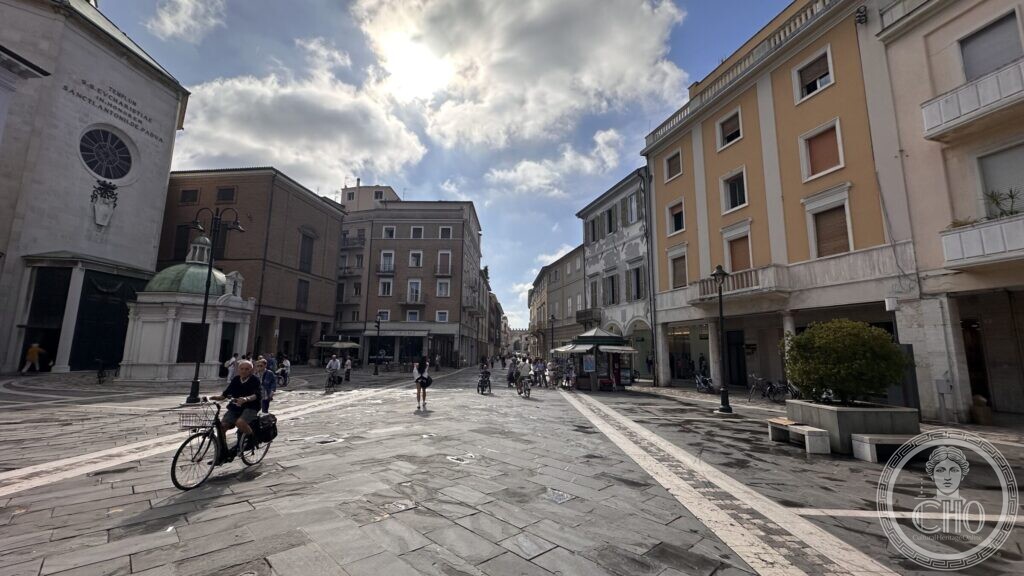
The square is a long open space, paved in stone in the scheme carried out in 2000, which was designed to bring out both the Roman plan and the marks of memory. Look down as you cross it: fenced openings let you see the big rectangular slabs of the Roman forum below the modern level.
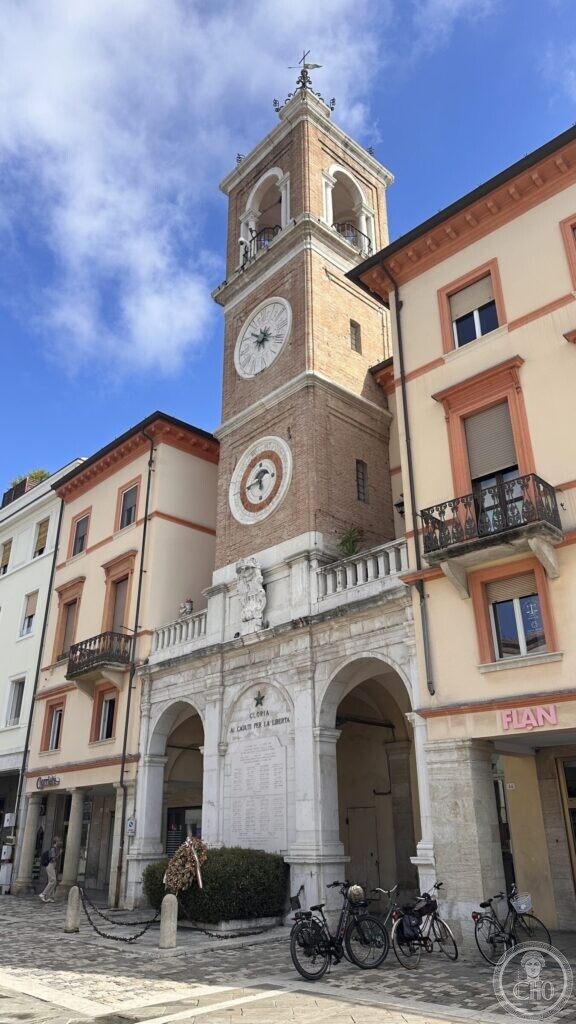
On the east side, the block of 1547 runs behind a portico, with the clock tower rising out of its middle: brick, with a small open belfry at the top, a white clock face below it and, lower still, the round painted dial of the calendar with its zodiac and moon. Under the tower’s three arches is the memorial to the fallen for liberty, a marble wall of names under a bronze star, with the three martyrs named at the top.
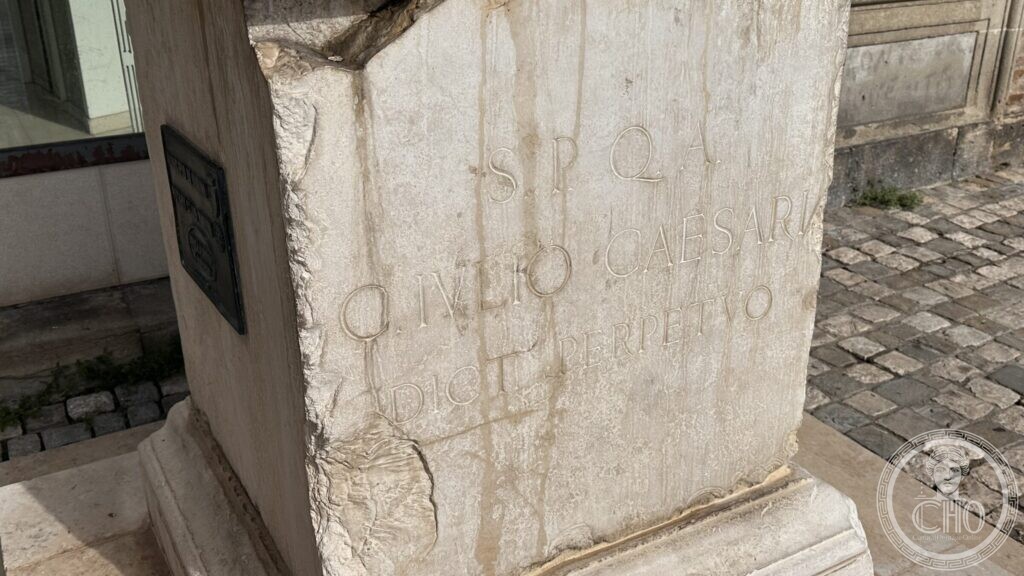
At the north end the statue of Caesar stands against a brick building in a plain stone pedestal cut with S.P.Q.A. — C. IVLIO CAESARI — DICT. PERPETVO, the Senate and People of Ariminum to Gaius Julius Caesar, dictator in perpetuity. The street sign on the corner above it keeps the old name alive. Opposite, across the square, the white front of the church of Sant’Antonio rises behind the small octagonal tempietto with its green dome, the two of them standing almost in the traffic. Look north along Corso d’Augusto from the middle of the square and the Arch of Augustus closes the view.
The square today

Practical information
- Open public space, free at any hour. The memorial to the Three Martyrs is now protected from foot and vehicle traffic; a lectern beside it explains the monument and the square.
- The fenced openings in the paving show the Roman forum below; they are easy to walk past without noticing.
- The ceremony for the anniversary of the three martyrs is held here every 16 August.
Getting there
Straight ahead from Rimini station down viale Dante, about ten minutes on foot. By car, the Gramsci-Santa Rita and via Roma car parks are both about five minutes away; the square itself is inside the restricted-traffic zone. From the airport, bus 9 to Arco d’Augusto, at the far end of Corso d’Augusto.
Nearby
- The Tempio Malatestiano, two minutes east along via IV Novembre
- The Arch of Augustus, at the end of Corso d’Augusto
- Piazza Cavour, the Teatro Amintore Galli and Palazzo Valloni with the Fulgor cinema, five minutes north
- The war memorial in Piazza Ferrari
Sources
- Comune di Rimini — Piazza Tre Martiri, municipal page, consulted 12 September 2026.
- Rimini Turismo (Comune di Rimini) — Piazza Tre Martiri and Monumento ai Tre Martiri, consulted 12 September 2026.
- The memorial plaque under the clock tower, the pedestal of the Caesar statue and the street sign, read and photographed on site, 11 September 2026.
Find it on the map
See this place and what’s around it →Record researched and written by Luigi De Marchi for Cultural Heritage Online, 2026.
📷 Become a Cultural Heritage Online photographer
Share your photos of places: they stay published under your name as the author. The more they're seen, the more you get noticed — and soon a contest will reward the most appreciated photos.
Log in or sign up free to add a photo