
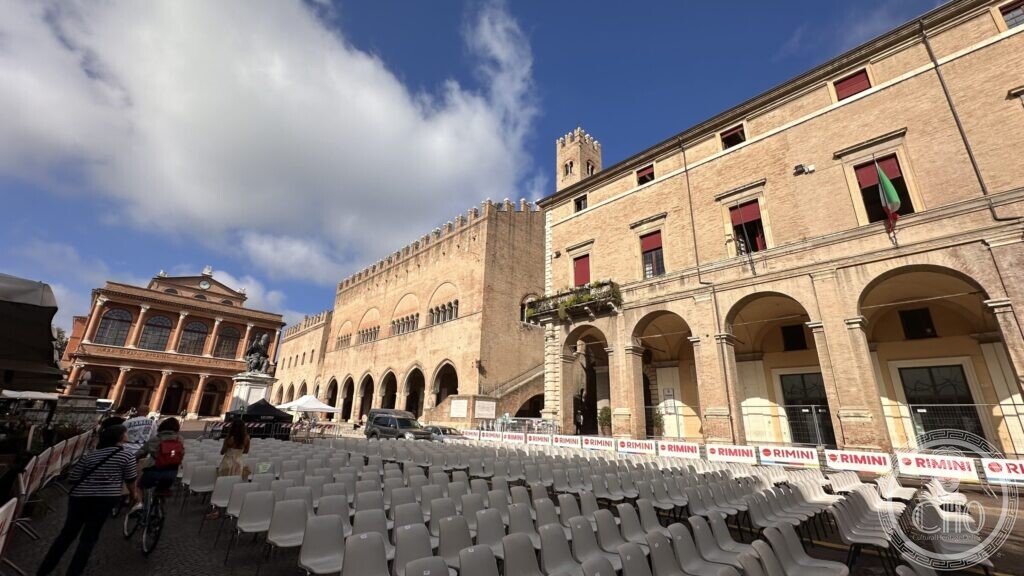
Six centuries of Rimini’s government stand around one square: the people’s palace of 1204, the podestà’s of 1334, the town hall of 1562, a 1543 fountain Leonardo admired, and an opera house of 1857.
At a glance
Piazza Cavour has been the centre of civic life in Rimini since the Middle Ages — the municipality calls it and Piazza Tre Martiri the city’s two main squares, one medieval, one Roman. Three palaces of government line its north side in chronological order: the Palazzo dell’Arengo, where the people’s council met from 1204; the Palazzo del Podestà of 1334, with a rope for hangings slung from its middle arch; and the Palazzo Garampi of 1562, still the town hall. The Teatro Amintore Galli closes the south end, the Pigna fountain and the bronze Pope Paul V stand in the middle, and the arcaded front of the old fish market opens off one corner.
Key facts
- Palazzo dell’Arengo: built 1204 under the podestà Modio de’ Carbonesi; altered in 1562, 1672 and 1919–23
- Palazzo del Podestà: 1334; restored 1912–22
- Palazzo Garampi: 1562, by the architect L. Carducci to a design by Serlio; rebuilt 1687 by Francesco Garampi, after whom it is named; today the town hall
- Fontana della Pigna: 1543, by Giovanni da Carrara, on a Roman drum; the city’s only drinking water until 1912
- Vecchia Pescheria: 1747, by Giovan Francesco Buonamici
- Teatro Amintore Galli: 1843–1857, by Luigi Poletti
- Now: the Arengo and the Podestà house PART — Palazzi dell’Arte Rimini
- Coordinates: 44.060748, 12.566003 — Google Maps
History
Rimini’s Roman forum is elsewhere, in what is now Piazza Tre Martiri. Piazza Cavour is the square the commune made for itself: Rimini Turismo describes it as the second forum of the Roman city and the monumental centre of the town, and the municipality dates its role as the heart of civic life to the Middle Ages.
The oldest building on it went up in 1204, under the podestà Modio de’ Carbonesi. The Palazzo dell’Arengo was the people’s palace: the Council of the People met in the great upper hall, while under the portico notaries kept their desks and justice was done in the open. The municipality’s own description preserves the most unforgettable detail of that arrangement — the pietrone, the lapis magnum, on which insolvent debtors were sentenced to strike their bare backsides three times.
In 1334 the commune added the Palazzo del Podestà beside it, for the magistrate sent from outside to keep order. Three Gothic arches opened along its front; from the middle one hung the rope used for hangings. Above, behind battlements, five small windows. In 1562 the Palazzo Garampi completed the row: built by the architect L. Carducci to a design by Serlio, rebuilt in 1687 by Francesco Garampi, and the seat of the municipality ever since.
In 1543 Giovanni da Carrara built the Pigna fountain in the middle of the square, setting a stone pine cone on a Roman drum carved with reliefs. Rimini Turismo records that the inscription on it quotes Leonardo da Vinci, who saw the fountain when he came to Rimini as Cesare Borgia’s engineer and military adviser: “Make harmony with the different falls of water, as I saw in the fountain of Rimini.” Until the public aqueduct opened in 1912, this was the only drinking water in the city.
The old fish market followed in 1747, built to Giovan Francesco Buonamici’s design just off the square, and the theatre in 1857. The last great change came with the restorations of 1912–22, which gave the Palazzo del Podestà the face it wears today — and the municipality is unusually honest about what that means: the pointed arcades facing the square are “pure invention of the restorer”, faithful copies of the real ones that still survive at the back of the building, which once faced a square that no longer exists.
What you see
Stand with your back to the theatre and the north side of the square reads as one brick wall built in three centuries. On the left, the Palazzo dell’Arengo: a heavy arcade at ground level, battlements along the top. Next to it the Palazzo del Podestà, taller, with its own crenellated crown and a stair climbing to the first floor. Then the Palazzo Garampi, classical and calm, its portico now the town hall’s front door, with the Italian flag over the balcony.
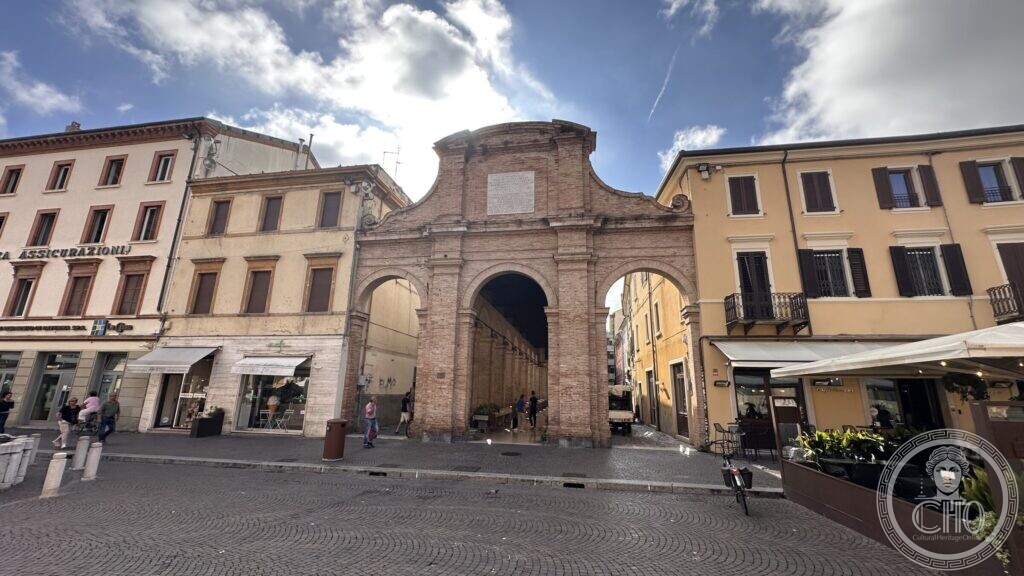
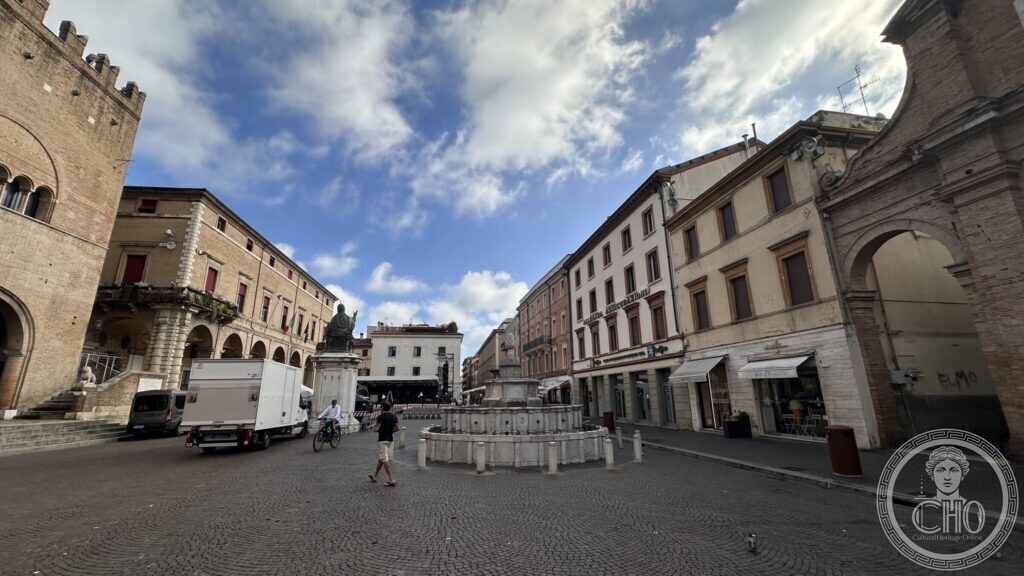
In the middle of the square the bronze Pope Paul V sits on a high plinth, and beyond him the Pigna fountain — a low circular basin, a carved Roman drum, and the pine cone that gives it its name. At the eastern corner, framed between ordinary houses, the Vecchia Pescheria opens as a two-storey loggia of three round arches: inside are the long benches of Istrian stone where the fish was laid out, the numbers of the stalls still legible in the stone, and four small dolphins at the corners that once poured water for washing the catch.
The square’s biggest surprise is what it is now used for. On the day these photographs were taken, hundreds of white chairs stood in rows across the paving under banners reading RIMINI — the medieval seat of government turned into an auditorium for the evening.
The square today

Practical information
- The square is open public space; the town hall, the theatre and PART have their own hours.
- PART — Palazzi dell’Arte Rimini occupies the Arengo and the Podestà and shows works from the San Patrignano Foundation Collection. The municipality’s page reported the palaces closed for refurbishment when it was last checked; confirm before visiting.
- The Vecchia Pescheria and the neighbouring Piazzetta San Gregorio are now the centre of the city’s evening life, with bars and restaurants under the arcades.
- Free wi-fi under the arcades of Piazza Cavour; step-free access to the town hall from Piazzetta Solferino.
Getting there
Ten to fifteen minutes on foot from Rimini station, straight down viale Dante and Corso d’Augusto. By car, exit the A14 at Rimini Sud and follow Rimini centro; the usual car parks are Ponte di Tiberio, Largo Gramsci, Italo Flori and Piazza Ferrari. From the airport, bus 9 to Arco d’Augusto.
Nearby
- Teatro Amintore Galli, at the south end of the square
- Castel Sismondo — behind the theatre, with a 360° virtual tour
- Palazzo Valloni, the Fulgor cinema and the Fellini Museum, on Corso d’Augusto
- The Tempio Malatestiano and Piazza Tre Martiri, five minutes along Corso d’Augusto
Sources
- Comune di Rimini — Piazza Cavour, Palazzo dell’Arengo and Palazzo del Podestà, municipal pages, consulted 12 September 2026.
- Rimini Turismo (Comune di Rimini) — Piazza Cavour, Fontana della Pigna, Palazzo del Podestà, Palazzo Garampi, Vecchia Pescheria, consulted 12 September 2026.
- On-site observation and photography, 11 September 2026.
Find it on the map
See this place and what’s around it →Record researched and written by Luigi De Marchi for Cultural Heritage Online, 2026.
📷 Become a Cultural Heritage Online photographer
Share your photos of places: they stay published under your name as the author. The more they're seen, the more you get noticed — and soon a contest will reward the most appreciated photos.
Log in or sign up free to add a photo