
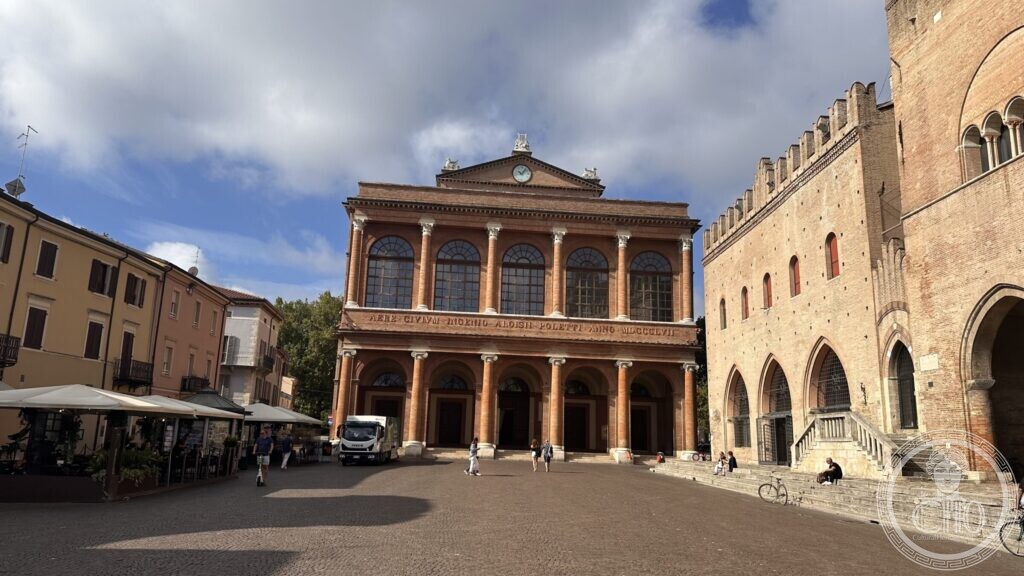
Verdi opened it in 1857 with an opera written for the occasion. A bomb took the roof off in 1943. It reopened in 2018, after seventy-five years of silence.
At a glance
Rimini’s municipal theatre closes the south side of Piazza Cavour with a two-storey neoclassical front of brick and stone. It was designed by Luigi Poletti of Modena, built between 1843 and 1857 at the expense of the town and a company of shareholders, and inaugurated in the summer of 1857 with Aroldo — a new opera that Giuseppe Verdi wrote for it and came to present in person, something he did for no other Italian theatre. An air raid on 28 December 1943 brought down the roof of the auditorium. The hall stood ruined for three generations; the city rebuilt it and reopened it on 28 October 2018.
Key facts
- Architect: Luigi Poletti of Modena (1792–1869), commissioned 15 May 1841
- Built: 1843–1857; contractor Pietro Bellini of Rimini, works handed over 17 March 1843
- Paid for by: the municipality and a company of shareholders
- Auditorium: four tiers of 23 boxes each — among the largest theatres in Italy when it was built
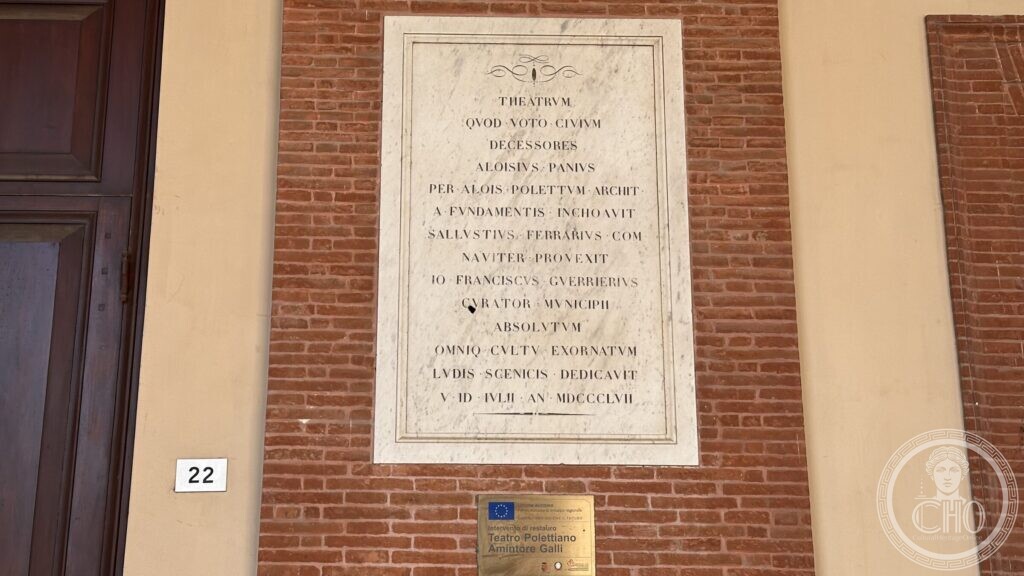
- Opened: summer 1857, with Verdi’s Aroldo. The plaque under the portico gives the dedication date as V ID IVLII AN MDCCCLVII — 11 July 1857
- Named: Teatro Nuovo (1857), Teatro Vittorio Emanuele II (1859), Teatro Amintore Galli (1947)
- Destroyed: air raid of 28 December 1943
- Reopened: 28 October 2018, with Cecilia Bartoli
- Address: Piazza Cavour 22, Rimini
- Coordinates: 44.060166, 12.564864 — Google Maps
History
After a run of designs by local men, on 15 May 1841 Rimini gave the commission for its new theatre to Luigi Poletti, an architect from Modena trained in Rome and known for a purist neoclassicism he had begun to push beyond. Poletti designed a theatre in the Italian manner but with significant variations: an auditorium of four tiers with twenty-three boxes on each, which made it one of the largest theatres in the country. The contractor Pietro Bellini of Rimini took over the site on 17 March 1843, building the new theatre onto the forebuilding of the old municipal ovens.
Costs ran far beyond the estimates and the town had to borrow heavily; the work halted and only resumed in the spring of 1854. Poletti brought in first-rate craftsmen for the plasterwork and decoration, and the painter Francesco Coghetti was commissioned to paint the drop curtain: Caesar crossing the Rubicon, the local founding myth.
In the summer of 1857 the Teatro Nuovo opened with an opera season directed by Giuseppe Verdi, who brought a new work composed for the occasion, Aroldo. No other Italian theatre was opened by Verdi in person. Two years later, with Italian unification under way, the theatre was dedicated to Vittorio Emanuele II. In 1898 the unfinished upper ballroom was fitted out as a smaller “child theatre”, later demolished.
Between 1916 and 1923 earthquake damage kept the building shut; the repairs brought electric light, a new chandelier and an orchestra pit cut into the stage. It reopened in 1923 with Zandonai’s Francesca da Rimini and a second curtain showing Paolo and Francesca kissing. Between 1928 and 1931 the architect Gaspare Rastelli completed the Ridotto — today’s Sala Ressi — and the upper gallery, ignoring Poletti’s drawings in favour of his own neoclassical manner. The opera seasons of the 1930s ended in the spring of 1943; Puccini’s Madama Butterfly was the last work staged.
On 28 December 1943 bombs struck the theatre and the roof of the hall came down. The auditorium was not completely destroyed, but the aftermath finished the job: the building was occupied by troops and then stripped by the people of Rimini themselves, who took the furnishings, the seats and the chandeliers to rebuild their bombed houses. In 1947 the ruin was dedicated to Amintore Galli (1845–1919), the Rimini-born music critic and composer whose Inno del Lavoratore, to words by Filippo Turati, had made him a national name.
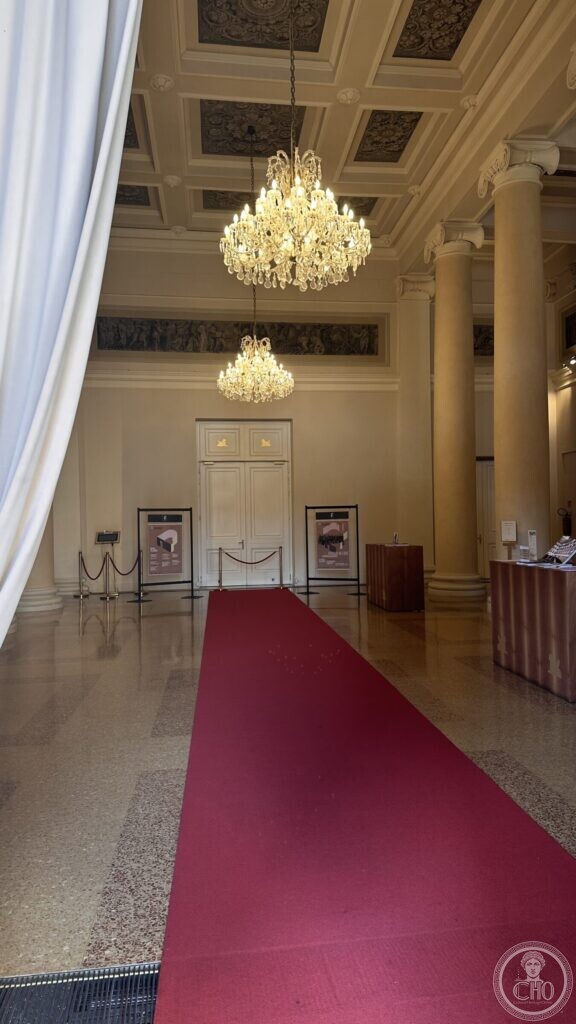
The argument over what to do with the shell lasted decades. A competition for an entirely new theatre was set aside, and in 2010 the city approved instead the reconstruction of Poletti’s hall and stage. The restored foyer was handed back to Rimini on 28 March 2015; during the works the ballet room Poletti had planned in the second attic, unbuilt since 1857, was finally made. On 28 October 2018 the curtain went up again, on Cecilia Bartoli — by the theatre’s own count 27,333 days after the last one came down.
What you see
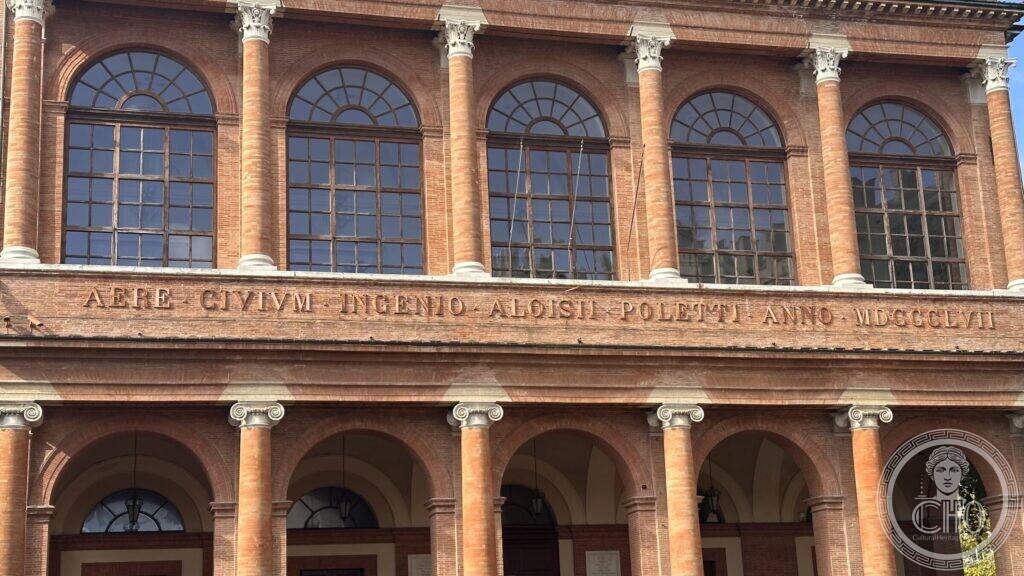
From Piazza Cavour the theatre presents a portico of six brick columns on the ground floor and a loggia of six Corinthian columns above, framing tall round-headed windows, with a clock in the pediment. Between the two orders runs the dedicatory frieze, cut into the brick in Roman capitals: AERE CIVIVM · INGENIO ALOISII POLETTI · ANNO MDCCCLVII — “with the money of the citizens, by the genius of Luigi Poletti, in the year 1857”. It is a rare thing, a building that names its architect across its own front.
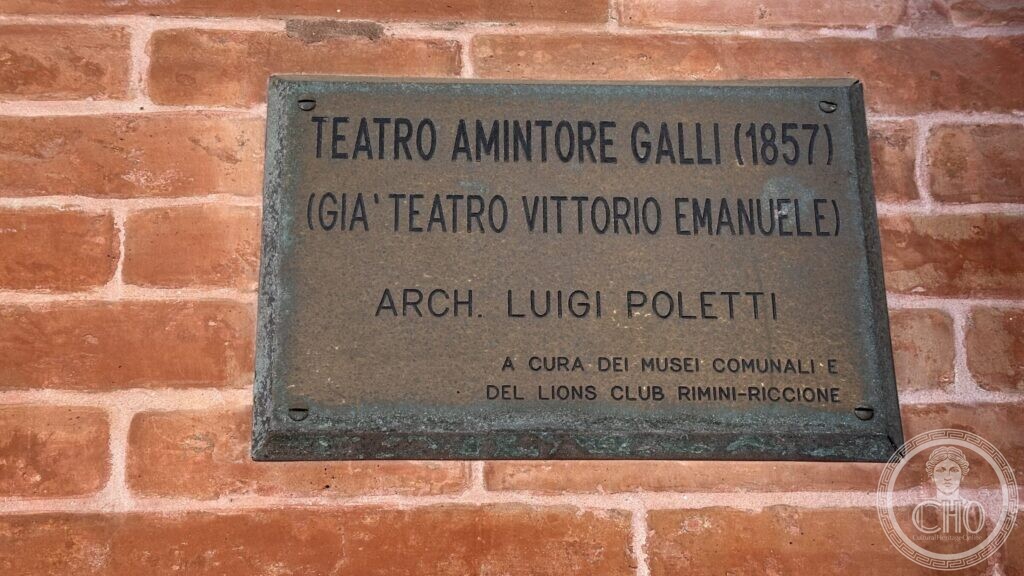
Under the portico, beside the door at number 22, a marble tablet records the whole enterprise in Latin: the theatre willed by the citizens, begun from the foundations through the architect Luigi Poletti, carried forward by Count Sallustio Ferrari, completed and dedicated with stage performances by the municipal curator Giovanni Francesco Guerrieri on the fifth day before the Ides of July in the year 1857. A small bronze plate nearby, placed by the municipal museums and the Rimini-Riccione Lions Club, gives the same facts in modern Italian.
Inside, the foyer restored in 2015 runs between tall columns under a coffered ceiling and a painted frieze, lit by crystal chandeliers — the part of Poletti’s building that survived the war most nearly intact, and the first room the city got back.
The theatre today

Practical information
- The Galli is a working opera house with its own season; the foyer and the Sala Ressi are also used for exhibitions and civic events.
- Programme, tickets and guided visits: teatrogalli.it (Comune di Rimini).
- The facade is best read from the middle of Piazza Cavour, where the frieze is legible from the ground.
Getting there
Piazza Cavour is in the historic centre, ten to fifteen minutes on foot from Rimini station along Corso d’Augusto. The theatre’s stage block faces Piazza Malatesta and Castel Sismondo on the other side. Nearest car parks: Ponte di Tiberio, Largo Gramsci, Piazza Ferrari.
Nearby
- Piazza Cavour, with the Palazzo dell’Arengo, the Palazzo del Podestà and the Pigna fountain, immediately in front
- Castel Sismondo — behind the theatre, with a 360° virtual tour
- Palazzo Valloni, the Fulgor cinema and the Fellini Museum
- The Tempio Malatestiano, five minutes away
Sources
- Teatro Galli (Comune di Rimini), Storia — the theatre’s own chronology, consulted 12 September 2026.
- Rimini Turismo (Comune di Rimini) — Piazza Cavour, consulted 12 September 2026.
- The dedicatory frieze and the two plaques on the building, read and photographed on site, 11 September 2026.
Find it on the map
See this place and what’s around it →Record researched and written by Luigi De Marchi for Cultural Heritage Online, 2026.
📷 Become a Cultural Heritage Online photographer
Share your photos of places: they stay published under your name as the author. The more they're seen, the more you get noticed — and soon a contest will reward the most appreciated photos.
Log in or sign up free to add a photo