
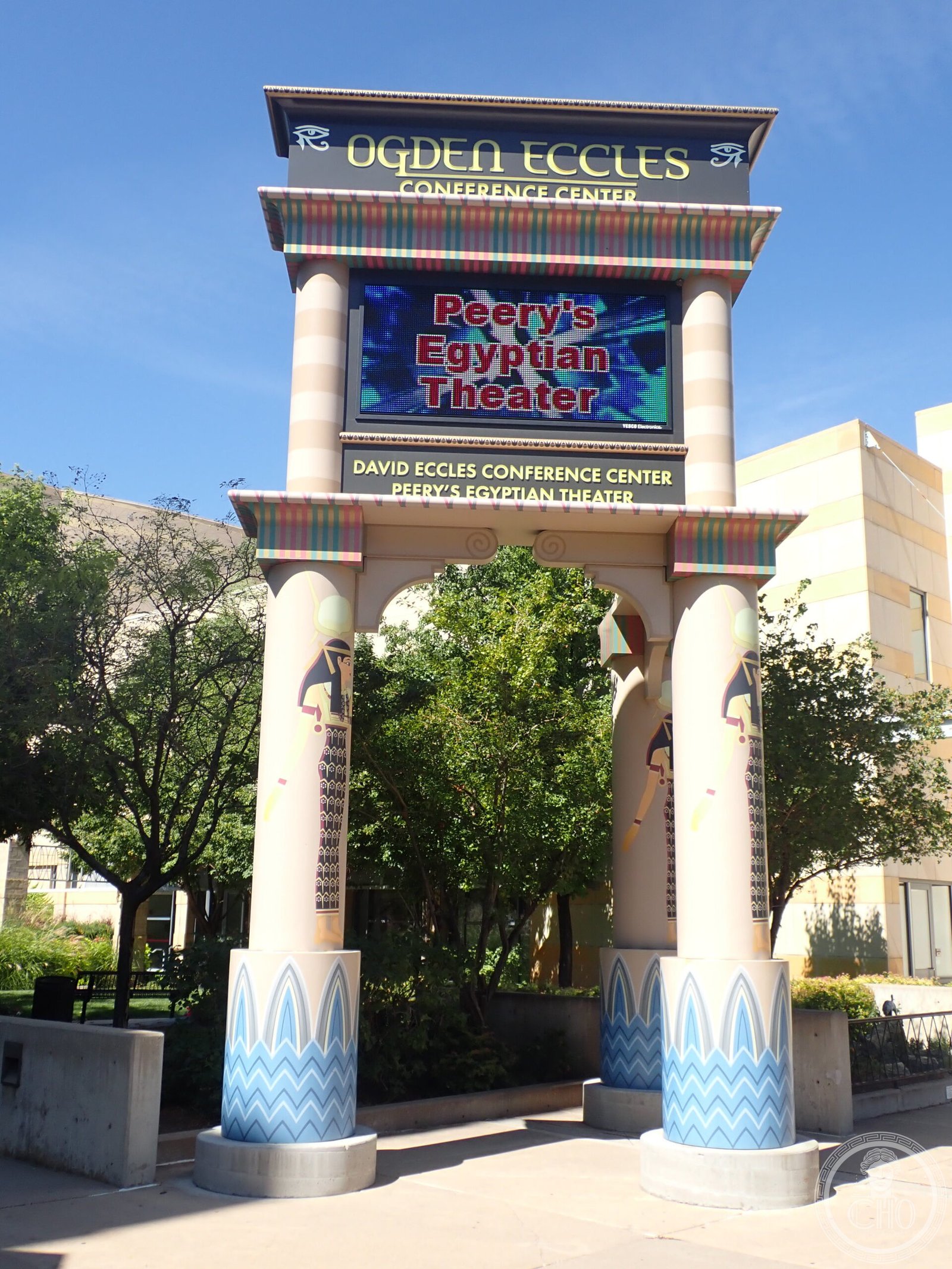
Built two years after Howard Carter opened Tutankhamun’s tomb, Peery’s Egyptian Theater brought pharaonic spectacle to Ogden’s main commercial boulevard and remains one of the best-preserved Egyptian Revival theatres in the American West.
At a glance
Standing at 2415 Washington Boulevard in the heart of Ogden, Utah, Peery’s Egyptian Theater opened in 1924 when the Egyptomania triggered by the 1922 discovery of Tutankhamun’s tomb was still reshaping popular design from jewellery to cinema architecture. The theatre was built for local businessman David Henry Peery and designed in an exuberant Egyptian Revival style: lotus-column pilasters flank the main facade, hieroglyphic friezes wrap the upper register, and a pair of pharaonic heads guard the entrance. Inside, the auditorium continues the theme with painted sky ceilings, ibis motifs, and faux-stone wall treatments. Now managed by Weber County as a performing arts venue, the Egyptian Theater hosts live concerts, film festivals, and community events, its improbable desert-dynasty facade still commanding attention on a Utah main street.
Key facts
- Address: 2415 Washington Blvd, Ogden, UT 84401
- Opened: 1924
- Patron: David Henry Peery
- Style: Egyptian Revival / Egyptomania
- Heritage listing: National Register of Historic Places
- Current use: Performing arts venue, managed by Weber County
- Inspired by: Discovery of Tutankhamun’s tomb, November 1922
History
On November 4, 1922, archaeologist Howard Carter broke through a sealed doorway in the Valley of the Kings and discovered the intact burial chamber of the pharaoh Tutankhamun. The find—golden treasures, painted walls, the mummy of a boy-king dead for three thousand years—ignited a global fascination with ancient Egypt that infiltrated fashion, product design, and architecture almost overnight. Within two years, Egyptian-themed buildings were rising across the United States, from humble storefronts to elaborate movie palaces.
David Henry Peery, a prominent Ogden property developer, commissioned the Egyptian Theater to capitalise on this craze and give his city a landmark entertainment venue on Washington Boulevard. The theatre opened in 1924 as a silent-film house, its orchestra pit accommodating the musicians who scored the pictures. Sound arrived in the late 1920s, and the theatre prospered through the Depression as one of Ogden’s main entertainment destinations. Like many single-screen palaces, it struggled in the post-war era against the rise of the drive-in and the suburban multiplex, eventually closing as a first-run cinema.
Weber County acquired and began restoring the theatre in the 1980s—1990s, a project that addressed decades of deferred maintenance while preserving the original Egyptian decorative scheme. The restored Egyptian Theater was listed on the National Register of Historic Places, and today functions as a public performing arts venue hosting touring acts, community theatre, film events, and jazz festivals.
What you see
The Washington Boulevard facade is the Egyptian Theater’s calling card. Two large engaged columns with lotus-bud capitals frame the central entrance, their shafts decorated with polychrome hieroglyphic bands. Above the marquee, a horizontal frieze carries winged sun-disc motifs—the Egyptian symbol of divine royalty—between carved cartouches. Flanking the roofline, sculpted pharaonic heads in profile gaze toward the street. The palette is warm: ochre, terracotta, and sand-coloured stucco that read convincingly as stone in Utah’s dry mountain light.
The auditorium carries the Egyptian theme into the seating bowl, with painted wall panels depicting the Nile, papyrus marshes, and processional scenes in a flattened, bas-relief style. The ceiling is painted as a night sky, with gold stars set against deep blue—a conceit derived from the painted astronomical ceilings of actual Egyptian temples. The proscenium arch is framed by stylised obelisk motifs, and the organ grilles are worked with scarab beetles and ankh symbols. The cumulative effect is of a theatre that commits fully to its borrowed mythology without irony.
Practical information
- Season: Year-round events; check Weber County Events calendar for schedule
- Tickets: Via Weber County ticketing portal and at the box office
- Tours: Group architectural tours available by appointment with Weber County Arts and Events
- Time needed: A self-guided exterior review takes 20 minutes; interior access requires a ticketed event or scheduled tour
- Access: Ground-level entrance; the building has been partially upgraded for accessibility
Getting there
Ogden is situated 35 miles north of Salt Lake City on I-15. By train, Amtrak’s California Zephyr and the Utah Transit Authority FrontRunner commuter rail serve Ogden Station on Wall Avenue, a five-minute walk west of the Egyptian Theater on Washington Boulevard. Salt Lake City International Airport (SLC) is approximately 40 minutes by car or 60 minutes by combined TRAX and FrontRunner rail. Street parking is available on Washington Boulevard and adjacent blocks; the Ogden City Centre Parking Terrace is one block east.
Nearby
- Ogden Union Station (1924) — A Spanish Colonial Revival railway depot on Wall Avenue, built the same year as the Egyptian Theater and now housing several museums including the Browning Firearms Museum and the Utah State Railroad Museum.
- Historic 25th Street — Ogden’s Victorian-era commercial street, one block south, lined with 1890s–1910s brick warehouses that once served the transcontinental railroad.
- Ogden Amphitheater — An outdoor summer performance venue in the Municipal Gardens, two blocks from the Egyptian Theater, used for the Ogden Twilight Concert Series.
- Weber State University Campus — The university’s historic core includes Lindquist Hall and the Stewart Bell Tower, representatives of mid-century institutional Modernism on the eastern Ogden bench.
Sources
- National Register of Historic Places nomination, Peery’s Egyptian Theater, Ogden, Utah
- Weber County Arts and Events, institutional documentation
- Naylor, David. American Picture Palaces: The Architecture of Fantasy. Van Nostrand Reinhold, 1981
- Curl, James Stevens. The Egyptian Revival: Ancient Egypt as the Inspiration for Design Motifs in the West. Routledge, 2005
- Ogden City Historic Preservation Commission records
Find it on the map
See this place and what’s around it →Record researched and written by Luigi De Marchi for Cultural Heritage Online, 2026.
📷 Become a Cultural Heritage Online photographer
Share your photos of places: they stay published under your name as the author. The more they're seen, the more you get noticed — and soon a contest will reward the most appreciated photos.
Log in or sign up free to add a photoIs this page about you?
This page is read by travellers and heritage enthusiasts who find it on Google. Tell us how you are connected to this place and we will take it from there.