
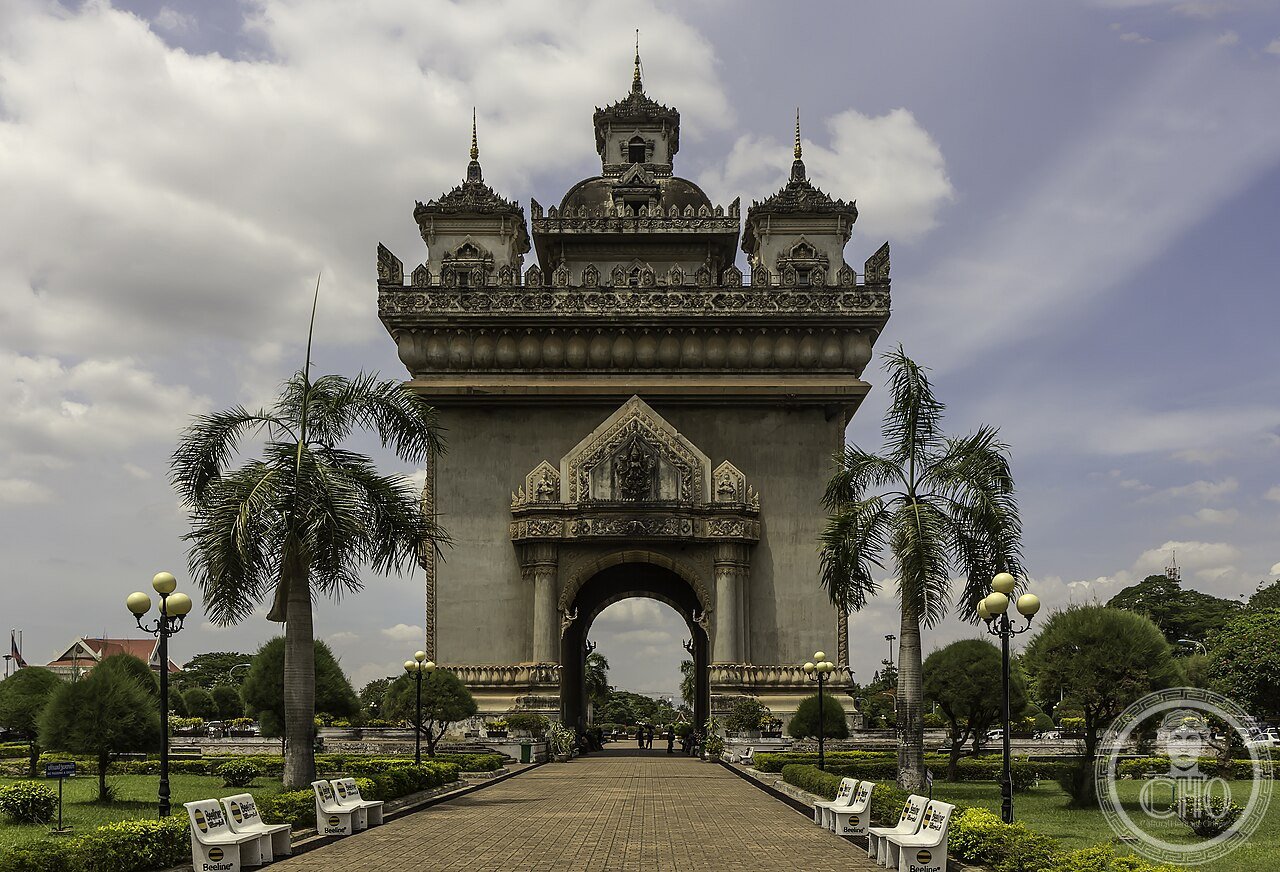
The Arc de Triomphe of Vientiane, crowned with naga serpents and lotus towers – built, the Lao say with a smile, from American cement meant for an airport runway.
At a glance
- Type
- Victory monument
- Period
- 1957-1968
- Style
- Lao monumental (French triumphal form, Buddhist ornament)
- Location
- Lane Xang Avenue, Vientiane, Laos
- Coordinates
- 17.9707, 102.6133
- Designer
- Tham Sayasthsena
Overview
Patuxai – the Gate of Victory – closes the vista of Lane Xang Avenue, Vientiane’s Champs-Elysees, with a four-arched triumphal gate whose silhouette is unmistakably French and whose every surface is unmistakably Lao: five lotus-bud towers, naga serpent finials, and bas-reliefs of Hindu-Buddhist mythology in place of imperial laurels.
History
Built between 1957 and 1968 to honour those who died in the struggle for independence from France, the monument acquired its famous legend: cement supplied by the United States for Wattay airport’s runway was diverted to the arch, earning it the nickname of the vertical runway. After 1975 the socialist government rededicated it as Patuxai, the victory gate of the new republic, and laid out the surrounding park with its musical fountain, a gift from China.
Architecture and Design
The reinforced-concrete gate carries four facades of arched openings beneath a ceiling painted with Vishnu, Rama, and the gods of the Lao pantheon; stairways climb past souvenir floors to open galleries in the towers, from which the whole axis of the planned city – Presidential Palace to That Luang stupa – unrolls beneath.
Cultural significance
Patuxai is the civic emblem of Vientiane and a wry national symbol – colonial form repurposed for independence, foreign aid repurposed for memory. It shares the city’s monumental axis with Pha That Luang, the golden stupa that is the holiest monument of Laos.
Visiting today
Open daily for a small fee; climb the seven storeys for the best panorama of Vientiane, ideally at sunset when the fountain plays and the avenue fills with evening strollers.
Getting there
The monument stands a kilometre northeast of the Presidential Palace along Lane Xang Avenue, an easy walk or tuk-tuk ride from the Mekong riverfront and the morning market.
Sources and resources
Find it on the map
See this place and what’s around it →Record researched and written by Luigi De Marchi for Cultural Heritage Online, 2026.
📷 Become a Cultural Heritage Online photographer
Share your photos of places: they stay published under your name as the author. The more they're seen, the more you get noticed — and soon a contest will reward the most appreciated photos.
Log in or sign up free to add a photoIs this page about you?
This page is read by travellers and heritage enthusiasts who find it on Google. Tell us how you are connected to this place and we will take it from there.