
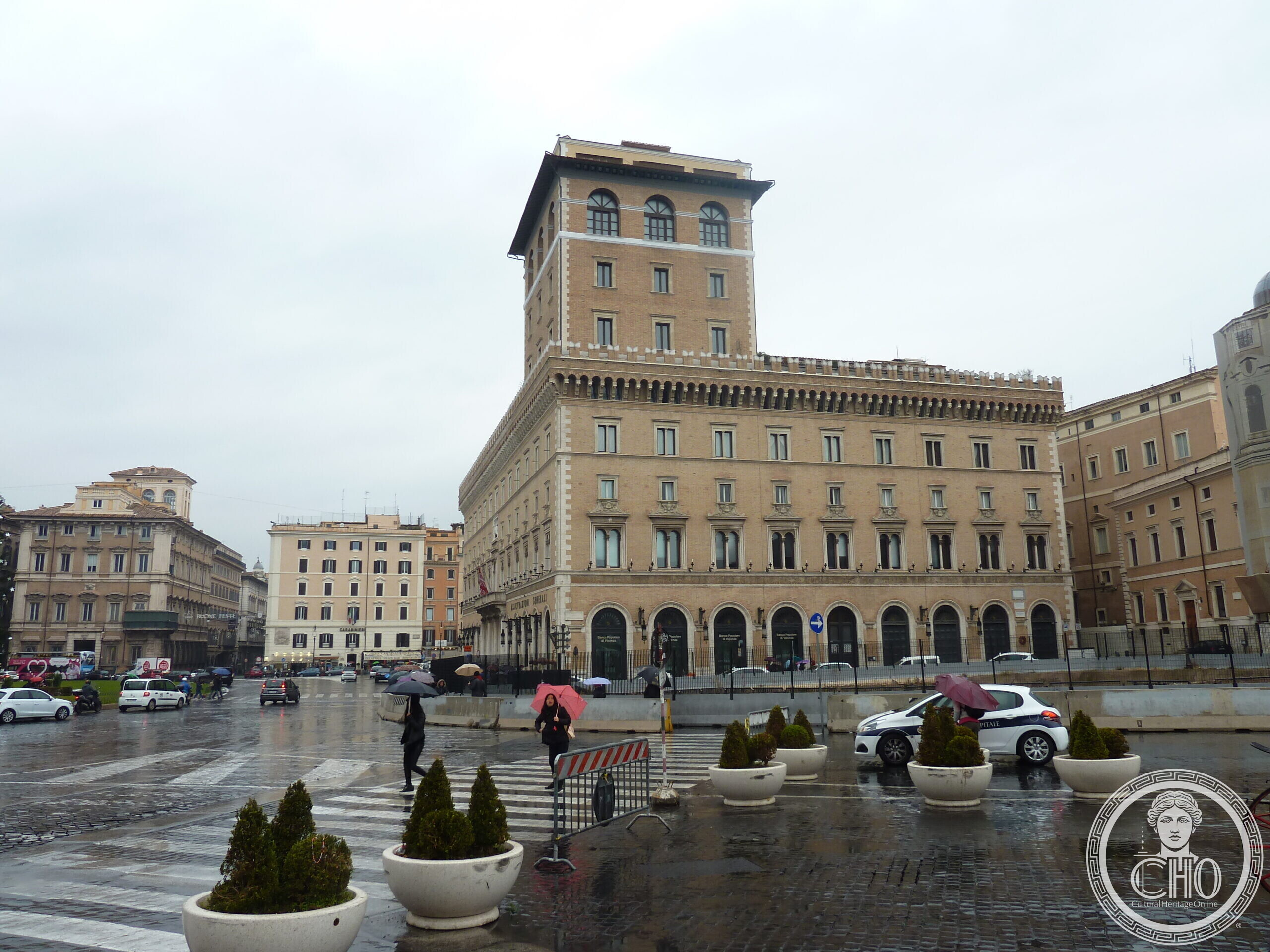
The largest civil building of fifteenth-century Rome was begun by a Venetian cardinal who became pope, lent to the Republic of Venice as its embassy, used by Austria for a century, and for fourteen years was the seat of the head of the Fascist government. Today it is a museum.
At a glance
Palazzo Venezia stands on the west side of Piazza Venezia, at the foot of the Capitol. It was built between 1455 and 1468 for the Venetian cardinal Pietro Barbo, who became Pope Paul II in 1464, and is attributed to Francesco del Borgo, architect of the papal court. In 1564 part of it was given to the Republic of Venice for its embassy, which is where the name comes from. Since 1916 it belongs to the Italian State and houses the Museo Nazionale di Palazzo Venezia, today part of the VIVE complex together with the Vittoriano.
Key facts
- Built: 1455–1468, for Cardinal Pietro Barbo (Pope Paul II, 1464–1471)
- Attributed to: Francesco del Borgo
- Materials: travertine reused from the Colosseum and the Theatre of Marcellus
- Embassy of Venice: 1564–1797 · Austrian embassy: 1814–1916
- 1929–1943: seat of the Head of Government and of the Grand Council of Fascism
- Today: Museo Nazionale di Palazzo Venezia (VIVE) and the Istituto Nazionale di Archeologia e Storia dell’Arte
- Note: the historic rooms are closed for restoration until 2026, according to the museum
- GPS: 41.89645, 12.48138 · Open in Google Maps
History
Pietro Barbo, nephew of Pope Eugenius IV, was cardinal of San Marco, the basilica that the palace encloses on its south side. He began the building in 1455 as a residence for the cardinals of San Marco; after his election as Paul II in 1464 it became a papal residence, with a garden court, the Palazzetto, towards the square. Erasmus of Rotterdam and the Emperor Charles V were among its guests.
In 1564 Pius IV ceded part of the palace to the Republic of Venice, whose ambassadors lived there until the fall of the Republic in 1797. After the Napoleonic years the Austro-Hungarian diplomatic mission used it from 1814 until Italy entered the First World War in 1916, when the State took it over. The museum was installed soon after.
Between 1929 and 1943 Mussolini had his office in the Sala del Mappamondo, and the balcony on the square was the one from which he spoke. Since then the building has returned to its civic use: museum, library and research institute.
What you see
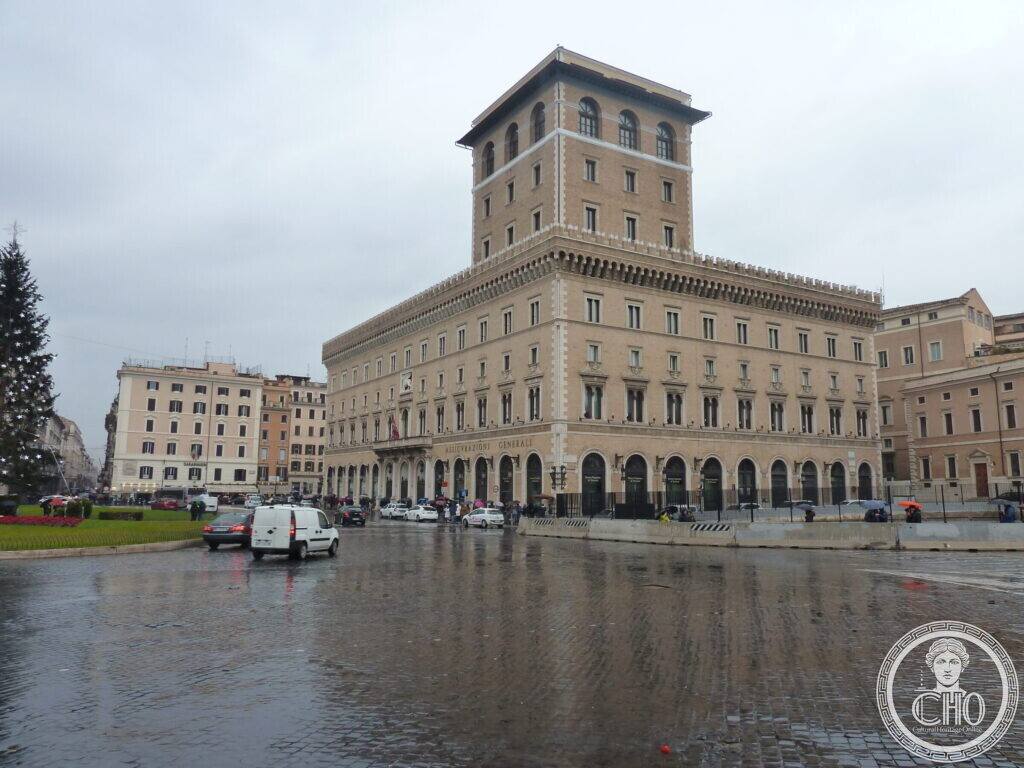
From the square, a long front of three storeys of windows under a crenellated top, with the massive tower at the corner: the fortified look of a Roman palace built before the Renaissance had softened. The photographs were taken on a wet day, with the Christmas tree of the square on the left of the second one.
Nearby
- Vittoriano — the monument to Victor Emmanuel II on the other side of the square
- Piazza del Campidoglio — Michelangelo’s square on the Capitol, a few minutes up the hill
Gallery
Sources
- Turismo Roma — Palazzo di Venezia: dates 1455–1468, the attribution to Francesco del Borgo, the travertine from the Colosseum and the Theatre of Marcellus, the Venetian embassy 1564–1797, Austria 1814–1916, the Fascist period 1929–1943, the museum and INASA today
- VIVE — Vittoriano e Palazzo Venezia (Ministry of Culture): the founder Pietro Barbo, the guests Erasmus and Charles V, the collections from the Middle Ages to Neoclassicism, the closure for restoration
Find it on the map
See this place and what’s around it →📷 Become a Cultural Heritage Online photographer
Share your photos of places: they stay published under your name as the author. The more they're seen, the more you get noticed — and soon a contest will reward the most appreciated photos.
Log in or sign up free to add a photoIs this page about you?
This page is read by travellers and heritage enthusiasts who find it on Google. Tell us how you are connected to this place and we will take it from there.