
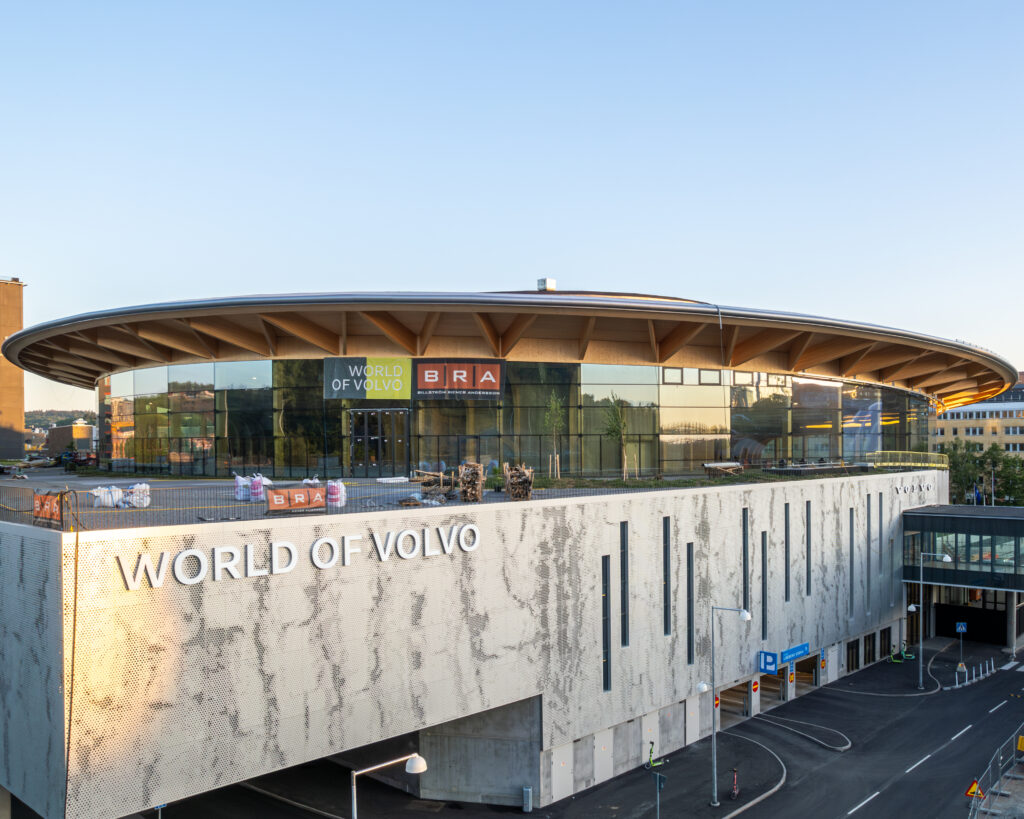
Inaugurated as a landmark mass-timber architectural monument designed by Henning Larsen, World of Volvo in central Gothenburg brings together nearly a century of Swedish automotive history, safety engineering, and public exhibitions dedicated to the passenger cars born at Lundby in 1927.
At a glance
Situated along Mölndalsvägen at Lyckholms torg in Gothenburg’s event district, World of Volvo opened in April 2024 as the permanent home of Sweden’s automotive cultural heritage. Replacing the former Volvo Museum at Arendal, the 22,000-square-meter civic center unites Volvo Cars and the Volvo Group under one roof. Designed around the Scandinavian concept of Allemansrätten (the right of public access), the center displays the foundational 1927 ÖV 4 “Jakob” roadster, revolutionary three-point seatbelt prototypes, and historic royal limousines.
Key facts
- Location: Lyckholms torg 1, 412 63 Göteborg (Krokslätt / Centrum), Sweden
- Historic manufacturing connection: Successor exhibition home to the original 1927 assembly sheds at Lundby (Hisingen)
- Architectural design: Henning Larsen Architects; structural design by Lindner Scandinavia; constructed with 2,800 curved glued-laminated timber beams
- Permanent collection: Over 100 historic vehicles, including the 1927 ÖV 4, PV444, P1800 sports coupe, 240 series, concept vehicles, and marine drive units
- Sustainability milestone: Sweden’s largest mass-timber civic building, engineered from sustainably harvested Nordic spruce
- Current status: Publicly accessible cultural and event venue, interactive museum, restaurant, and corporate conference arena
- Coordinates: 57.68951, 11.99780 · open in Google Maps
History and automotive heritage
On April 14, 1927, the first production Volvo passenger car—an open-topped four-cylinder tourer named the ÖV 4—rolled out of the former ball-bearing manufacturing buildings at Lundby on the island of Hisingen. Founders Assar Gabrielsson and Gustaf Larson insisted that because automobiles were driven by people, safety and durability under harsh Scandinavian winter conditions had to guide every engineering choice.
Throughout the twentieth century, Volvo engineers invented pivotal global safety benchmarks, including the three-point safety belt by Nils Bohlin in 1959, rear-facing child seats, and side-impact protection systems (SIPS). While active automotive assembly relocated to the sprawling Torslanda plant in 1964, the historic corporate memory was conserved through private corporate archives before being unveiled to international travelers at World of Volvo.
Mass-timber architecture and Scandinavian design
World of Volvo is celebrated internationally as an engineering tour de force in modern timber architecture. The building rises in three colossal organic tree-trunk columns that branch outward into an expansive canopy resembling a Scandinavian forest grove. Constructed from cross-laminated timber (CLT) and curved glulam beams manufactured in Austria and Sweden, the structure eliminates traditional steel columns in favor of exposed natural wood.
Sweeping glass facades seamlessly merge the interior promenade with the natural rock outcroppings and native birch trees of the adjacent parkland, evoking traditional Swedish woodland scenery right in the heart of urban Gothenburg.
What you see today
Today, World of Volvo welcomes visitors into an airy, naturally lit public concourse. Visitors can wander freely through the open atrium, admire historic prototypes suspended above, or purchase exhibition tickets to enter the multi-level thematic galleries.
The interactive exhibits trace automotive design decade by decade, allowing guests to sit inside mid-century family wagons, examine crash-test dummies and safety simulation sleds, and explore futuristic electric autonomous concept vehicles.
Practical information and visits
- Opening hours: Open daily throughout the year (typically 10:00 to 18:00, with extended evening hours on weekends).
- Public areas: The central atrium, public lounges, and Nordic restaurants (operated by Michelin-starred chef Stefan Karlsson) are accessible without an admission fee.
- Exhibition tickets: Access to the permanent automotive heritage galleries and interactive simulators requires paid admission tickets, which can be booked online or at the information desk.
Getting there
World of Volvo is situated directly south of the Liseberg amusement park. It is reached via Gothenburg Tram lines 2 and 4, disembarking at “Liseberg Södra” or “Almedal” right outside the building. The Gothenburg Central Station (Centralstationen) is just ten minutes away by tram.
Related enterprise history
This place card documents the architecture, public experience, and heritage collection at World of Volvo in Gothenburg. For the corporate biography of Assar Gabrielsson, the 1927 ÖV 4 launch, and passenger vehicle patents, read our companion magazine feature on the founding and passenger car history of Volvo (1927).
Sources
- World of Volvo Official Archive: Historical vehicle inventory, architectural documentation, and heritage timeline.
- Henning Larsen Architects: Architectural monographs, mass-timber engineering specifications, and urban spatial studies for World of Volvo.
- OpenStreetMap: Footprint polygon, spatial boundary, and coordinates of World of Volvo (Way 1164894809), Göteborg, Sweden.
Find it on the map
See this place and what’s around it →📷 Become a Cultural Heritage Online photographer
Share your photos of places: they stay published under your name as the author. The more they're seen, the more you get noticed — and soon a contest will reward the most appreciated photos.
Log in or sign up free to add a photo