
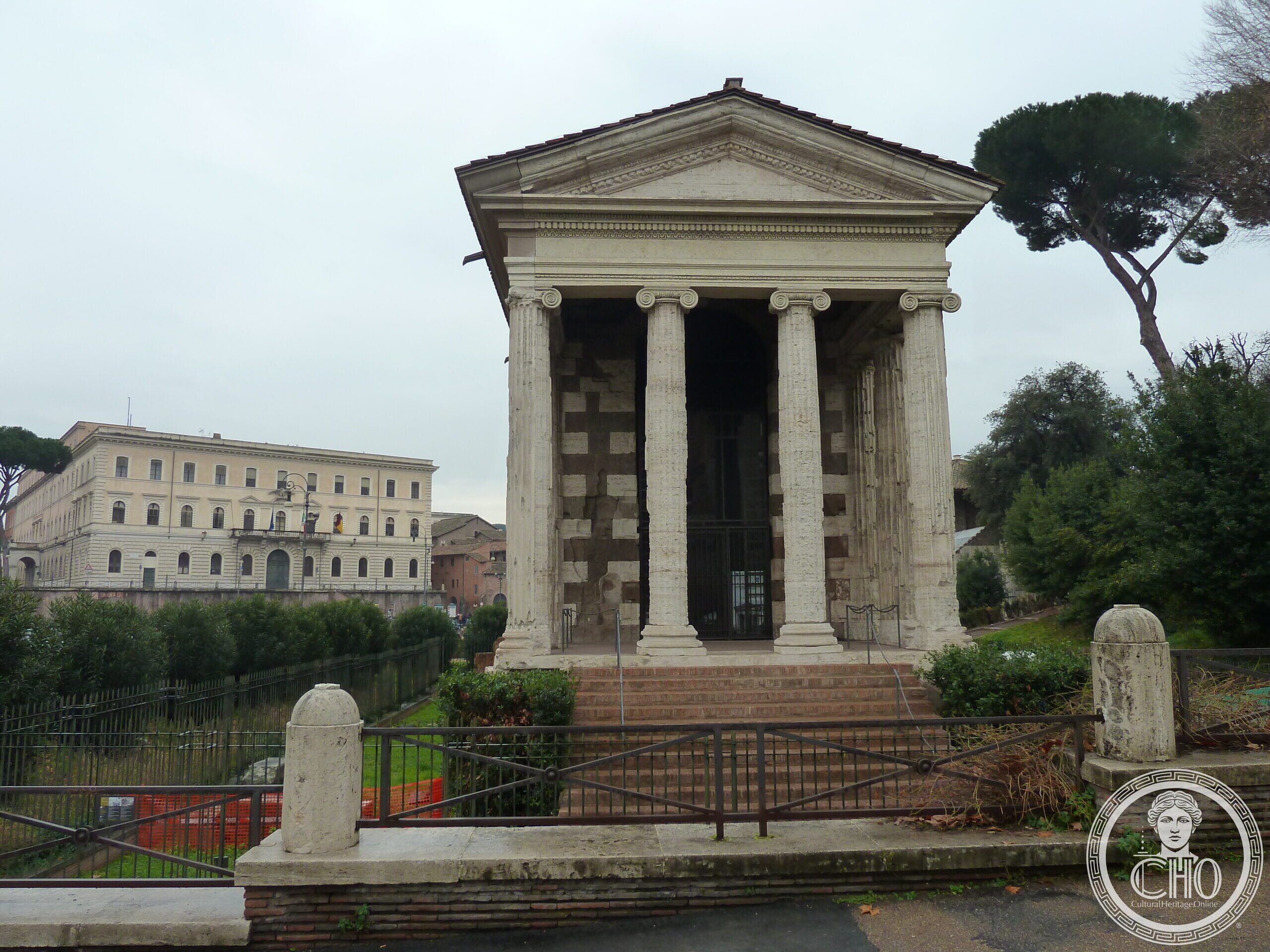
The best-preserved Republican temple in Rome owes its survival to the ninth century, when it became the church of Santa Maria Egiziaca. In 1916 the church was stripped away, and on the walls appeared the early medieval frescoes that the restoration of recent years has made legible again.
At a glance
The small temple on Piazza della Bocca della Verità was dedicated to Portunus, the god of harbours and of river trade, and stood by the Portus Tiberinus, the first commercial port of Rome on the Tiber. The foundation goes back to the fourth or third century BC; the building we see is of the second half of the second century BC, with work after 70 BC. In the ninth century it was turned into a church, first Santa Maria Secundicerii and then Santa Maria Egiziaca, and that is why it still stands almost complete. The Ministry of Culture manages it; visits are by reservation.
Key facts
- Dedicated to: Portunus, god of harbours and river trade
- Dating: founded 4th–3rd century BC; present appearance second half of the 2nd century BC, restored after 70 BC
- Order: Ionic; four columns on the front, half-columns on the sides (pseudoperipteral)
- Materials: tufa and travertine, originally stuccoed; high podium with travertine facing and front steps
- Church: Santa Maria Secundicerii, then Santa Maria Egiziaca, from the 9th century; deconsecrated in 1916
- Inside: early medieval frescoes with scenes from the life of the Virgin, restored recently
- Visits: by reservation, through CoopCulture
- GPS: 41.88924, 12.48092 · Open in Google Maps
History
The Forum Boarium was the cattle market of early Rome and the landing place on the river. Two temples survive there, this one and the round Temple of Hercules Victor beside it. The temple of Portunus belonged to the port: its god watched over doors, harbours and the goods that came up the Tiber.
Like the Pantheon, it was saved by becoming a church. In the ninth century it was dedicated to the Virgin and later to Mary of Egypt, the penitent saint of the desert; the cella was painted, and those paintings, an early medieval cycle on the life of the Virgin, are what the restorers found in 1916, when the State removed the church fittings to give the temple back its ancient form. A recent restoration has made the frescoes readable again.
What you see
A rectangular temple on a high podium with a flight of steps on the front, four fluted Ionic columns under the pediment and half-columns engaged in the side walls. The columns of the front are travertine, the walls tufa; the stucco that once covered everything is gone. In the photograph the long building of the former Monte di Pietà rises behind, on the slope towards the Aventine.
Nearby
- Temple of Hercules Victor — the round temple a few steps away
- Forum Boarium — the ancient cattle market and river port
Sources
- Ministero della Cultura — Tempio di Portunus al Foro Boario: the dating, the restoration after 70 BC, the church of Santa Maria Secundicerii and Santa Maria Egiziaca, the 1916 removal of the church, the frescoes, the address and the reservation
- Turismo Roma — Tempio di Portuno: the present appearance of the second century BC, the Ionic columns, the podium faced with travertine, tufa and travertine in the walls, Portunus and the Portus Tiberinus, the frescoes on the life of the Virgin
Find it on the map
See this place and what’s around it →📷 Become a Cultural Heritage Online photographer
Share your photos of places: they stay published under your name as the author. The more they're seen, the more you get noticed — and soon a contest will reward the most appreciated photos.
Log in or sign up free to add a photoIs this page about you?
This page is read by travellers and heritage enthusiasts who find it on Google. Tell us how you are connected to this place and we will take it from there.