
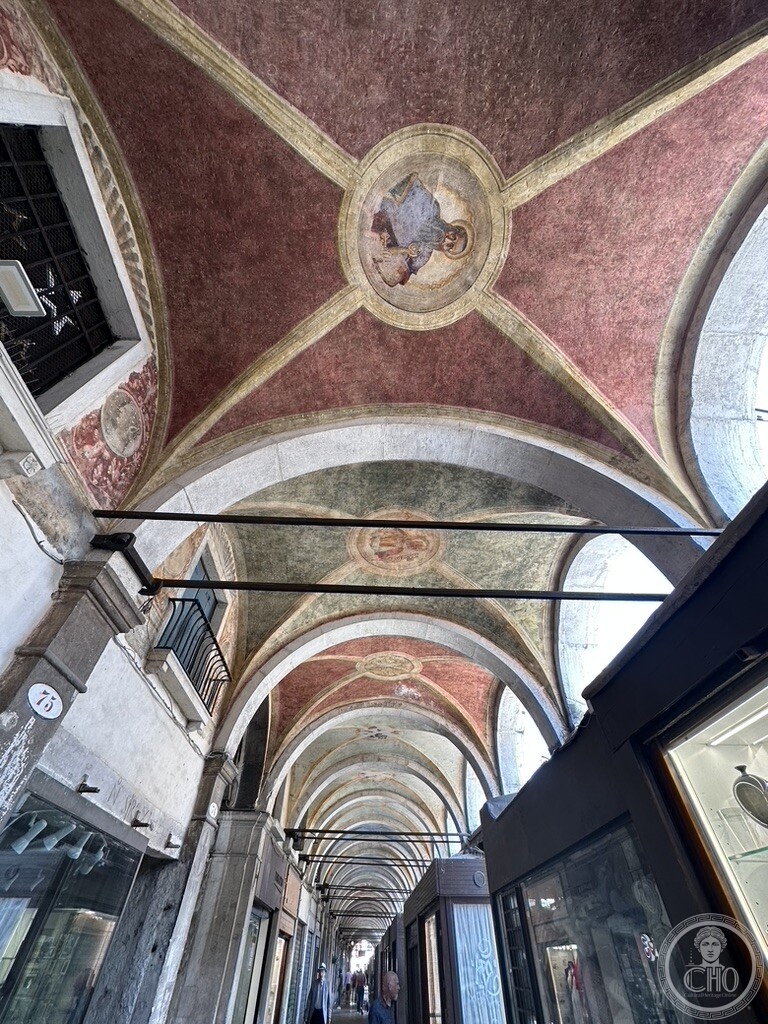
Rebuilt after a fire destroyed Venice’s market quarter, a run of shops and trade offices whose covered passageway still carries a run of sixteenth-century painted vaults overhead — easy to miss, harder to forget once seen.
At a glance
The Fabbriche Vecchie is the older of the two market buildings that still frame the Rialto: a long, arcaded complex rebuilt in 1520–1522 to a design by Antonio Abbondi, known as Scarpagnino, after a fire destroyed the previous buildings on the site in 1514. It housed the everyday machinery of Venetian trade — produce and fish markets, moneylenders’ benches, cloth dealers — at street level, with the offices of the magistracies that regulated commerce and shipping on the floors above. One of its covered passageways still keeps a series of cross-vaults frescoed in the sixteenth century, largely unnoticed by the crowds heading for the market stalls beyond.
Key facts
- Architect: Antonio Abbondi, called Scarpagnino
- Rebuilt: 1520–1522, after the 1514 Rialto fire
- Original uses: Erbaria (produce market), Pescaria (fish market), Bancogiro (banking), Drapperia (cloth trade) at ground level; magistracies overseeing commerce and shipping on the upper floors
- Notable feature: a covered passageway (sottoportego) with cross-vaults frescoed in the 16th century
- Companion building: the Fabbriche Nuove, built 1553–1555 a little further along, a separate but related complex
- Location: Rialto, San Polo, Venice
- GPS: 45.43827, 12.33559 · Open in Google Maps
History
A fire in 1514 tore through the buildings around the Rialto, the commercial heart of Venice since the Middle Ages, destroying the market structures that had grown up over the centuries. The Republic held a competition for the rebuilding, won by Scarpagnino with a plan that kept the same layout as what had burned but rebuilt it in a restrained classical style: uniform units of the same height, tied together by continuous porticoes and stringcourses, finished between 1520 and 1522.
The building was never meant to be admired from a distance so much as worked in: its ground floor held the Erbaria and Pescaria markets, moneylenders at the Bancogiro, cloth merchants at the Drapperia, while its upper storeys housed the magistracies that regulated Venetian trade and shipping. In the midst of this practical, commercial architecture, one covered passageway received a set of frescoed cross-vaults — a small, unexpected flourish of decoration in a building built above all to keep Venice’s markets running.
Getting there
The Fabbriche Vecchie stand at the Rialto, San Polo, a short walk from the Rialto Mercato and Rialto vaporetto stops, beside the market stalls and just inland from the Grand Canal.
Sources
- Canal Grande di Venezia, Fabbriche Vecchie di Rialto — canalgrandevenezia.it: the 1514 fire, Scarpagnino’s 1520–1522 rebuilding, and the building’s market and administrative functions
- Camminando a Venezia, Fabbriche Vecchie e Fabbriche Nuove di Rialto — camminandoavenezia.com: the 16th-century frescoed vaults of the sottoportego
- Coordinates cross-checked against OpenStreetMap Nominatim for Rialto
Find it on the map
See this place and what’s around it →Record researched and written by Carla Szathvary for Cultural Heritage Online, 2026.
📷 Become a Cultural Heritage Online photographer
Share your photos of places: they stay published under your name as the author. The more they're seen, the more you get noticed — and soon a contest will reward the most appreciated photos.
Log in or sign up free to add a photoIs this page about you?
This page is read by travellers and heritage enthusiasts who find it on Google. Tell us how you are connected to this place and we will take it from there.