
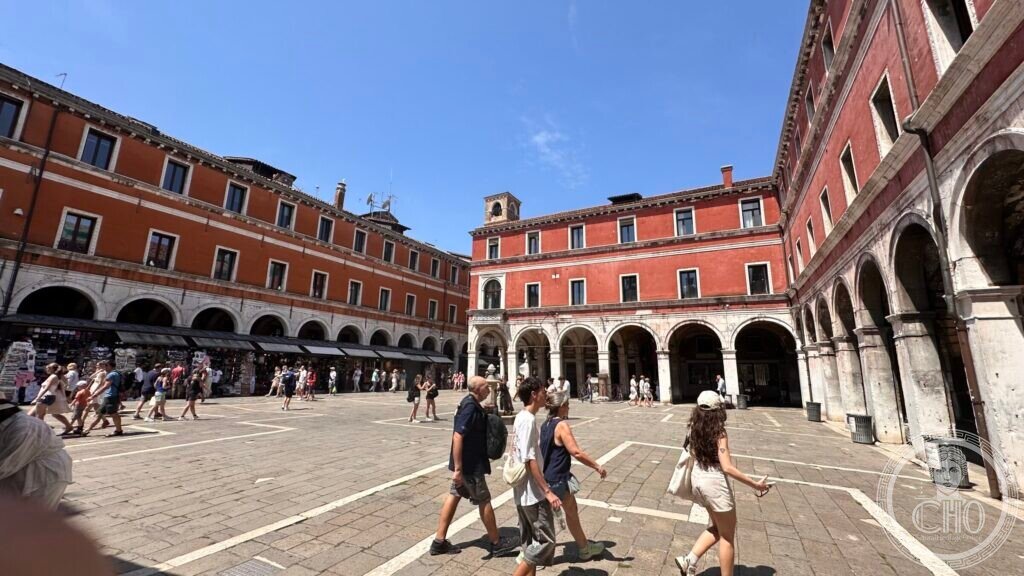
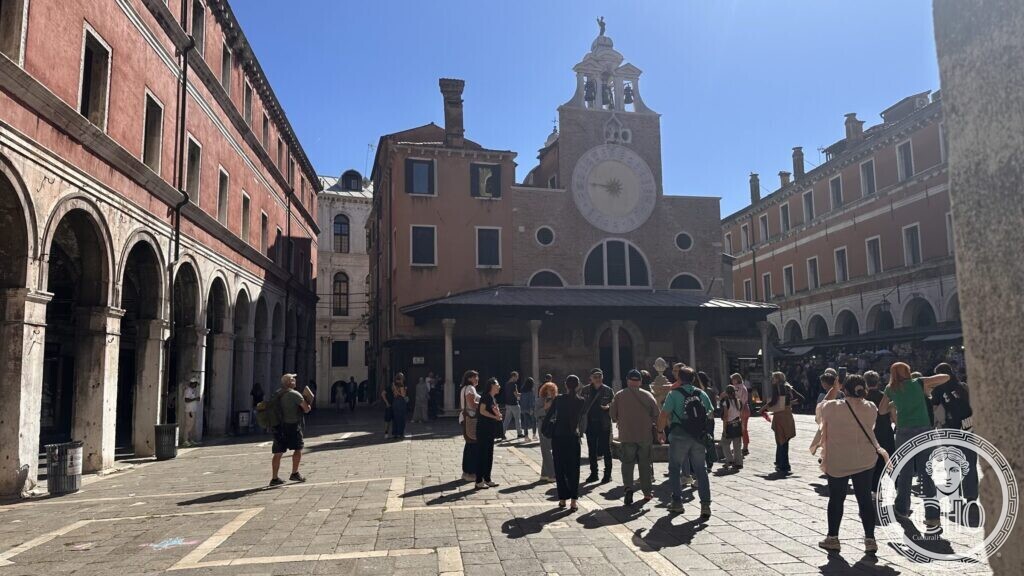
A small square at the foot of the Rialto bridge, ringed by arcades, with the city’s oldest church at one end and, facing it, the stone from which sentences were read aloud.
At a glance
Campo San Giacomo di Rialto — San Giacometo, to Venetians — is where the Republic did business. Bankers worked under the portico, the market began a few steps away, and heralds climbed a stone stair to read out sentences and the names of those banished from the city. The square burned with the rest of Rialto in 1514 and was rebuilt within a decade. Five centuries later the city is still writing rules about what may be sold here.
Key facts
- What it is: market square in the sestiere of San Polo, at the foot of the Rialto bridge
- The church: San Giacomo di Rialto, built between the 11th and 12th centuries and contemporary with the market; tradition dates it to 421, and calls it the oldest church in Venice
- The clock: 1410, on the church front, above a small Gothic porch in stone and wood — the only original example left in Venice
- The fire: 10 January 1514, which destroyed the shops of Rialto
- The rebuilding: Antonio Abbondi, called lo Scarpagnino (born 1465–70, died in Venice on 26 November 1549). His scheme was chosen on 26 August 1514 over that of fra’ Giocondo da Verona, for speed and economy; the work ran to 1523
- The portico: known as the Banco Giro, after the circulating credit bank whose merchants worked beneath it
- The Gobbo di Rialto: a stump of red granite — the same stone as the pietra del bando in Piazza San Marco, brought from Acre in 1291 — with a stone stair beside it
History
Rialto was a market before it was anything else, and the church went up with it: San Giacometo dates from the 11th or 12th century, at the same time as the market around it. The legend that puts it in 421, founded by a carpenter who vowed a church if a fire spared him, is older than the evidence and has outlived it.
On 10 January 1514 a fire destroyed the shops of Rialto. The Republic took eight months to choose how to rebuild: on 26 August the project of Antonio Abbondi, lo Scarpagnino, was preferred to that of fra’ Giocondo da Verona, because it promised to be quicker and cheaper. Work continued until 1523. Abbondi had already been given charge of repairing and strengthening the Rialto bridge in 1511. The church survived the fire, which is why the clock of 1410 and its porch are still there while everything around them is sixteenth-century.
What you see
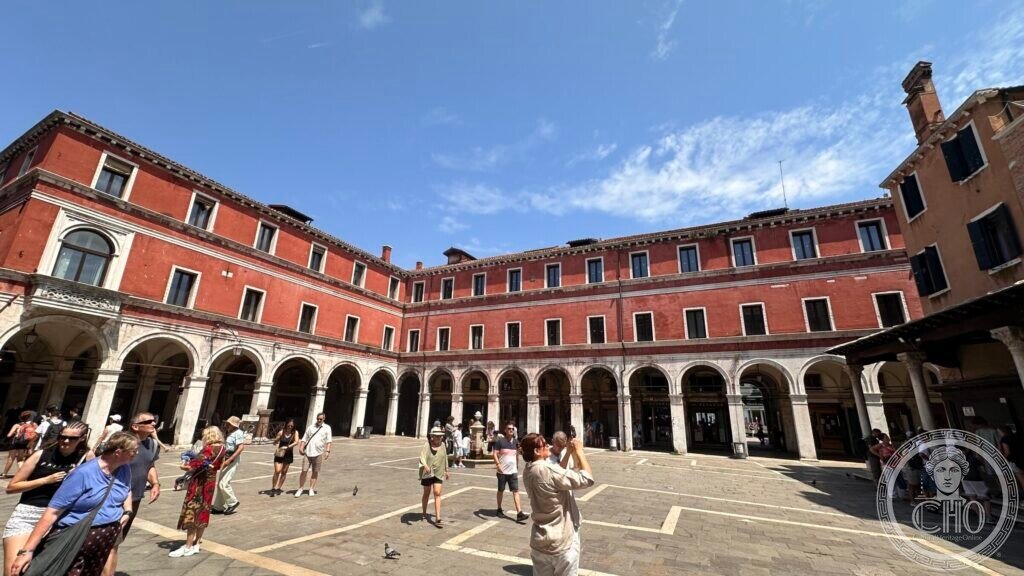
Three sides of the square are arcaded ranges in red plaster over stone, with shops at ground level and offices and storerooms above — the arrangement Abbondi rebuilt after the fire, and the reason the campo reads as a single room rather than a gap between buildings.
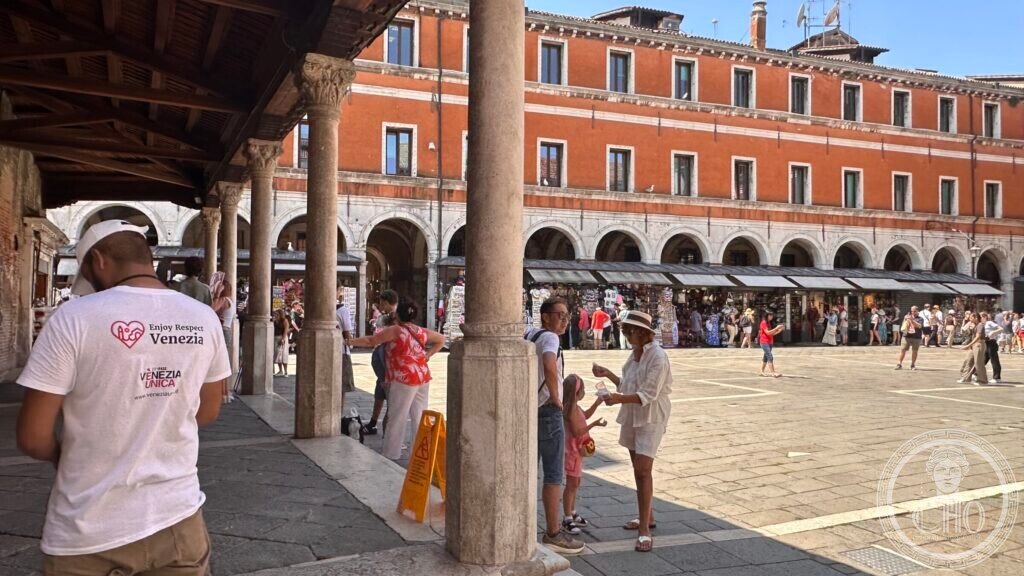
The church closes the fourth side. Its front carries a large clock of 1410 above a small Gothic porch of stone and wood: the last one of its kind in the city, and the detail that dates the building to before everything facing it.
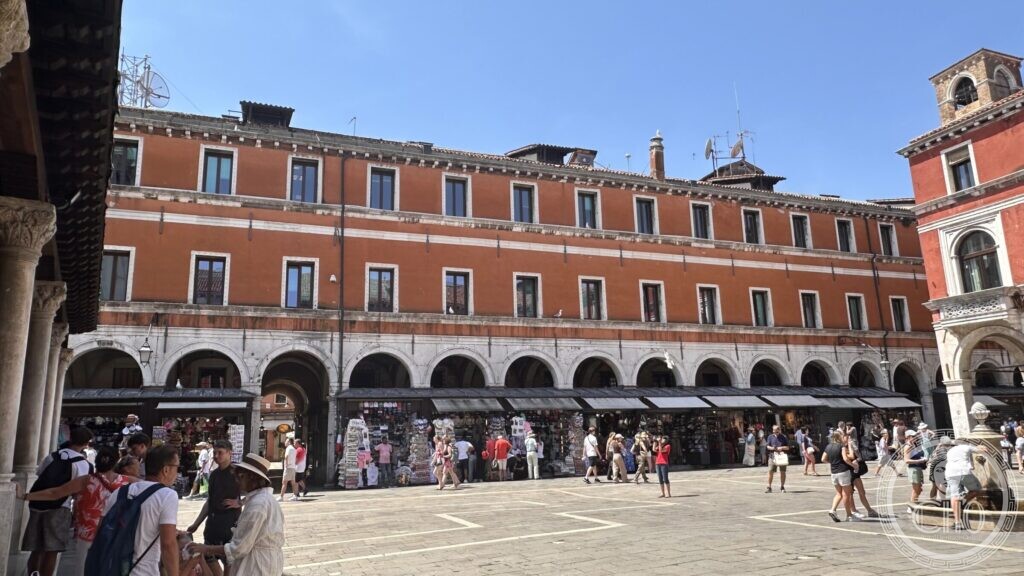
Opposite the church stands the Gobbo di Rialto, a stump of red granite with a stone stair. The granite is the same as the pietra del bando in Piazza San Marco, brought back from Acre in 1291. Heralds climbed the stair to read out sentences and the lists of those banished; the foot of it was also where a condemned thief’s run through the city ended.
Why it matters
This square is where Venice put its money, its market and its public punishments within thirty metres of one another, and it is still the most crowded few hundred square metres in the city. It is also one of the few places in Europe whose commerce is governed by name. Council resolution no. 73 of 5 June 2003 forbids opening or transferring, here and in four other parts of Venice, any business selling seventeen listed categories of goods — among them souvenirs, masks, postcards, carnival costumes, and Venetian glass and lace. A 2018 resolution allows the city to grant exemptions for projects that improve the protected areas. From 2019, and by later extension, the shops facing the Rialto bridge and the surrounding Realtina area — Ponte degli Oresi, Sotoportego dei Oresi, Sotoportego Rialto, this campo, Naranzaria and Erbaria — have had rules of their own.
Practical information
- The campo is public and open at all hours; the market beside it works in the morning
- The church of San Giacomo di Rialto stands on the square and is open to visitors, with its own hours
Getting there
The nearest waterbus stop is Rialto Mercato, on the Grand Canal; Rialto is one bridge away on the San Marco side. On foot the campo is immediately at the western foot of the bridge, through the arcades.
Gallery
Sources
- Comune di Venezia, Una calle, una storia: campo San Giacometo — live.comune.venezia.it
- Treccani, Dizionario Biografico degli Italiani, entry ABBONDI, Antonio detto lo Scarpagnino
- Comune di Venezia, Sportello Unico Commercio, Venezia: quali attività commerciali si possono aprire? (Deliberazione di Consiglio Comunale 73/2003; Deliberazione di Giunta 138/2018; Deliberazioni di Consiglio Comunale 54/2019 e 26/2022)
On the square, and a minute away
- San Giacomo di Rialto — the clock of 1410 and the last Gothic porch in Venice
- The Gobbo di Rialto — the stone Venice read its sentences from
- Sotoportego dei Oresi — the goldsmiths who paid for the ceiling above their own doors
- The monument to Carlo Goldoni — across the bridge, in Campo San Bartolomeo
Photographs by Luigi De Marchi. Editorial text © Cultural Heritage Online, 2026.
Find it on the map
See this place and what’s around it →
📷 Become a Cultural Heritage Online photographer
Share your photos of places: they stay published under your name as the author. The more they're seen, the more you get noticed — and soon a contest will reward the most appreciated photos.
Log in or sign up free to add a photo