
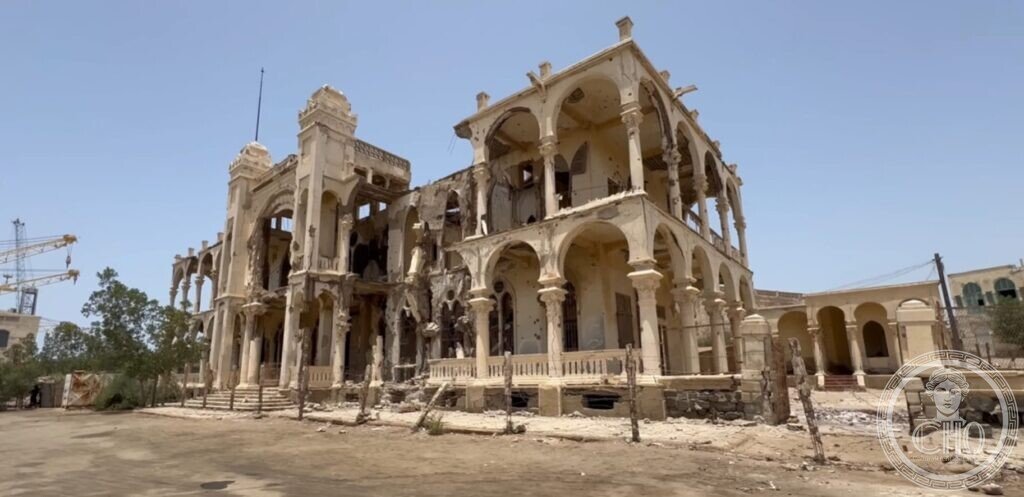
A Moorish-arcaded bank built by Italians on the Red Sea, wrecked by a war of independence, and left standing exactly as the shells left it in 1990.
At a glance
The building stands in the port quarter of Massawa island, the old heart of Eritrea’s Red Sea harbour city. The engineer Giuseppe Canè designed it for the Bank of Italy after the 1921 earthquake, and it opened in 1928; for decades it was one of the largest bank branches in Italian Africa. Since the fighting of February 1990 it has been a roofless shell — two storeys of pointed arcades, corner towers and shrapnel scars — and it has become one of the most photographed ruins of the city. It is not open to visitors; the exterior is fully visible from the street.
Key facts
- Designer: the engineer Giuseppe Canè
- Built: 1925–1928, for the Banca d’Italia; inaugurated in 1928, during the visit of Prince Umberto of Savoy
- Style: Moorish, or Arab-Ottoman — the language chosen for the reconstruction of Massawa after the earthquake of 1921
- Predecessors: Massawa agency opened 15 April 1914; a first purpose-built seat rose on Taulud island in 1916 and was wrecked by the 1921 earthquake
- Later use: seat of the Commercial Bank of Ethiopia from 1952
- Damaged: February 1990, in the fighting of Operation Fenkil during Eritrea’s war of independence; never restored
- Location: port area, Massawa island, Eritrea — 15.6098 N, 39.4752 E
History
The Bank of Italy decided in 1906 to open in the Eritrean colony, and Massawa’s agency began work on 15 April 1914, two months after Asmara’s. In 1916 the bank moved into a purpose-built seat on Taulud, the residential island of the city. It stood for five years: the earthquake that struck Massawa in 1921 destroyed much of the town and damaged the building beyond repair.
The replacement went up between 1925 and 1928 on the harbour island, inside the reconstruction that governor Jacopo Gasparini was directing in a deliberately Arab-Ottoman key — the new public buildings of Massawa were to look like the Red Sea port it was, not like a piece of transplanted Italy. Canè gave the bank two floors of pointed arcades on slender columns, corner towers with crowned finials, and deep loggias against the heat. The Istituto Luce photographed it with tricolour flags on the facade in April 1928, when Prince Umberto came for the inauguration. In the ledgers of the Bank of Italy it counted for decades among the largest branches in Italian Africa, serving the port and its free-deposit trade.
Italian rule ended in 1941; from 1952 the palace housed the Commercial Bank of Ethiopia. In February 1990 the Eritrean People’s Liberation Front took Massawa in Operation Fenkil, and in three days of fighting — ground assault, then Ethiopian air attacks on the fallen port — the building was gutted. Financing for its restoration has been announced more than once since; none has arrived on the walls. It stands today as the war left it.
What you see
The ruin reads from the street as a lace of arches with the sky behind them. The two arcaded storeys survive on their columns, and so do the corner towers with their little domed lanterns; the roof, the floors and most of the rear rooms are gone. Shell and bullet impacts pit every surface. The pale render has worn back to masonry in patches, and shrubs grow from the cornices. What remains legible is exactly what Canè wanted seen: a bank that presented itself to the harbour like a Red Sea palace, with the depth of its loggias doing the work that air conditioning would do elsewhere.
Cultural significance
Massawa keeps one of the most complete Italian colonial ensembles in Africa, and this is its emblem: a building that compresses the whole arc — colonial banking, earthquake, reconstruction in borrowed local dress, Ethiopian federation, and the war that made Eritrea independent — into one facade. Unlike Asmara, whose modernist centre earned a UNESCO listing and careful attention, Massawa’s architecture still waits in suspension, and the bank has become the shorthand image of that wait. Whether it should be restored, stabilised as a ruin, or left as a war memorial is a question Eritrea has not yet had the means to answer.
Practical information
- The building is a ruin: there is no interior access, and the structure should not be entered.
- The exterior can be seen at any time from the surrounding streets of the port quarter.
- Photography is straightforward; light is best early, before the Red Sea glare flattens the arcades.
Getting there
Massawa is about 115 km from Asmara by the mountain road that drops from 2,300 metres to the sea. The building stands in the port quarter of Massawa island, reached by the causeways that link the mainland, Taulud and the harbour island.
Sources
Find it on the map
See this place and what’s around it →Record researched and written by Luigi De Marchi for Cultural Heritage Online, 2026.
📷 Become a Cultural Heritage Online photographer
Share your photos of places: they stay published under your name as the author. The more they're seen, the more you get noticed — and soon a contest will reward the most appreciated photos.
Log in or sign up free to add a photoIs this page about you?
This page is read by travellers and heritage enthusiasts who find it on Google. Tell us how you are connected to this place and we will take it from there.