
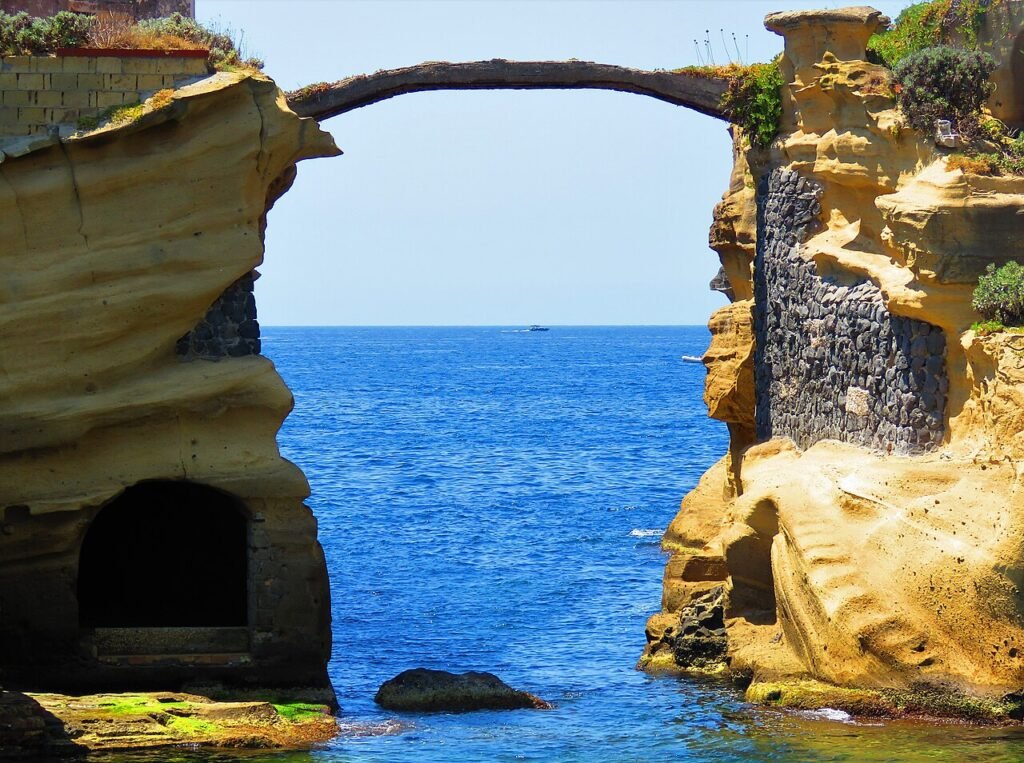
Two rocks a stone’s throw from Posillipo, joined by a narrow arch, with a Roman emperor’s pleasure grounds under the water and a reputation Naples has never quite forgiven them.
At a glance
The Gaiola is the smallest of Naples’ islands: two islets a few metres off the Posillipo shore, at the centre of the Parco Sommerso di Gaiola, the marine protected area established in 2002. Around and beneath them lie the drowned edges of Pausilypon, the villa that Publius Vedius Pollio built in the first century BC and left to Augustus — quays, fishponds and nymphaea now sitting below the waterline because of bradyseism, the slow volcanic rise and fall of this coast. On the larger islet stands a single abandoned villa, the source of the island’s other reputation: Neapolitans call it l’isola maledetta, the cursed island.
Key facts
- Setting: two islets off Posillipo, north-western Gulf of Naples, a few metres from the shore
- Ancient remains: part of the Pausilypon complex of Publius Vedius Pollio (d. 15 BC), later an imperial villa; submerged structures visible through the water
- Protection: Parco Sommerso di Gaiola, marine protected area established by interministerial decree on 7 August 2002; 41.6 hectares from Marechiaro to the Trentaremi bay; EU Natura 2000 site IT8030041
- Managed by: Centro Studi Interdisciplinari Gaiola onlus, with a research and outreach centre (CeRD) on the shore
- The villa: built after 1874 by Luigi de Negri; owned in the twentieth century by, among others, Norman Douglas, Maurice Sandoz, Gianni Agnelli and J. Paul Getty; empty for decades; the island now belongs to the Regione Campania
- Access: the islets themselves are in the integral reserve zone and are not visited; the park is experienced from the Gaiola beach and coastline, with numbers limited in summer
- Location: 40.7917 N, 14.1869 E
History
This was the seaward edge of Pausilypon — «the place where sorrow ends» — the estate of Publius Vedius Pollio, the freedman’s son who became one of Augustus’ men and one of Rome’s bywords for luxury. At his death in 15 BC the villa passed to the emperor, and the whole headland kept the name; it survives in «Posillipo». What the sea did not take of the villa’s landing places and fishponds can still be made out under the surface, and it is this fusion of archaeology, volcanology and marine life that the 2002 decree was written to protect.
The islets themselves carried a gun battery in the nineteenth century, and an hermit nicknamed lo Stregone — the Wizard — lived on them in the early 1800s on the charity of fishermen. In 1874 Luigi de Negri bought the larger rock and built the villa that still crowns it; the writer Norman Douglas, author of Siren Land, owned it for a time; a cableway briefly linked the island to the shore in the 1920s.
Then came the run of misfortunes that made the island’s name. Between the 1920s and the 1970s the villa’s owners included the Swiss Hans Braun, found dead in the house, his wife drowning soon after; Otto Grunback, who died of a heart attack there; the pharmaceutical heir Maurice Sandoz, who died by suicide; the steel baron Paul Karl Langheim, ruined; Gianni Agnelli, in the years his family was struck by deaths; J. Paul Getty, whose grandson was kidnapped; and the insurer Gianpasquale Grappone, bankrupted in 1978. Local newspapers have kept the tally ever since, and Naples reads the list as proof of the maledizione della Gaiola. We report it as what it is — a legend built on real griefs — and note that the island has since passed to the Regione Campania and to quieter work: since 2009 the villa’s shore-side dependance has housed the park’s research and outreach centre.
What you see
From the little Gaiola beach the two rocks sit so close they seem touchable: yellow tuff carved by the sea into overhangs and windows, black volcanic stone patching the base, and the slender arch of the footbridge stretched between the islets like a drawn line. On the larger rock the abandoned villa stands white against the water, shutters gone. Look down instead of up and the other monument appears — walls and cut channels of the Roman landing places, a metre or two under a sea that is unusually clear for a city shore.
Cultural significance
The Gaiola condenses what makes the Posillipo coast singular: a Roman imperial pleasure-landscape read through water, a nineteenth-century folly, a modern legend, and a working nature reserve, all within swimming distance of a metropolis. The protected area is small — 41.6 hectares — but it is one of only two parchi sommersi in Italy, and its research centre has turned an island famous for bad luck into a place children visit with snorkels to count sea urchins over an emperor’s fishponds.
Practical information
- The islets are in the integral reserve zone: landing and swimming around them are not permitted.
- The Gaiola beach and the surrounding park are open to the public; in summer access is limited and managed by the park body — check the official site for current booking rules.
- The CeRD visitor and research centre organises guided snorkelling, kayak and glass-bottom boat visits over the submerged remains.
- Nearest entry: discesa Gaiola, at the end of via Tito Lucrezio Caro, Posillipo.
Getting there
From central Naples, bus or taxi to Posillipo and then the discesa Gaiola on foot; the last stretch is a stepped lane down to the beach. The Pausilypon archaeological park above, entered through the 770-metre Grotta di Seiano tunnel from Coroglio, makes the natural companion visit.
Sources
- Area Marina Protetta Parco Sommerso di Gaiola — official site (decree of 7 August 2002, extent, Pausilypon, managing body)
- Ministero dell’Ambiente e della Sicurezza Energetica — Parco Sommerso di Gaiola
- NapoliToday — «La maledizione della Gaiola» (the legend and the owners’ chronicle)
- Sergio Zazzera, Le isole di Napoli, Rome 1997; «La maledizione della Gaiola», Il Mattino, 19 May 2002
Find it on the map
See this place and what’s around it →Record researched and written by Luigi De Marchi for Cultural Heritage Online, 2026.
_01.jpg)
📷 Become a Cultural Heritage Online photographer
Share your photos of places: they stay published under your name as the author. The more they're seen, the more you get noticed — and soon a contest will reward the most appreciated photos.
Log in or sign up free to add a photo