
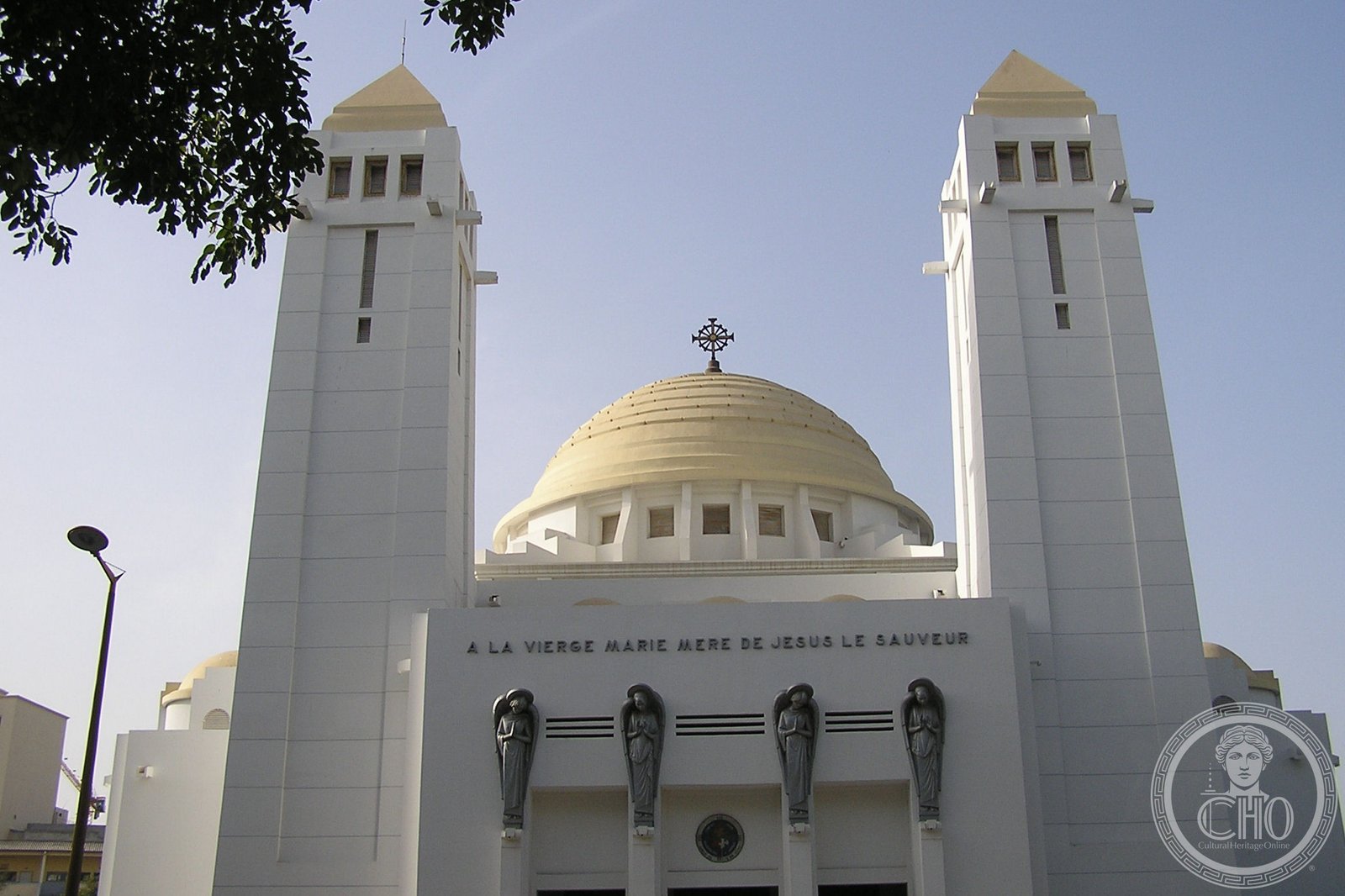
Rising above the Atlantic shoreline of Dakar with twin towers that function as landmarks for ships approaching the harbour, the Our Lady of Victories Cathedral is one of the most architecturally significant Catholic churches in West Africa. Completed in 1929 during the French colonial era, the building blends Art Deco simplicity with Romanesque elements, producing a monumentally austere facade that contrasts with the animated urban life of the Plateau neighbourhood below. The cathedral is the seat of the Archdiocese of Dakar and has remained an active centre of Catholic worship and community life through Senegalese independence in 1960 and into the present. For architectural historians and travellers interested in colonial-era religious heritage, the cathedral represents a rare and well-preserved example of French West African ecclesiastical ambition translated into the idiom of early twentieth-century modernism.
At a glance
- Type
- Roman Catholic cathedral
- Period
- Completed 1929
- Style
- Art Deco / Romanesque Revival
- Location
- Plateau, Dakar, Senegal
- Coordinates
- 14.6653° N, 17.4378° W
- Architect(s)
- French colonial architects (name unrecorded)
Overview
The Our Lady of Victories Cathedral, known in French as Cathédrale Notre Dame des Victoires, stands as the mother church of the Archdiocese of Dakar, the largest Catholic diocese in Senegal. Situated on the Plateau — the historical administrative heart of colonial Dakar — the building commands a prominent position between the ocean and the city centre. Its twin bell towers, rising to approximately 45 metres, serve as navigational landmarks visible from the sea. The cathedral is open to worshippers and visitors daily, and it continues to host major religious celebrations attended by large congregations from the diverse Catholic community of Dakar.
History
The construction of a major Catholic cathedral in Dakar was part of the broader project of French colonial urbanism in West Africa. The current building was completed in 1929, replacing an earlier church on the Plateau. Its completion coincided with the consolidation of Dakar as the capital of French West Africa, a vast federation of territories stretching from Senegal to present-day Mali and beyond. After Senegalese independence in 1960, the Catholic Church maintained its presence and the cathedral retained its role as the seat of a local archbishop. Despite being a minority faith in a predominantly Muslim country, the cathedral has coexisted peacefully with Dakar’s grand mosques, reflecting Senegal’s celebrated tradition of religious tolerance.
Architecture & Design
The cathedral presents a restrained Art Deco facade with Romanesque Revival undertones — a combination typical of French colonial religious architecture of the late 1920s. The twin towers frame a broad central nave entrance with semicircular arches and minimal decorative surface ornament, a deliberate choice that contrasts with the exuberant Gothic cathedrals of metropolitan France. The interior is cool and luminous, with a barrel-vaulted nave, simple pilasters, and stained glass windows that filter the intense West African light. The building’s pale masonry absorbs the coastal heat, and its orientation takes advantage of Atlantic breezes. The Deco influence is most visible in the simplified geometric mouldings at the tower cornices and the elongated vertical proportions of the facade.
Cultural significance
As one of the earliest Art Deco religious buildings in sub-Saharan Africa, the Cathedral of Dakar occupies a unique position in the history of colonial-era architecture on the continent. It stands as a tangible reminder of the French mission civilisatrice and its built legacy — a legacy that Senegal has chosen to preserve rather than erase. The cathedral also carries deep significance for the local Catholic community, estimated at around five percent of Senegal’s population, providing a spiritual anchor in an overwhelmingly Sufi Muslim city. Its silhouette has become an icon of Dakar’s skyline, appearing in postcards, films, and literature set in the city.
Visiting today
The cathedral is open daily for prayer and visiting, typically from early morning until late afternoon. Visitors are welcome to enter outside of Mass times. Dress modestly — covered shoulders and knees are respectful. There is no admission charge. Photography is generally permitted in exterior and interior spaces. The cathedral is located in the Plateau neighbourhood, a walkable area with several other colonial-era buildings, restaurants, and the Dakar waterfront nearby.
Getting there
The cathedral is centrally located in the Plateau district of Dakar. From central Dakar, the Plateau is served by local bus routes (Dakar Dem Dikk) and taxis, which are the most convenient option for visitors. The Place de l’Indépendance and the main government district are within easy walking distance. Dakar–Yoff–Léopold Sédar Senghor International Airport is approximately 15 km away; taxis are the standard transfer option.
Sources & resources
Find it on the map
See this place and what’s around it →Record researched and written by Luigi De Marchi for Cultural Heritage Online, 2026.
📷 Become a Cultural Heritage Online photographer
Share your photos of places: they stay published under your name as the author. The more they're seen, the more you get noticed — and soon a contest will reward the most appreciated photos.
Log in or sign up free to add a photoIs this page about you?
This page is read by travellers and heritage enthusiasts who find it on Google. Tell us how you are connected to this place and we will take it from there.