
_-_Otto-Wagner-Villa,_H%C3%BCttelbergstra%C3%9Fe_26_(1).JPG)
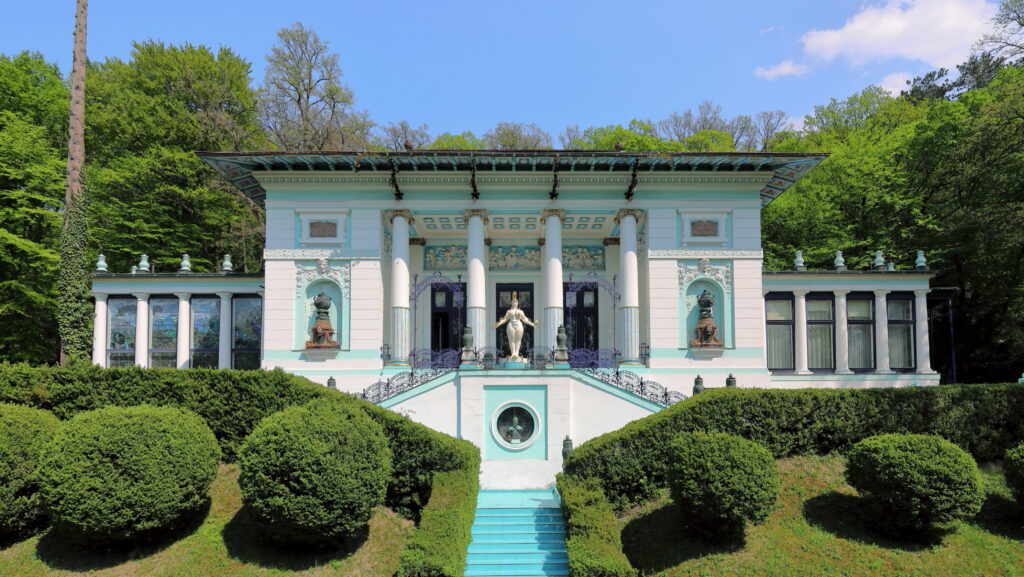
Wagner built himself a Palladian summer palace in 1888. Twelve years later he tore the inside out of one wing and rebuilt it as Jugendstil, in the same house, for himself.
At a glance
Otto Wagner built this villa between 1886 and 1888 on Hüttelbergstraße in the Penzing district, at the western edge of Vienna, as a summer house for himself and his wife Louise. It is a white classical villa in the Palladian manner, with a colonnade and flanking wings, surrounded by woodland. In 1900 Wagner converted the left wing into a Jugendstil hall, with Tiffany glass designed by Adolf Böhm. Until 1911 the house served chiefly for entertaining, and Viennese society came to its summer balls. The painter Ernst Fuchs (1930–2015) bought it in 1972 and reopened it as his own museum in 1988, the villa’s centenary.
Key facts
- Built: 1886–1888
- Architect: Otto Wagner, for himself and his wife Louise
- Style: a summer palais in the Roman villa manner, with Palladio as the acknowledged model
- Altered: 1900, when Wagner made the left wing a Jugendstil hall
- Glass: Tiffany windows designed by Adolf Böhm
- Sold: to Ben Tiber, owner of Viennese theatres including the Ronacher
- Bought by Ernst Fuchs: 1972; opened as his museum in 1988
- GPS: 48.209887, 16.255926 — View on Google Maps
History
In 1886 Otto Wagner was still the establishment architect of imperial Vienna, decades before the manifesto of Moderne Architektur and the Postsparkasse. The villa he built for himself is the work of that earlier man: symmetrical, colonnaded, unembarrassedly classical, sited in the Vienna Woods as a summer retreat from the city he was about to reshape.
The 1900 alteration is why the house matters. By then Wagner had committed publicly to the new architecture, and rather than build fresh he went back into his own villa and rebuilt the left wing as a Jugendstil interior, with Adolf Böhm’s Tiffany glass. Very few buildings let you see an architect’s change of mind inside a single structure, addressed to himself as client.
Wagner sold the house to Ben Tiber, a Viennese theatre owner. In 1972 the painter Ernst Fuchs, a founder of the Vienna School of Fantastic Realism, bought it, restored it and added his own work; the museum opened in 1988, a hundred years after Wagner finished building. Fuchs died in 2015 and the museum continues.
What you see
A white block raised on a terrace, with a recessed colonnade at the centre and lower wings to either side, set against trees. The classical grammar is correct and the proportions are careful; if you did not know who built it you would date it to the 1880s and move on.
Then the left wing corrects you. Inside, the Jugendstil hall belongs to 1900 and to a different architectural argument entirely, and Böhm’s Tiffany glass is the best thing in the house. Fuchs’s own interventions are a third layer, unmistakably of the 1970s, and the museum does not hide them. Three periods, one address, all of them deliberate.
Practical information
- A private museum with limited opening — check days and times before travelling
- The Jugendstil hall and the Tiffany glass are the reason to go inside
- Wagner’s Villa II, built next door in 1912 in his late manner, is private and can be seen only from outside
Getting there
Hüttelbergstraße is in Penzing, the 14th district, at the western edge of Vienna. Hütteldorf station, on the U4 underground and the suburban rail, is about fifteen minutes on foot, partly uphill.
Nearby
- Hotel Paříž — Secession and revivalism arguing in one Prague building
- Museum Wiesbaden — Theodor Fischer, the same generation in Germany
Sources
- Ernst Fuchs Museum, own pages on the Otto Wagner Villa — the construction between 1886 and 1888, Wagner and Louise, the Palladian model, the 1900 Jugendstil hall and Adolf Böhm’s Tiffany glass, the use for entertaining until 1911, the sale to Ben Tiber, the purchase by Ernst Fuchs in 1972 and the opening of the museum in 1988
- wien.info, the official Vienna tourist board — the museum and access
- OpenStreetMap Nominatim — coordinates verified against Hüttelbergstraße 26
Find it on the map
See this place and what’s around it →📷 Become a Cultural Heritage Online photographer
Share your photos of places: they stay published under your name as the author. The more they're seen, the more you get noticed — and soon a contest will reward the most appreciated photos.
Log in or sign up free to add a photoIs this page about you?
This page is read by travellers and heritage enthusiasts who find it on Google. Tell us how you are connected to this place and we will take it from there.