
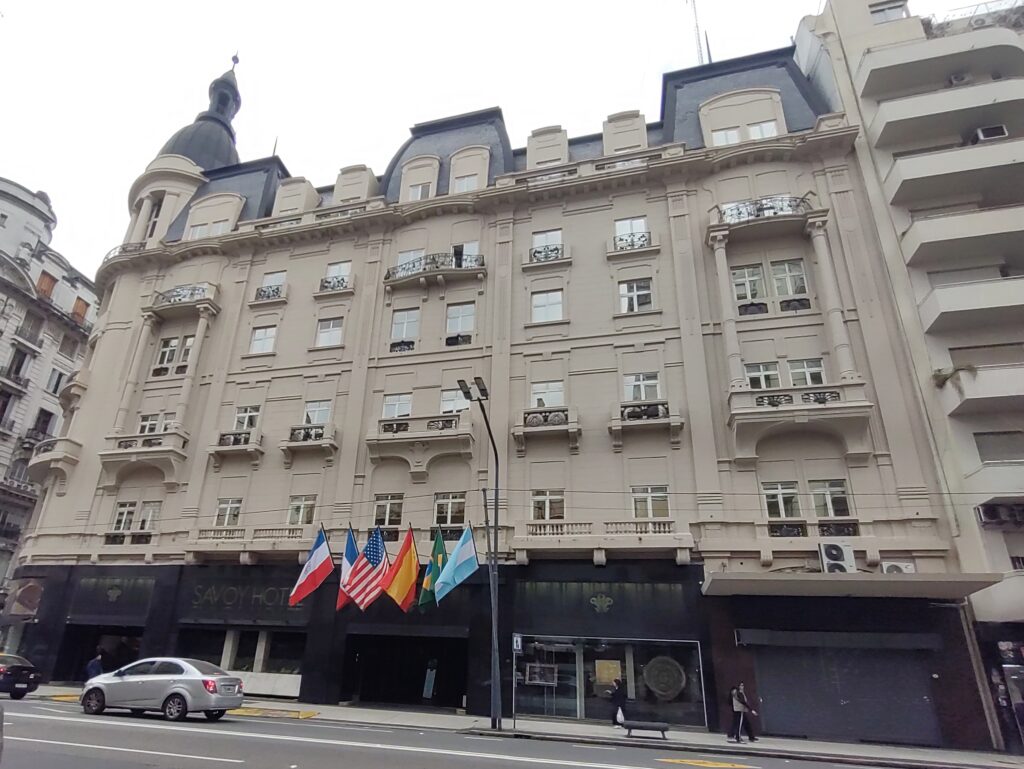

Buenos Aires opened five grand hotels for the centenary of 1910. This is the one that dressed its rooms in Viennese Secession and put a dome on the corner.
At a glance
The Savoy stands at Avenida Callao 181, in the San Nicolás district of central Buenos Aires. It opened in 1910, in the run-up to the centenary of the May Revolution, when the Palace, Plaza, Majestic, Paris and Savoy hotels all opened within a short span. The Italian architect Gerónimo Agostini built five storeys in an eclectic manner with a strong debt to Milanese Liberty, and, because the site is a corner, tied the two facades together with a dome set among the mansards. The interiors were done in a modernism that looks openly to the Viennese Secession.
Key facts
- Opened: 1910
- Architect: Gerónimo Agostini
- Storeys: five, on a corner site
- Style: eclectic, with strong influence from Milanese Liberty; interiors with clear reference to the Viennese Secession
- Corner treatment: a dome linking the Callao and Cangallo fronts, set among mansards
- Context: one of five grand hotels opened for the 1910 centenary of the May Revolution
- Address: Avenida Callao 181, Buenos Aires
- GPS: -34.607061, -58.391958 — View on Google Maps
History
The centenary of 1910 was the moment Buenos Aires presented itself to the world as a European capital in the southern hemisphere, and its hotels were part of the argument. Five opened close together, all of them designed to receive visitors who would be comparing the city with Paris, Madrid and Rome.
Agostini was Italian, and what he built shows it. Milanese Liberty — the Italian branch of Art Nouveau — was at its height in the years he trained, and the Savoy carries its decorative language onto a Buenos Aires corner. The eclecticism is not a compromise: it was the international grammar of the grand hotel, and using it was a statement about where the city belonged.
The interiors went a different way, towards the Viennese Secession, which is a more advanced reference for 1910 and suggests a client and architect paying attention to Europe in real time rather than at a decade’s remove. The hotel has traded continuously since, on an avenue that was the centre of the city in its heyday.
What you see
Five storeys of eclectic facade with the ornament concentrated at the openings and the cornice, then the corner: a dome raised above the roofline, with mansards running away on both sides. The corner dome was the standard Buenos Aires answer to a street intersection in these years, and the Savoy’s is one of the better ones because it is proportioned to the building rather than added on top of it.
Look for the Liberty detail in the window surrounds and the ironwork, where the Milanese training shows most clearly. Inside, the Secession reference is in the geometry rather than the floral line — a different, cooler taste than the facade leads you to expect.
Practical information
- A working hotel; the facade and the dome are freely visible from Avenida Callao
- Central, on a broad avenue — the corner is best photographed from the far pavement
- The other centenary hotels are within walking distance and make a coherent half-day
Getting there
Avenida Callao 181 is in San Nicolás, a few blocks from the Obelisco and Avenida Corrientes. Callao stations on the B and D subway lines are within two minutes on foot.
Nearby
- Broadway Theatre — on Avenida Corrientes, a few blocks away
- Buenos Aires Botanical Garden — in Palermo, the other side of the centenary city
Sources
- Savoy Hotel, own history pages — the opening in 1910, Gerónimo Agostini, the five storeys and the eclectic manner with Milanese Liberty influence, the corner dome linking the Callao and Cangallo fronts, the Secession interiors, and the five centenary hotels
- Wikimedia Commons file description for the facade photograph — architect and date, cross-checked against the hotel’s own account
- OpenStreetMap Nominatim — coordinates verified against Avenida Callao 181
Find it on the map
See this place and what’s around it →📷 Become a Cultural Heritage Online photographer
Share your photos of places: they stay published under your name as the author. The more they're seen, the more you get noticed — and soon a contest will reward the most appreciated photos.
Log in or sign up free to add a photoIs this page about you?
This page is read by travellers and heritage enthusiasts who find it on Google. Tell us how you are connected to this place and we will take it from there.