
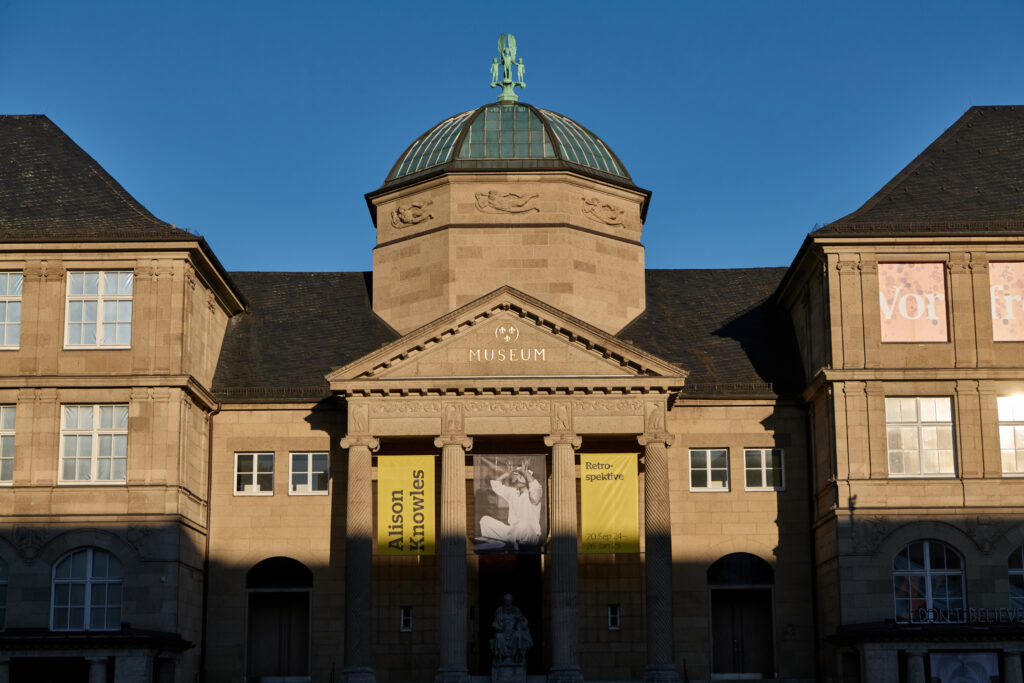

Three collections, one building, and an architect who solved the problem by designing for change — in 1913, before anyone had a word for it.
At a glance
The Museum Wiesbaden occupies a building put up between 1913 and 1915 to plans by Theodor Fischer, one of the most influential German architects of his generation and the teacher of a good part of the next. It was built to house three separate holdings at once: the collection of the Association for Nassau Antiquities and Historical Research, a natural science collection and a picture gallery. Fischer gave it two wing buildings flanking a recessed entrance formed as a columned portico, and made room for temporary exhibitions from the start. The picture gallery opened first, on 1 October 1915. Today it is one of the three Hessian state museums.
Key facts
- Built: 1913–1915
- Architect: Theodor Fischer
- Built for: three collections — Nassau antiquities, natural sciences and a picture gallery
- Plan: two wings flanking a recessed entrance formed as a columned portico
- Picture gallery opened: 1 October 1915
- Natural sciences and Nassau antiquities reopened: 15 July 1920
- Status: Landesmuseum, one of the three Hessian state museums
- GPS: 50.077479, 8.246241 — View on Google Maps
History
Wiesbaden’s three museum collections passed into municipal ownership in 1900, and the problem that followed was where to put them. The answer, commissioned a decade later, was a single building designed from the outset to serve three institutions with different needs — pictures, natural history specimens and antiquities all want different light, different floor loads and different room shapes.
Theodor Fischer is the reason it worked. He was the leading German museum and civic architect of the years before the First World War, a founder of the Deutscher Werkbund and the teacher of Bruno Taut, Erich Mendelsohn and Hugo Häring among others. The plan he produced was modern in the practical sense: flexible, planned for changing exhibitions, and unsentimental about how the departments were fitted together.
The war intervened. The picture gallery opened on 1 October 1915, and the natural sciences collection moved in the same year, but the natural history museum and the museum of Nassau antiquities did not reopen to the public until 15 July 1920. The building now holds the art and natural history collections as a Hessian state museum.
What you see
A long, symmetrical front in pale stone, quiet to the point of severity, with the entrance set back between two projecting wings and marked by a columned portico. There is very little ornament. Fischer belongs to the moment when German public architecture was stripping classical form back to its proportions, and this facade is a clear example of that reduction.
The interest is in the section rather than the elevation. Look at how the roof lights are arranged over the picture galleries and how the wings differ from each other: the building is three museums wearing one coat, and Fischer did not pretend otherwise.
Practical information
- State museum with regular opening; closed Mondays in the usual German pattern — check before travelling
- Art and natural history are both on show; the Jugendstil holdings are a particular strength
- Allow half a day, more if a temporary exhibition is running
Getting there
The museum stands on Friedrich-Ebert-Allee in central Wiesbaden, about ten minutes on foot from the main station. Wiesbaden is half an hour by train from Frankfurt and from Mainz.
Nearby
- Glessner House — the stripped, material-led manner in Chicago a generation earlier
- Hotel Paříž — central European building of the same decade, taking the opposite view of ornament
Sources
- Museum Wiesbaden, own history pages — the 1913–1915 building by Theodor Fischer, the three collections, the portico and wings, the opening of the picture gallery on 1 October 1915 and the reopening of 15 July 1920
- Wikipedia, « Museum Wiesbaden » — the municipal transfer of 1900 and the museum’s present status
- OpenStreetMap Nominatim — coordinates verified against Friedrich-Ebert-Allee
Find it on the map
See this place and what’s around it →📷 Become a Cultural Heritage Online photographer
Share your photos of places: they stay published under your name as the author. The more they're seen, the more you get noticed — and soon a contest will reward the most appreciated photos.
Log in or sign up free to add a photoIs this page about you?
This page is read by travellers and heritage enthusiasts who find it on Google. Tell us how you are connected to this place and we will take it from there.