
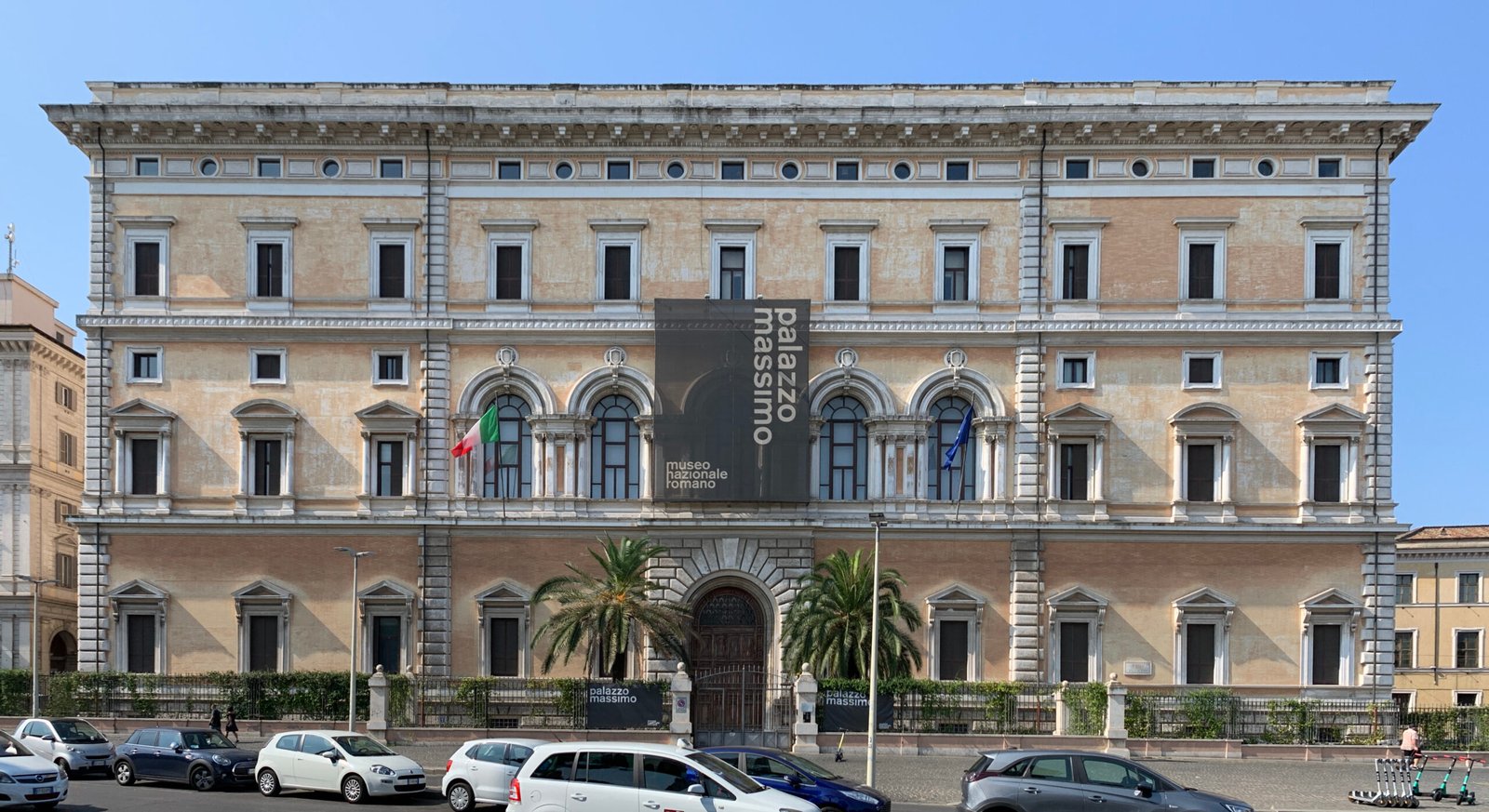
One museum in four buildings, founded in 1889 to hold what the new capital was digging up. Its main seat is a Jesuit college of the 1880s that now keeps the Boxer at Rest and the painted garden of Livia’s villa.
At a glance
The Museo Nazionale Romano is not one building but four. Palazzo Massimo alle Terme, beside Termini station, holds the main collection of ancient sculpture, painting, mosaic and coins. Palazzo Altemps, near Piazza Navona, shows the great Renaissance collections of antiquities. The Crypta Balbi, in the Campus Martius, presents an excavated city block from antiquity to the Middle Ages. The Baths of Diocletian, the museum’s original seat, keep the epigraphic and protohistoric sections around Michelangelo’s cloister. This page follows Palazzo Massimo, where the temporary exhibitions are held.
Key facts
- Address (Palazzo Massimo): Largo di Villa Peretti 2, 00185 Roma
- Coordinates: 41.9012951, 12.4986590
- Museum founded: 1889, opened 1890
- Palazzo Massimo: built 1883–1887 by Camillo Pistrucci; acquired by the State in 1981; restored 1983–1998
- Other seats: Palazzo Altemps (museum since 1997), Crypta Balbi (2001), Baths of Diocletian
- Website: museonazionaleromano.beniculturali.it
History
The museum was founded in 1889 and opened in 1890 to collect and display the archaeological material that was coming out of the ground as Rome was rebuilt as the capital of the Kingdom of Italy. Its first nucleus was the Kircherian Museum, the antiquarian collection assembled by the Jesuit Athanasius Kircher and taken over by the State in 1874 after the suppression of the Society of Jesus. In 1901 the State added the Ludovisi collection and the national collection of ancient sculpture; a decree of 1913 divided the Kircherian holdings among the new museums of the capital. The seat was the sixteenth-century charterhouse that Michelangelo had laid out inside the Baths of Diocletian, converted into exhibition space from the International Exhibition of 1911 and completed in the 1930s.
Palazzo Massimo has a different story. It stands on the site of the Villa Montalto-Peretti of Pope Sixtus V and was commissioned by Prince Massimiliano Massimo as a new home for the Jesuit Roman College, evicted from its convent in 1871. Camillo Pistrucci built it between 1883 and 1887 in the Neo-Renaissance manner, and it remained one of the most prestigious schools in Rome until 1960, serving in part as a military hospital during the Second World War. Left in disrepair, it was bought by the State in 1981 for 19 billion lire and given to the museum; restoration and adaptation ran from 1983 to 1998, when it became the main seat of the collection.
What you see
On the ground floor of Palazzo Massimo are the bronzes that most visitors come for, the Boxer at Rest and the Hellenistic Prince, and the sculpture of the late Republic and early Empire: the Tivoli General, the Tiber Apollo, the Via Labicana Augustus, the Sleeping Hermaphroditus, the Portonaccio sarcophagus. One room holds the mummy found on the Via Cassia in 1964 with its amber and jewellery.
The second floor is painting: the frescoes, stuccoes and mosaics from Roman villas, above all the summer dining room of Livia’s villa at Prima Porta, discovered in 1863, whose walls of the first century BC open onto a continuous painted garden of fruit trees and birds. The basement keeps the largest coin collection in Italy, from Theodoric’s medallion to the papal piastres with views of Rome. The other seats reward a second day: the Ludovisi Throne and the Suicide of a Gaul at Palazzo Altemps, the excavation of the Theatre of Balbus at the Crypta Balbi, and the cloister, the colossal animal heads and more than ten thousand inscriptions at the Baths of Diocletian.
Practical information
- Opening hours, tickets and the current exhibition programme are published on the official website; a combined ticket covers the four seats.
- Palazzo Massimo alone needs at least two hours; the Baths of Diocletian are across the square.
- Temporary exhibitions at Palazzo Massimo are listed below when we have a page for them.
Getting there
Palazzo Massimo faces Piazza dei Cinquecento, a two-minute walk from Termini station (metro lines A and B, all regional and high-speed trains, airport trains from Fiumicino). The Baths of Diocletian are on the same square; Palazzo Altemps and the Crypta Balbi are a twenty-minute walk or a short bus ride into the historic centre.
Nearby
Sources
- Museo Nazionale Romano, official website: museonazionaleromano.beniculturali.it
- Wikipedia (en): Museo Nazionale Romano
- Coordinates verified on OpenStreetMap (Nominatim).
Find it on the map
See this place and what’s around it →Historical events at this place (1)
📷 Become a Cultural Heritage Online photographer
Share your photos of places: they stay published under your name as the author. The more they're seen, the more you get noticed — and soon a contest will reward the most appreciated photos.
Log in or sign up free to add a photoIs this page about you?
This page is read by travellers and heritage enthusiasts who find it on Google. Tell us how you are connected to this place and we will take it from there.