
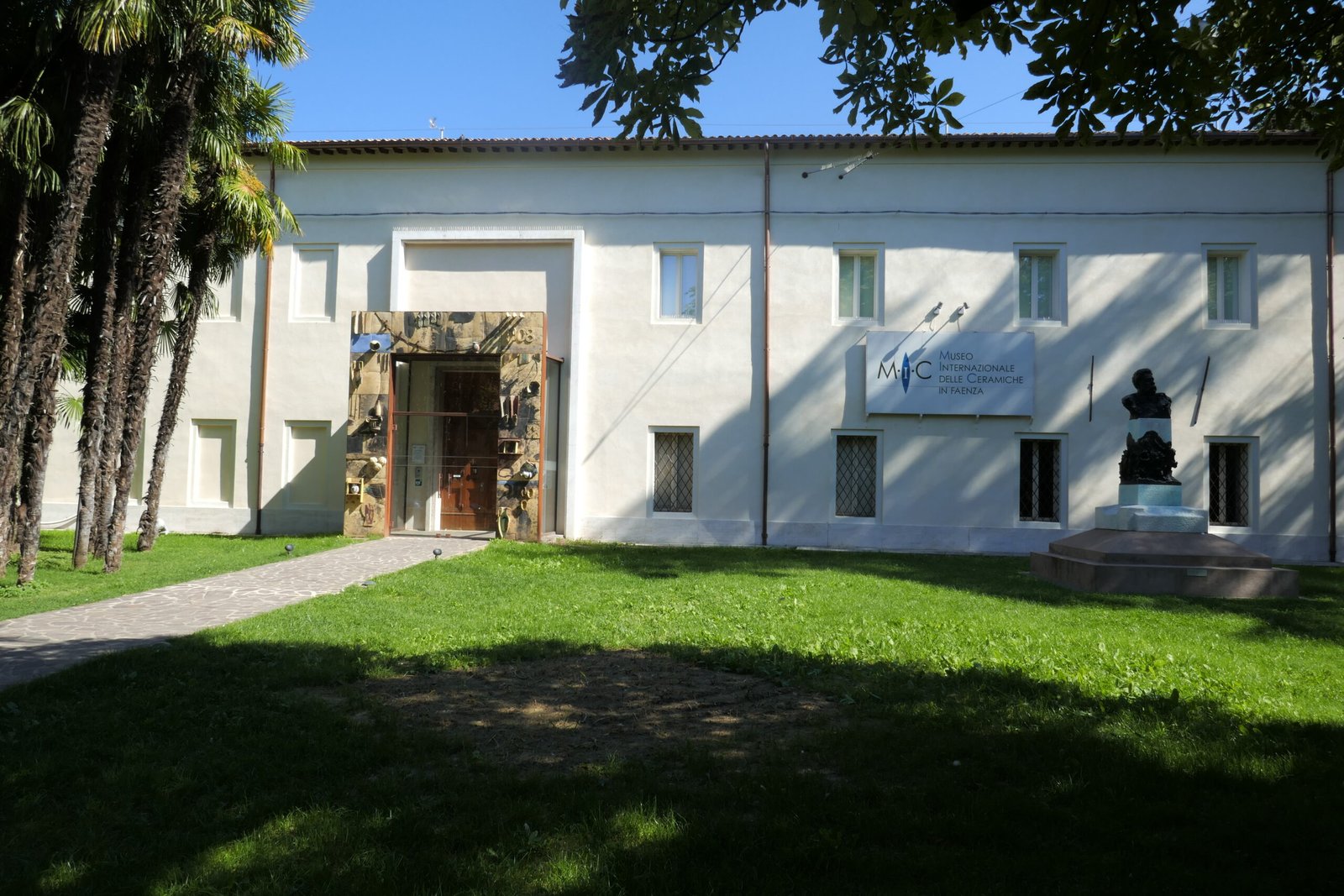
A museum born from a 1908 exhibition, bombed in 1944 and rebuilt with gifts from Picasso and Chagall, in the town whose fame in maiolica gave English and French the word faience.
At a glance
The Museo Internazionale delle Ceramiche occupies the former convent of San Maglorio and the modern wings added around it in the 1990s, more than 16,000 square metres of galleries in all. The collection runs from the fourth millennium BC to the present: Italian maiolica from the Middle Ages to the nineteenth century, the ancient Near East, Greek, Etruscan and Roman pottery, Islamic and pre-Columbian wares, the Far East, and a large twentieth-century section built up largely through the Premio Faenza, the international ceramics competition the museum has organised since 1938.
Key facts
- Address: Viale Alfredo Baccarini 19, 48018 Faenza (RA)
- Coordinates: 44.2894707, 11.8810593
- Founded: 1908, by Gaetano Ballardini, after the Faenza International Exhibition
- Galleries: more than 16,000 square metres, from the 4th millennium BC to today
- Premio Faenza: international ceramics competition, held since 1938
- Website: micfaenza.org
History
Everything began with the Faenza International Exhibition of 1908, staged for the third centenary of the birth of the physicist Evangelista Torricelli, a native of the town. A whole district was fitted out for the event, which drew the best-known artists in the applied arts of the day. Gaetano Ballardini, the exhibition’s driving force, used its success to found a museum of ceramics, installing the first collection in the rooms of the former convent of San Maglorio and soliciting gifts from private collectors and public bodies. From the outset he tied the museum to technical and artistic training, founded the specialist journal Faenza, and promoted national and international exhibitions. By 1926 the museum already had a section on the great European ceramic factories and on leading contemporary ceramists.
The Second World War nearly ended it. The bombing of 13 May 1944 caused severe damage to the buildings and the collections. Ballardini, no longer young, set about raising funds and rallying the art world and the institutions, and the first galleries reopened in 1949. It was in those years that Picasso, Léger, Matisse and Chagall donated works to the museum, the nucleus of today’s modern collection. Major private donations followed in the post-war decades, among them the Merenghi, Benini, Ugolini, Rusconi, Cora, Fanfani and Cantagalli collections.
What you see
The permanent display follows two routes. The ancient collections occupy the restored convent quadrangle: on the ground floor the great civilisations (Far East, pre-Columbian, Greek, Etruscan and Roman, ancient Near East and Egypt, Islamic), on the first floor the ceramics of Faenza, the Italian Renaissance and Italian production from the seventeenth to the nineteenth century, with a unit reserved for the historic Ferniani manufactory of Faenza, active from about 1693 to 1893.
The modern wings hold the early twentieth century in Italy, the Italian collection from the post-war years to today, and the Sala Europa, with the works Picasso gave for the reconstruction of the modern collections after the war, opening onto the international sculpture of the twentieth and twenty-first centuries that each edition of the Premio Faenza enlarges. The basement is given to popular ceramics, design and tiles, and to the nineteenth-century Zucchini crib, 61 painted terracotta figures with painted scenery by Romolo Liverani, donated in 1990. A mezzanine above the classical gallery tells the museum’s own story, from the foundation to the rebuilding after 1944.
Practical information
- Opening hours, tickets and temporary exhibitions are published on the official website; check before travelling.
- Allow two to three hours for the permanent collection alone.
- The museum library and the Premio Faenza archive are part of the same complex.
Getting there
Faenza lies on the Via Emilia between Bologna and Rimini; regional trains from Bologna Centrale take about 35 minutes, and the museum is a fifteen-minute walk from the railway station across the historic centre. The nearest airports are Bologna and Rimini.
Nearby
Sources
- MIC Faenza, official website: micfaenza.org
- Wikipedia (it): Museo Internazionale delle Ceramiche in Faenza
- Coordinates verified on OpenStreetMap (Nominatim).
Find it on the map
See this place and what’s around it →Historical events at this place (1)
📷 Become a Cultural Heritage Online photographer
Share your photos of places: they stay published under your name as the author. The more they're seen, the more you get noticed — and soon a contest will reward the most appreciated photos.
Log in or sign up free to add a photoIs this page about you?
This page is read by travellers and heritage enthusiasts who find it on Google. Tell us how you are connected to this place and we will take it from there.