
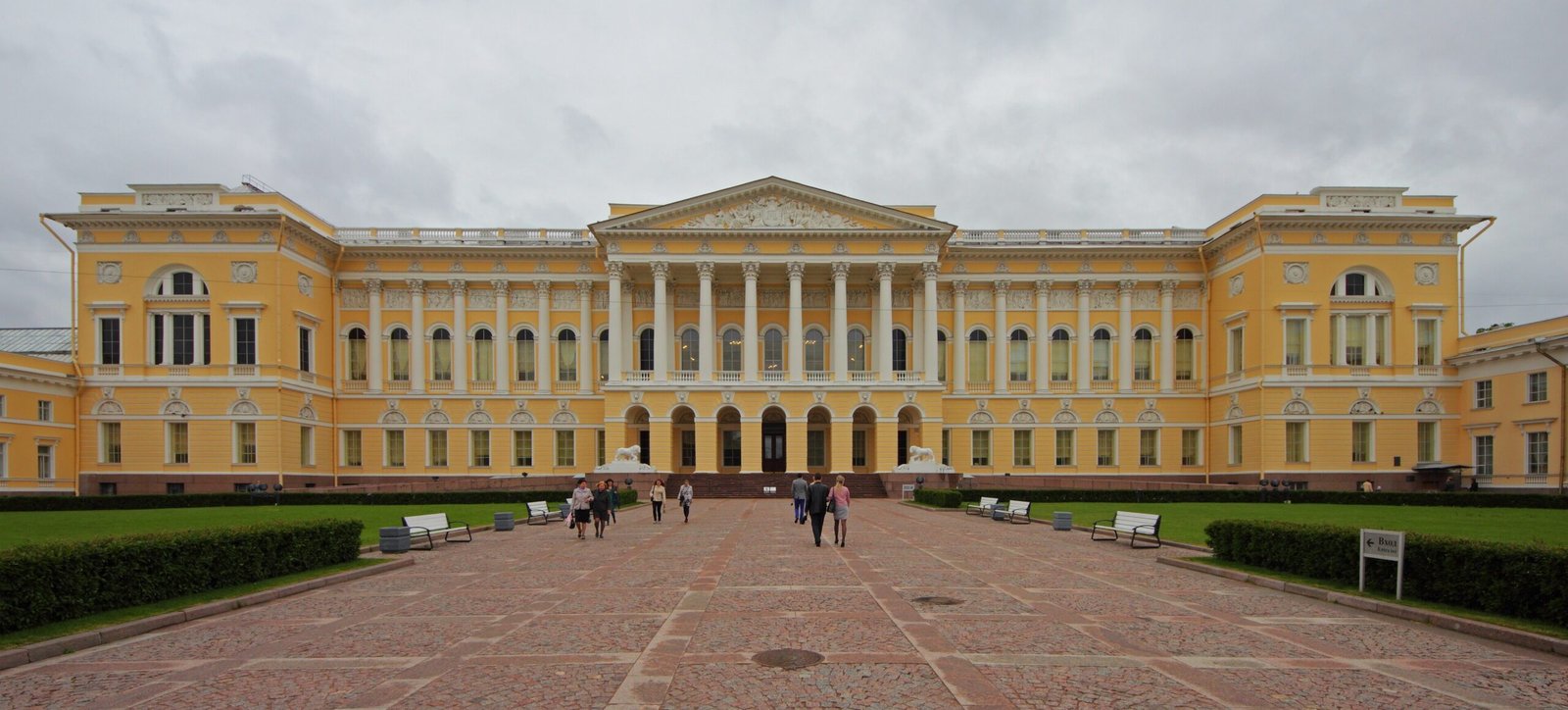
A neoclassical residence built for a Romanov grand duke now shelters one of Russia’s great art collections behind its Corinthian colonnade.
At a glance
Facing Arts Square, the Mikhailovsky Palace was raised between 1819 and 1825 to designs by Carlo Rossi. It served as the Saint Petersburg home of Grand Duke Michael Pavlovich and his family for decades. Since the 1890s it has housed the main building of the Russian Museum, holding early, folk, and 18th- and 19th-century Russian art.
History
Emperor Paul I set aside funds for the palace from 1798, intending it for his youngest son Michael. Paul’s murder in 1801 delayed the project. Alexander I revived it, commissioning Rossi in 1817 after rejecting two costlier sites. Construction began on 26 July 1819, with masons Foma Adamini, Domenico Adamini and Iosif Bernadazzi executing the core work while Adam Menelaws laid out the adjoining garden. The main structure rose within two years; decoration, which alone consumed some four million of the total 7.875 million rubles, took longer still. Alexander I presented the finished palace to Michael on 11 September 1825, rewarding Rossi with a ring and an imperial order. Grand Duchess Elena Pavlovna, Michael’s widow, hosted celebrated salons here until her death in 1873. Their daughter Catherine Mikhailovna inherited the house, and by her death in 1894 the family had largely withdrawn into the wings, leaving the staterooms disused. Concerned the palace might leave Romanov hands, Alexander III arranged its purchase; Nicholas II completed the deal through Finance Minister Sergei Witte and gave it to the newly founded Russian Museum. A wing was demolished and rebuilt for the Museum of Ethnography, and the Benois wing was added in the 1910s.
What you see
Rossi conceived the palace as the anchor of an entire urban ensemble, cutting new streets and a square around it. The facade rises from a rusticated ground floor to a piano nobile loggia fronted by an eight-column Corinthian colonnade and a pediment carrying armour reliefs by Stepan Pimenov and Vasily Demut-Malinovsky. Medici lions flank the entrance stair. Inside, a vestibule opens beneath a skylight and Corinthian colonnade decorated with bas-reliefs. Caryatid-flanked doors lead to the Blue Gallery and a dining room roofed with grisaille coffers, then on to a marble dancing hall and the former staterooms. Michael’s own quarters stayed deliberately spare apart from an extensive weapons collection; his wife’s rooms were far more ornate. So admired was the design that George IV of Britain requested a scale model, built by Nikolai Tarasov and shipped to London.
Cultural significance
The Mikhailovsky Palace stands as one of Rossi’s mature statements of Empire-style planning, tying architecture to city fabric rather than a single building. Its transformation from grand ducal residence into the Russian Museum reoriented its purpose entirely, turning private staterooms into public galleries of national art. That shift, ordered in memory of Alexander III, embedded the palace in Russia’s cultural institutions rather than its dynastic ones. The building’s reputation abroad, evidenced by royal curiosity in London, marks it as a design once watched closely beyond Russia’s borders.
Key facts
- Architect: Carlo Rossi
- Style: Neoclassicism (Empire style)
- Construction began: 1819
- Completed and gifted to Grand Duke Michael: 1825
- Later addition: Benois wing, 1910s
- Current use: main building of the Russian Museum
- Heritage status: listed
Practical information & getting there
The palace sits on Arts Square in central Saint Petersburg, close to Nevsky Prospekt. You can reach it easily on foot from the Nevsky Prospekt or Gostiny Dvor metro stations. As the Russian Museum’s main building, it keeps regular museum visiting hours; checking the museum’s own schedule before travelling is sensible, since state holidays and seasonal changes can affect access.
Sources & resources
Find it on the map
See this place and what’s around it →📷 Become a Cultural Heritage Online photographer
Share your photos of places: they stay published under your name as the author. The more they're seen, the more you get noticed — and soon a contest will reward the most appreciated photos.
Log in or sign up free to add a photoIs this page about you?
This page is read by travellers and heritage enthusiasts who find it on Google. Tell us how you are connected to this place and we will take it from there.