
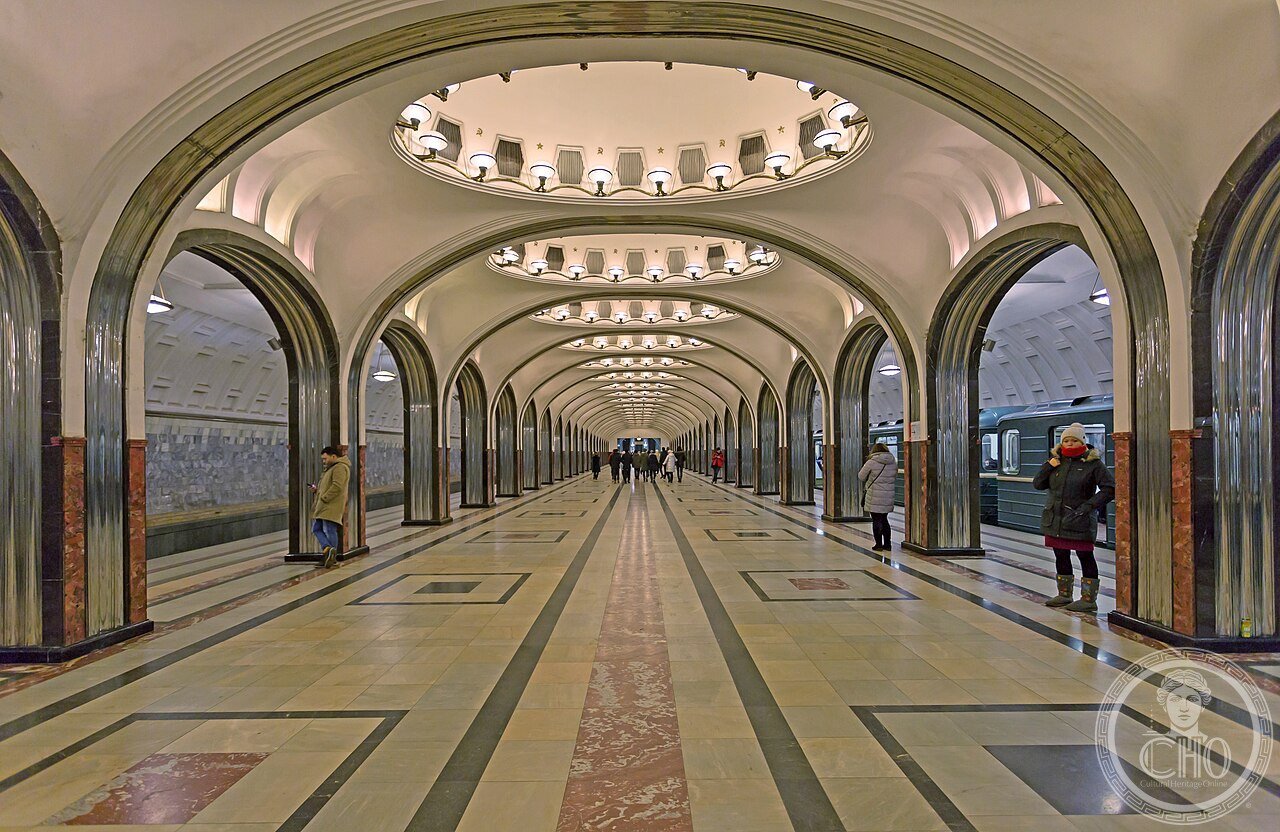
Deep beneath Tverskaya Street, at a depth of thirty-three metres, Mayakovskaya is the most beautiful metro station in Moscow — and, many would argue, in the world. Designed by architect Alexey Dushkin and opened in September 1938, it married the industrial ambitions of Stalin-era Soviet infrastructure with the sensuous curves of Art Deco. Stainless-steel arches lined with pink rhodonite frame an island platform of breathtaking length, while thirty-four oval ceiling oculi glow with mosaic panels by Alexander Deineka portraying a sky full of Soviet achievement. The station won the Grand Prize at the 1939 New York World’s Fair — a life-size replica was exhibited for international audiences who could hardly believe such opulence existed underground. Three years later, with Nazi forces at Moscow’s doorstep, Stalin descended to deliver his Revolution Day address here, transforming the station into a symbol of Soviet resolve. Today Mayakovskaya stands not only as an engineering landmark but as a monument to the moment when propaganda, beauty, and fear converged beneath a besieged city.
At a glance
- Type
- Underground metro station
- Period
- 1935–1938
- Style
- Stalinist Art Deco / Soviet High Deco
- Location
- Tverskoy District, Moscow, Russia
- Coordinates
- 55.7701° N, 37.5958° E
- Architect(s)
- Alexey Dushkin
Overview
Mayakovskaya station sits on the Zamoskvoretskaya line of the Moscow Metro, named after the Futurist poet Vladimir Mayakovsky. Its defining feature is a sequence of sixty elliptical arches clad in corrugated stainless steel, alternating with columns of pink rhodonite — a semi-precious stone quarried in the Urals — set against walls of white Ufaley and grey diorite marble. The island platform stretches beneath a barrel-vaulted ceiling punctuated by thirty-four shallow domes, each housing a mosaic panel by Alexander Deineka. The effect is of a cathedral reimagined by an engineer with an unlimited budget and an absolute sovereign to impress.
History
Construction on the second stage of the Moscow Metro began in the mid-1930s under the direct patronage of Lazar Kaganovich and the personal interest of Stalin himself. Dushkin, then in his early thirties, had already proved himself on the Kropotkinskaya station but was handed an even greater brief for Mayakovskaya: to create a station worthy of international exhibition. The structural challenge was immense — the deep-tube oval-section tunnel required a novel system of two parallel colonnades to support the vault, the first of its kind globally. The station opened on 11 September 1938, and a replica immediately travelled to New York, where it won the Grand Prix at the World’s Fair. On 7 November 1941, with German Army Group Centre fifty kilometres from the Kremlin, Stalin addressed party leaders and invited citizens here — the station serving as both air-raid shelter and propaganda stage.
Architecture & Design
Dushkin’s genius lay in making structure and ornament inseparable. The sixty stainless-steel arches — a first in Soviet architecture — are not decorative additions but the structural ribs of the tunnel itself, their corrugated finish catching and diffusing the amber light. Columns of pink rhodonite break the platform into rhythmic bays. Above, Deineka’s thirty-four mosaics depict the skies of a Soviet day from dawn to midnight: fighter planes, parachutists, athletes, harvest workers, a cosmonaut-age sky before the space age had begun. The mosaic tesserae are set in a shallow dome that reads as a window to the sky — a psychological masterstroke in a station thirty-three metres underground. Restoration in 2005 preserved the original palette while adding a second exit with complementary new mosaics.
Cultural significance
Mayakovskaya is simultaneously a peak of Soviet soft power, an Art Deco masterpiece, and a wartime historic site. The 1939 World’s Fair Grand Prix gave the USSR an international design credential at a moment of diplomatic isolation. Stalin’s 1941 speech — broadcast on radio across the Soviet Union — cast the station as the symbolic heart of a nation refusing to surrender. For contemporary Muscovites it remains a daily ritual of beauty: commuters who have passed through thousands of times still look up at Deineka’s skies.
Visiting today
Mayakovskaya station is fully operational and free to enter with a standard Moscow Metro fare. The platform is best appreciated outside rush hours — early morning or midday on weekdays — when the crowd thins enough to stand beneath each mosaic dome in turn. Photography is permitted on the platform. The 2005 north exit and its complementary mosaics are worth seeking out. The station is wheelchair-accessible via lift at the north entrance.
Getting there
Take the Zamoskvoretskaya line (green line, Line 2) to Mayakovskaya station. Surface exits open onto Triumfalnaya Square and the Garden Ring. The nearest landmark is the Tchaikovsky Concert Hall. From central Moscow (Teatralnaya / Red Square area), it is two stops north on the green line — approximately four minutes.
Sources & resources
Do you know more?
On this page we have published what we were able to verify. If you know Mayakovskaya Metro Station first-hand — you work there, have studied it, or remember how it used to be — and can add a detail, a date, a story or an old photograph, write to Sofia, who looks after these pages. Photographs of the place are welcome too: you can send them with the form at the bottom of this page.
Write to Sofia
or send a message on WhatsApp
Please start your message with the title of this page, so it reaches the right file. Every contribution is checked against independent sources before it goes on the page, and we always say where a piece of information came from.
Find it on the map
See this place and what’s around it →Record researched and written by Luigi De Marchi for Cultural Heritage Online, 2026.
📷 Become a Cultural Heritage Online photographer
Share your photos of places: they stay published under your name as the author. The more they're seen, the more you get noticed — and soon a contest will reward the most appreciated photos.
Log in or sign up free to add a photoIs this page about you?
This page is read by travellers and heritage enthusiasts who find it on Google. Tell us how you are connected to this place and we will take it from there.