
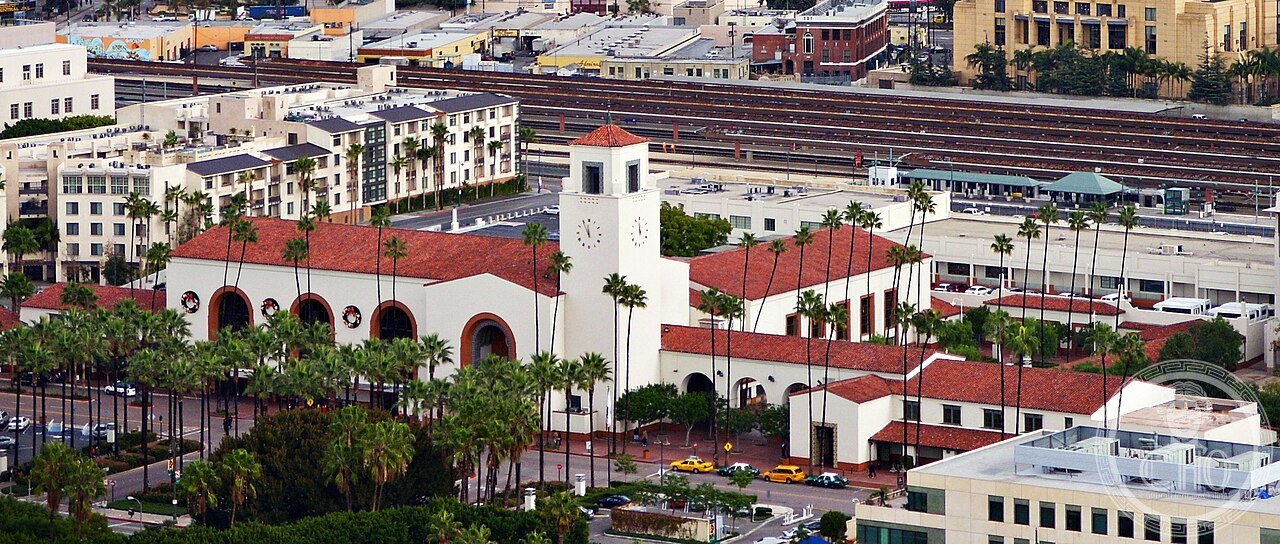
Opened on 3 May 1939, Los Angeles Union Station stands as the last great railroad terminal built in the United States and the largest passenger rail hub in the American West. Designed by father-and-son architects John and Donald Parkinson, the building weaves together Spanish Colonial Revival warmth — hand-painted ceramic tiles, carved wood ceilings, arched colonnades, and lush inner gardens — with the sleek horizontality of Streamline Moderne and Art Deco detailing. Its grand waiting hall, sheathed in travertine and lit by tall arched windows, became an instant civic landmark for a city that was rapidly remaking itself as a global metropolis. Consolidating three earlier terminals, Union Station ended decades of fragmented rail service while asserting Los Angeles’ ambitions on the national stage. Called the “Last of the Great Railway Stations,” it remains a living hub: Amtrak, Metrolink, and LA Metro converge here daily, carrying more than 110,000 passengers through corridors that once saw wartime troop movements, Hollywood glamour, and the quiet drama of a city in transit.
At a glance
- Type
- Railway terminal
- Period
- 1939
- Style
- Spanish Colonial Revival / Art Deco / Streamline Moderne
- Location
- 800 N Alameda Street, Los Angeles, California, USA
- Coordinates
- 34.0552° N, 118.2353° W
- Architect(s)
- John Parkinson and Donald Parkinson
Overview
Los Angeles Union Station replaced three competing downtown depots — La Grande, Central, and Salt Lake stations — at a cost of $11 million. From its opening day it functioned as civic theatre as much as transport infrastructure: movie studios used its arcades and gardens as ready-made sets, and its waiting hall projected an image of Californian prosperity to every arriving traveller. Today it anchors a regional transit network serving millions of annual riders while retaining its original finishes largely intact.
History
Planning for a unified Los Angeles terminal began in the early 1900s, driven by the Southern Pacific, Santa Fe, and Union Pacific railroads. Decades of negotiation and community debate — including the forced relocation of the old Chinatown — preceded the groundbreaking in 1937. Construction proceeded quickly; the station opened to the public on 3 May 1939 with a three-day festival attended by hundreds of thousands. During the Second World War it processed an estimated one million troops departing for the Pacific theatre. Designated a Los Angeles Historic-Cultural Monument in 1972 and listed on the National Register of Historic Places in 1980, the station was purchased by LA Metro in 2011 for $75 million, cementing its future as the spine of regional transit.
Architecture & Design
The Parkinsons fused Mission Revival arches and red-tile rooflines with the aerodynamic vocabulary of Streamline Moderne — a synthesis that feels neither nostalgic nor futuristic but distinctly Californian. The main waiting hall measures 52 metres long and 18 metres high; its coffered ceilings and geometric Art Deco light fixtures recall the grand railway cathedrals of the East while the surrounding patios and garden courtyards, planted with palms and bougainvillea, dissolve any sense of enclosure. Hand-painted Moorish-influenced tiles line floors and walls. The clock tower, rising 42 metres above the forecourt, remains the building’s defining vertical accent and a beacon visible from the freeway.
Cultural significance
Union Station has appeared in dozens of Hollywood films, from noir classics to science-fiction blockbusters, lending its arcaded halls a cinematic familiarity worldwide. As the terminus of the California Zephyr and the Coast Starlight it carries a romantic charge for transcontinental travellers. Its completion also marked the painful erasure of Old Chinatown, a chapter in urban renewal whose legacy continues to be debated. The station’s survival and revival as a multi-modal hub is widely cited in urban planning circles as a model for adaptive reuse of monumental transit architecture.
Visiting today
The station is open around the clock as an active transit hub. The waiting hall and gardens are freely accessible. Self-guided tours are possible at any hour; the Traxx cocktail bar and several cafés occupy original concourse spaces. Metro B and D lines stop beneath the building; bus connections span Greater Los Angeles. Amtrak trains depart for San Diego, San Francisco, and Chicago.
Getting there
Los Angeles Union Station is served by LA Metro Rail (Lines B and D), Metrolink commuter rail, Amtrak long-distance trains, and dozens of bus lines. By car it sits just off Interstate 101 at Alameda Street; paid parking is available on site. From LAX, the FlyAway bus connects directly to the station in approximately 45 minutes.
Sources & resources
Find it on the map
See this place and what’s around it →📷 Become a Cultural Heritage Online photographer
Share your photos of places: they stay published under your name as the author. The more they're seen, the more you get noticed — and soon a contest will reward the most appreciated photos.
Log in or sign up free to add a photoDo you manage this place?
This page is read by travellers and heritage enthusiasts who find it on Google. Keep it accurate — and make it work for you. Free for non-profit heritage institutions.