
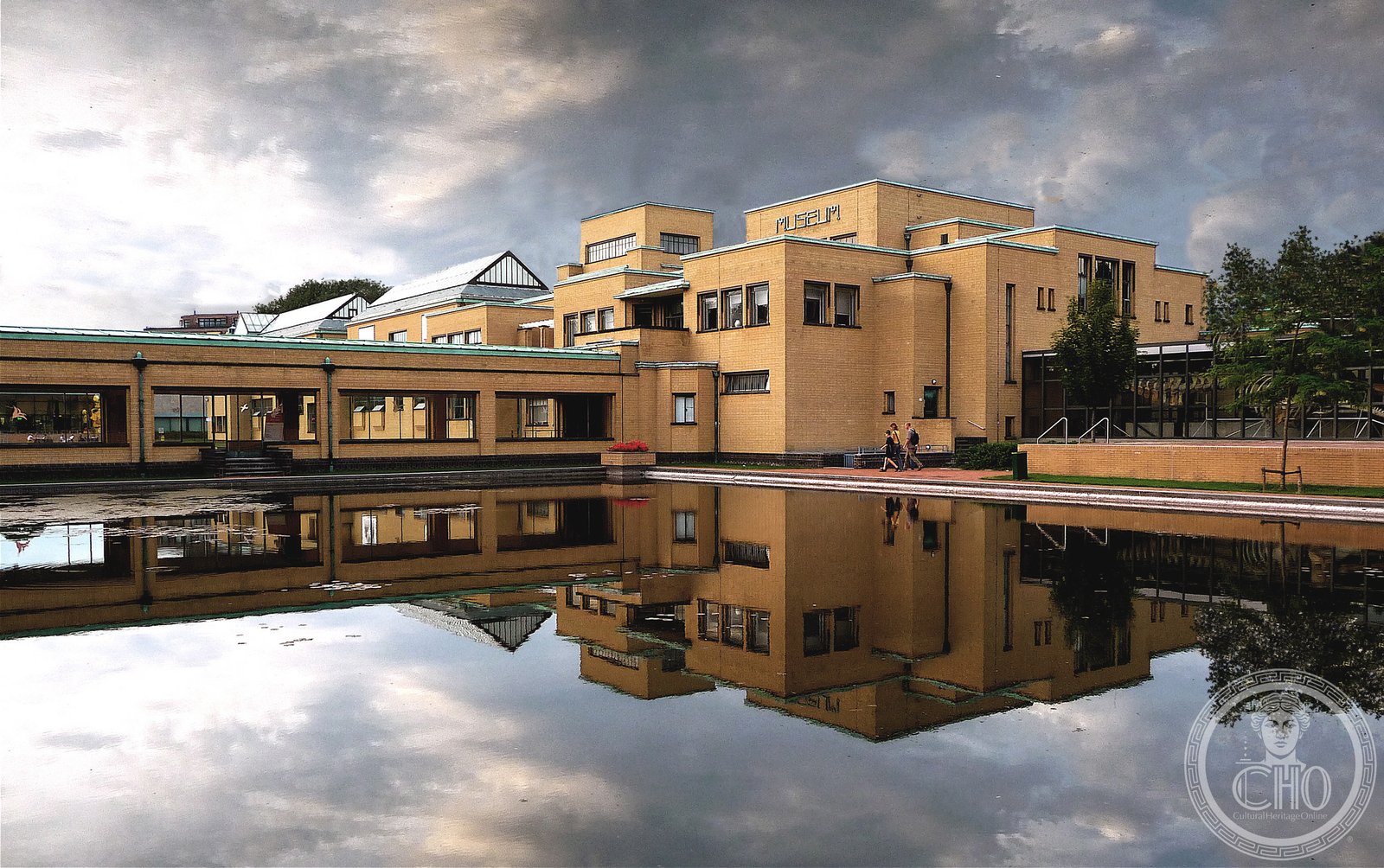
Set within a landscaped quarter of The Hague, the Kunstmuseum Den Haag is the final masterwork of the great Dutch architect H.P. Berlage, completed in 1935 — the year of his death. Founded in 1866 as the Museum voor Moderne Kunst and known for much of the twentieth century as the Haags Gemeentemuseum, the building was conceived not as a pompous temple of art but as an accessible, intimate gathering place for works and visitors alike. Berlage’s characteristic yellow brick, relieved by terracotta ornament and inventive brickwork patterns, clothes a reinforced-concrete frame with restrained functionalist conviction. Inside, a sequence of top-lit halls, coloured tile floors, and slender columns creates one of the most humane and unhurried museum interiors in northern Europe. The museum holds the world’s largest Mondrian collection, including the unfinished Victory Boogie-Woogie of 1944, and a collection of around 165,000 works spanning fine art, decorative arts, fashion, prints, and musical instruments.
At a glance
- Type
- Art museum
- Period
- 1931–1935
- Style
- Dutch Functionalism / Nieuwe Zakelijkheid
- Location
- Stadhouderslaan 41, 2517 HV The Hague, Netherlands
- Coordinates
- 52.0897° N, 4.2806° E
- Architect(s)
- H.P. Berlage; completed after his death by his son-in-law Emil Emanuel Strasser
Overview
The Kunstmuseum Den Haag is both a distinguished work of early twentieth-century architecture and one of the most significant art repositories in the Netherlands. Its collection of around 165,000 works covers modern and contemporary art, Delftware pottery, Persian ceramics, fashion, prints, and an extensive collection of musical instruments with a dedicated music library. The museum is globally renowned for holding the largest Mondrian collection in the world, including Victory Boogie-Woogie, his last and unfinished canvas. Associated institutions — KM21 for contemporary art and Fotomuseum Den Haag for photography — share the complex but operate with separate entrances and ticketing, extending the offer for visitors who wish to explore the full breadth of the site.
History
The museum’s origins lie in 1866 with the founding of the Museum voor Moderne Kunst in The Hague. For much of its existence it accumulated collections through gift and purchase, outgrowing successive homes. In 1931 the city commissioned H.P. Berlage — then nearing the end of his career but still at the peak of his powers — to design a purpose-built museum in a residential quarter south of the city centre. Construction proceeded from 1931 to 1935, but Berlage died before the building opened. His son-in-law Emil Emanuel Strasser oversaw the final stages, remaining faithful to Berlage’s vision. Early critics were divided: the exterior’s plain yellow brick struck some as factory-like, while the interior’s warmth and intimacy was universally praised. The museum was known as Haags Gemeentemuseum until 1998 and as Gemeentemuseum Den Haag until 2019, when it took its current name. The music collection was partly formed from the Scheurleer Music History Museum, acquired after its bankruptcy in 1932.
Architecture & Design
Berlage’s building is organised as a low, spreading composition around internal courtyards, with two tall service towers at the rear that became a target for early critics comparing them to a factory or swimming pool. The exterior is clad in the warm yellow brick characteristic of Berlage’s mature work, relieved by horizontal terracotta string courses and subtle patterning. Inside, the sequence of top-lit galleries, coloured tile floors, slender columns, and an impressive entrance hall with a coffered ceiling was praised from the opening day. Berlage used reinforced concrete for the structure while maintaining a warm, handcrafted surface quality. The layout prioritises movement through the collection in a logical, unhurried sequence, reflecting Berlage’s belief that a museum should invite rather than overawe. The combination of sober functionalism with decorative restraint — not the ornamental extravagance of Beaux-Arts museums, nor the arid minimalism of later modernism — defines the building’s enduring appeal.
Cultural significance
The Kunstmuseum Den Haag occupies a unique position in Dutch cultural life as both a Berlage monument and the custodian of the world’s largest Mondrian collection. Piet Mondrian is the defining figure of De Stijl, the Dutch movement that reshaped international abstract art and design; the concentration of his work here — including the mythologised Victory Boogie-Woogie — makes this museum indispensable for any serious understanding of twentieth-century visual culture. The building itself, as Berlage’s final completed work, represents the summation of his lifelong inquiry into an honest, sober Dutch architecture rooted in brickwork, structure, and social responsibility, influencing generations of Dutch architects including those of the Amsterdam School.
Visiting today
The Kunstmuseum Den Haag is open Tuesday to Sunday; it is closed on Mondays. Admission covers the permanent collection and most temporary exhibitions, with some exhibitions requiring a supplement. The museum stages around twenty-five to thirty exhibitions annually. A museum shop and café are on site. The associated KM21 (contemporary art) and Fotomuseum Den Haag are located in a separate building nearby with separate ticketing. Visitors with a Museumkaart (the Dutch national museum pass) gain free entry. Audio guides are available in several languages.
Getting there
The museum is at Stadhouderslaan 41 in the Zorgvliet quarter of The Hague. From Den Haag Centraal station, tram lines 17 and 24 run directly to the museum stop (Gemeentemuseum). By bicycle the journey from the centre takes around fifteen minutes. Street parking is available in the surrounding residential streets. The museum is approximately 2.5 km from Den Haag Centraal, making a pleasant walk through the Scheveningseweg parkway an option in good weather.
Sources & resources
Find it on the map
See this place and what’s around it →Record researched and written by Luigi De Marchi for Cultural Heritage Online, 2026.
📷 Become a Cultural Heritage Online photographer
Share your photos of places: they stay published under your name as the author. The more they're seen, the more you get noticed — and soon a contest will reward the most appreciated photos.
Log in or sign up free to add a photoIs this page about you?
This page is read by travellers and heritage enthusiasts who find it on Google. Tell us how you are connected to this place and we will take it from there.