

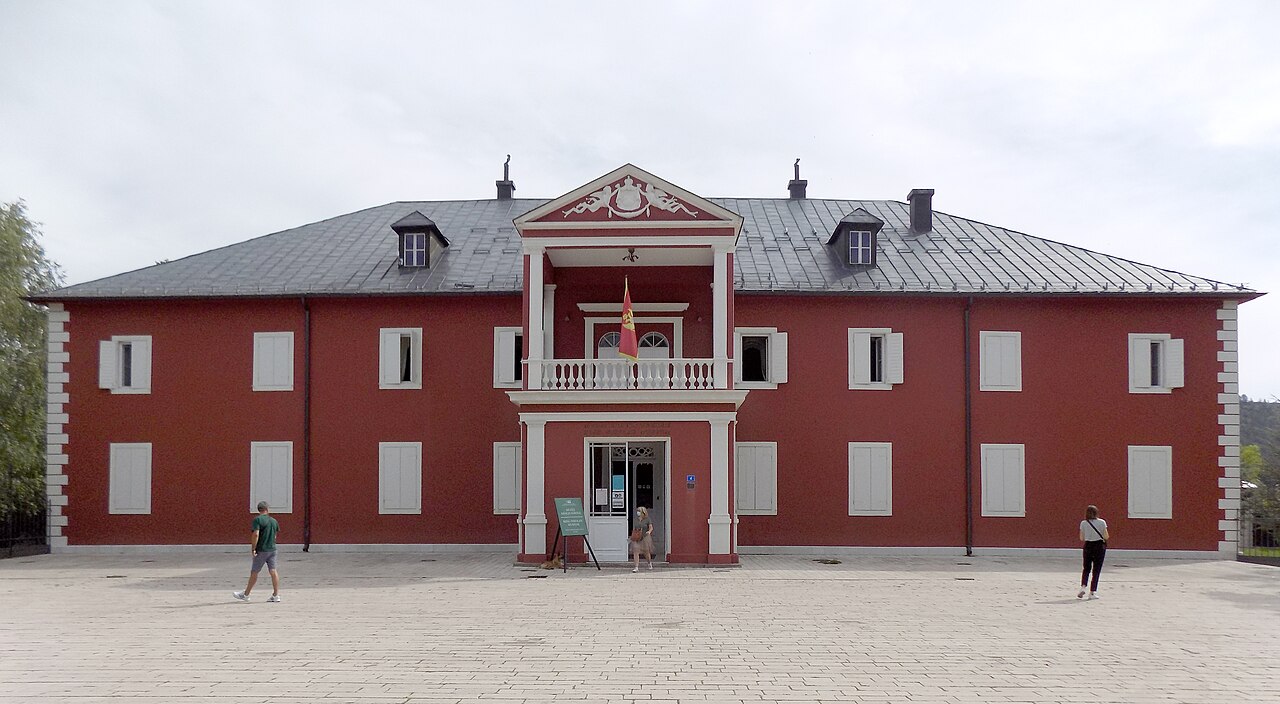
The modest royal palace of the mountain kingdom whose daughters married into the courts of Europe – the house of the father-in-law of Europe.
At a glance
- Type
- Royal palace, now museum
- Period
- 1863-1867
- Style
- Balkan royal residence
- Location
- Cetinje, Montenegro
- Coordinates
- 42.3886, 18.9226
- Patron
- Prince (later King) Nikola I Petrovic-Njegos
Overview
The palace of King Nikola in Cetinje is the unassuming heart of Montenegrin statehood: a long two-storey residence, rose-painted with green shutters, from which Nikola I ruled the mountain principality for 58 years (1860-1918) and married his daughters into the royal houses of Italy, Serbia, and Russia – earning the title of the father-in-law of Europe.
History
Cetinje, a capital of barely a few thousand people beneath Mount Lovcen, hosted a dozen foreign legations drawn by Montenegro’s strategic defiance of the Ottomans; the Biljarda of Njegos and the monastery of the prince-bishops adjoin the palace. Nikola proclaimed the kingdom in 1910 in its halls; the First World War swept it away, and Montenegro vanished into Yugoslavia until the restored independence of 2006 returned Cetinje to ceremonial primacy.
Architecture and Design
The palace is domestic rather than grandiose – parquet salons, tiled stoves, and the throne room’s crimson modesty reflecting a court that received emissaries of empires in a house smaller than their embassies. The interiors survive intact with original furnishings, uniforms, medals, and the standards captured from Ottoman armies.
Cultural significance
The palace-museum is the sanctuary of Montenegrin identity – the dynasty, the heroic resistance, and the European connections of the smallest Allied kingdom. Cetinje’s ensemble of legations, monastery, and court buildings is the open-air museum of a vanished diplomatic world.
Visiting today
The King Nikola Museum opens daily as part of the National Museum of Montenegro; combined tickets cover the Njegos Biljarda and art galleries. Cetinje monastery, keeper of relics including the icon of Our Lady of Philermos, is two minutes away.
Getting there
Cetinje lies 30 minutes from Podgorica and 40 from Kotor by frequent buses; the old royal capital is best combined with the Lovcen mausoleum drive above.
Sources and resources
Find it on the map
See this place and what’s around it →Record researched and written by Luigi De Marchi for Cultural Heritage Online, 2026.
📷 Become a Cultural Heritage Online photographer
Share your photos of places: they stay published under your name as the author. The more they're seen, the more you get noticed — and soon a contest will reward the most appreciated photos.
Log in or sign up free to add a photoIs this page about you?
This page is read by travellers and heritage enthusiasts who find it on Google. Tell us how you are connected to this place and we will take it from there.