
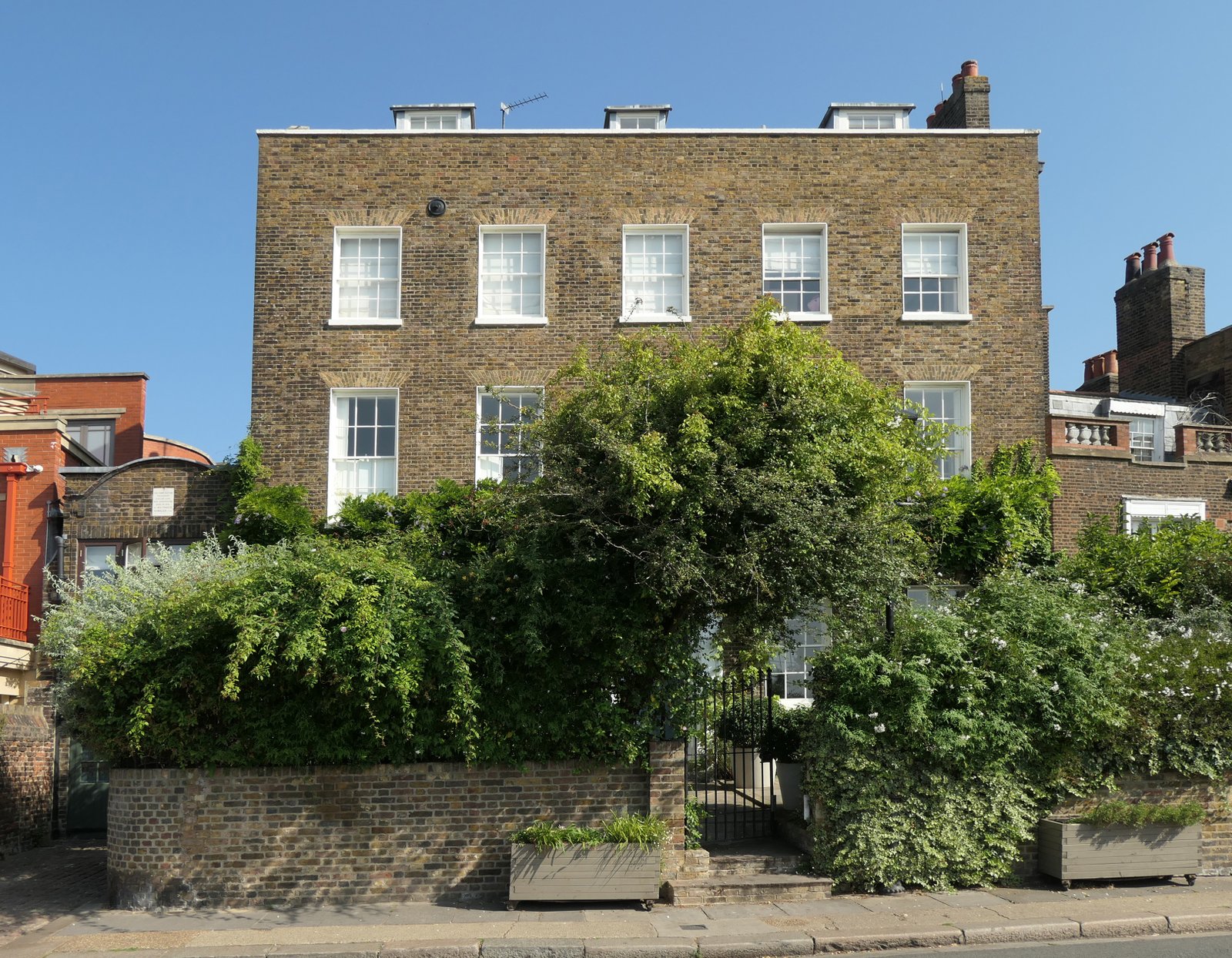

William Morris’s London home for the last eighteen years of his life — a Thames-side Georgian terrace that became the nerve centre of the Arts and Crafts movement.
At a glance
Kelmscott House stands at 26 Upper Mall on the north bank of the Thames in Hammersmith. Morris moved here in 1878 and lived in the house until his death in October 1896. The coach house and basement beneath the main terrace now hold the William Morris Society museum and archive, open to the public on limited days. The house itself is a private residence. It is Grade II* listed on the National Heritage List for England.
Key facts
- Address: 26 Upper Mall, Hammersmith, London W6 9TA
- Occupant: William Morris, 1878–1896
- Building type: Late Georgian terraced house, c. 1780s
- Listing: Grade II*, National Heritage List for England (no. 1193040)
- Named after: Kelmscott Manor, Oxfordshire, Morris’s country retreat
- Society rooms open: Coach house and basement (William Morris Society)
- Main house: Private residence, not open to the public
- GPS: 51.4906, −0.2355 — Google Maps
History
Morris took the lease on the Upper Mall house in 1878, shortly after his return from Iceland and during a period of intense political and artistic activity. He renamed it Kelmscott House after his beloved Oxfordshire manor, some 130 kilometres upriver — a deliberate act of geographical imagination, as if the same stretch of the Thames connected both homes. The name also signalled his attachment to the idea of the river as a living thread through English landscape and memory.
During the eighteen years Morris lived here, the house functioned as both home and hub. The coach house basement was the site of regular meetings of the Hammersmith Socialist Society, which Morris founded in 1884. Lectures, readings, and debates brought together figures central to late-Victorian radical politics and decorative arts. The Kelmscott Press — established in 1890 in rented premises in nearby Hammersmith — produced some of the most influential private press books of the century, including the 1896 Chaucer, completed just weeks before Morris died. Morris supervised the Press’s design work from this address.
Morris died at Kelmscott House on 3 October 1896. The cause was given as exhaustion brought on by overwork across too many fields simultaneously. He was 62. Subsequent tenants included George MacDonald, the Scottish novelist, who had lived here before Morris; the house had already attracted writers and artists before it became an Arts and Crafts landmark. The William Morris Society acquired use of the coach house and basement in the twentieth century and established the museum and archive that now occupies those spaces.
What you see
The house is a three-storey late-Georgian terrace of yellow London stock brick, fronted by a narrow garden strip that drops to the Thames towpath. The proportions are understated — large sash windows, a shallow parapet, the kind of quiet civic confidence typical of 1780s riverside building in west London. It reads very differently from the High Victorian exuberance of Morris’s textiles: the architecture is restrained where the furnishings, once inside, were not. A blue English Heritage plaque marks Morris’s tenure.
The coach house entrance beside the main house leads to the Society rooms below. Here the scale drops and becomes intimate: low ceilings, original brick, display cases holding printed textiles, wallpaper samples, books from the Kelmscott Press, and archival photographs. The contrast between the composed Georgian exterior and the dense decorative world that flourished inside it captures something essential about Morris — a man who used the ordinary fabric of English life as the ground for radical transformation.
The William Morris Society Museum
The coach house and basement are managed by the William Morris Society and open to the public on Thursday afternoons and Saturday mornings (typically 14:00–17:00 and 10:00–13:00 — verify current hours on the Society’s website before visiting). Entry is free. The archive holds a significant collection of original textiles, prints, and correspondence, and is accessible by appointment for researchers. Exhibition programmes change seasonally. The main house is a private residence and is not open at any time.
- Open: Thursdays 14:00–17:00, Saturdays 10:00–13:00 (verify at williammorrissociety.org)
- Admission: Free
- Archive access: By appointment
- Allow: 45–60 minutes for the museum rooms
- Note: The main house is private — do not attempt to enter
Getting there
The nearest Underground station is Ravenscourt Park on the District Line (Zone 2), a ten-minute walk west along the Thames Path. Stamford Brook station (also District Line) is a comparable distance to the east. From Hammersmith interchange (District, Piccadilly, and Overground lines), the Upper Mall is a fifteen-minute walk along the river, passing the Dove pub and the old Linden House boathouse. The Thames Path is flat, well-surfaced, and signposted throughout. By bus, routes 190 and H91 stop on King Street, a short walk inland.
Nearby heritage
- 7 Hammersmith Terrace (~200 m east): Home of Emery Walker, Morris’s closest collaborator on the Kelmscott Press. The house is preserved as Walker left it and opens for tours; it holds the finest surviving Arts and Crafts domestic interior in London.
- The Dove, Upper Mall (~100 m west): A seventeenth-century Thames-side pub; a credible piece of local atmosphere on the same stretch of river Morris walked daily.
- Chiswick House (~3 km east): Palladian villa and grounds by Lord Burlington, 1729; an earlier layer of the same west London Thames corridor.
- Kelmscott Manor, Oxfordshire (~130 km upriver): Morris’s country house from 1871, the other half of his imagined river journey; managed by the Society of Antiquaries and open seasonally.
Sources
- Wikipedia, “Kelmscott House” — tenancy dates, listing status, Society museum details.
- Wikipedia, “William Morris” — biography, Kelmscott Press, Socialist League, death 1896.
- William Morris Society, williammorrissociety.org — opening hours, archive access, exhibition programme.
- Historic England, National Heritage List no. 1193040 — Grade II* listing record.
- Wikipedia, Emery Walker — neighbour, Kelmscott Press co-founder, 7 Hammersmith Terrace.
Find it on the map
See this place and what’s around it →📷 Become a Cultural Heritage Online photographer
Share your photos of places: they stay published under your name as the author. The more they're seen, the more you get noticed — and soon a contest will reward the most appreciated photos.
Log in or sign up free to add a photoIs this page about you?
This page is read by travellers and heritage enthusiasts who find it on Google. Tell us how you are connected to this place and we will take it from there.