
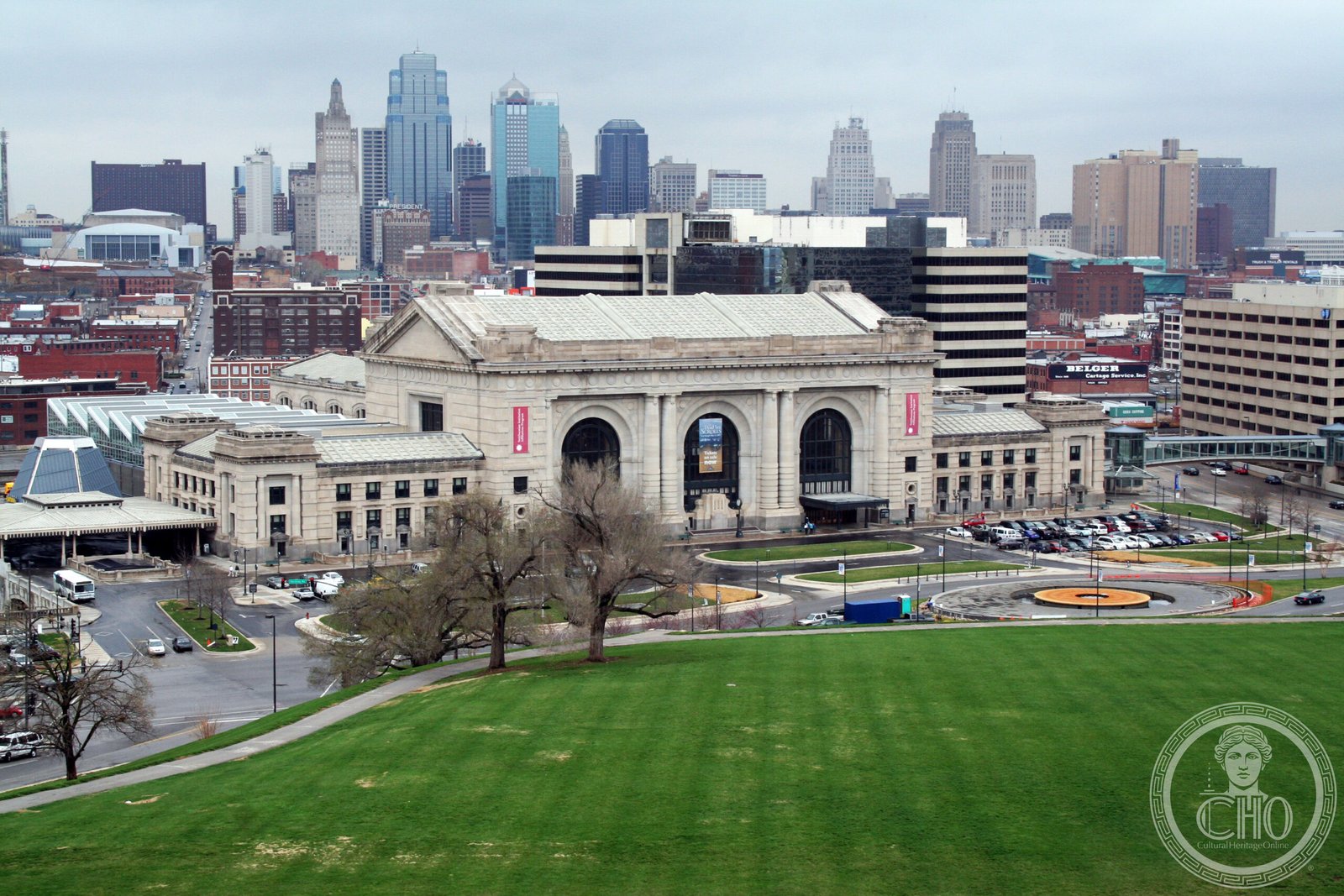
When Kansas City Union Station opened on 30 October 1914, it was the third-largest railway station in the world, a vast Beaux-Arts palace of Indiana limestone that announced the ambitions of the American heartland to travellers arriving from every direction. Designed by Chicago architect Jarvis Hunt, the building stretches 850 feet along Pershing Road and commands an entire city block south of the downtown grid. Its Grand Hall rises to a barrel-vaulted ceiling 95 feet overhead, lit by three chandelier clusters weighing 3,500 pounds each — an interior space deliberately scaled to overwhelm and impress. For three decades the station processed hundreds of thousands of passengers annually, reaching peak traffic of 678,363 in 1945. Then decline set in: car culture, the Interstate highway system, and deregulated air travel emptied the concourses by the 1970s, and the station closed in 1985. A decade-long, $250 million restoration returned it to life in 1999 as a cultural and entertainment destination. Today the historic fabric is intact — the 95-foot ceiling, the original terrazzo floors, the limestone facades — while Science City, a planetarium, theatres, and restaurants occupy the former waiting rooms and train sheds.
At a glance
- Type
- Historic railway terminal / cultural centre
- Period
- 1910–1914
- Style
- Beaux-Arts
- Location
- 30 West Pershing Road, Kansas City, Missouri, USA
- Coordinates
- 39.0848° N, 94.5853° W
- Architect(s)
- Jarvis Hunt
Overview
Kansas City Union Station sits on a prominent rise south of downtown, its 850-foot limestone facade visible from the Liberty Memorial and the National World War I Museum directly across the boulevard. The building encompasses 850,000 square feet of floor space across multiple levels. The main entrance leads directly into the Grand Hall, whose barrel-vaulted ceiling and three enormous chandelier clusters create one of the most dramatic interior spaces in the American Midwest. The exterior is characterised by the classical Beaux-Arts vocabulary of rusticated stone, arched windows, and a restrained but monumental cornice line that gives no hint of the sheer volume within.
History
The station replaced a congested 1878 Union Depot and was part of a broader civic improvement movement in Kansas City that also produced the Country Club Plaza and Loose Park. Architect Jarvis Hunt, who had designed stations in Chicago and Memphis, delivered a terminal scaled for decades of growth. The building earned a grim place in American history on 17 June 1933, when FBI agents escorting escaped gangster Frank Nash were ambushed in the station forecourt. Four officers and Nash were killed in what became known as the Kansas City Massacre, a watershed event that strengthened the FBI’s powers. Post-war decline was swift: passenger counts fell from the 1945 peak to near-zero by the 1980s. The station closed in 1985 and faced an uncertain future. A public and private partnership funded the $250 million restoration completed in 1999. The station was added to the National Register of Historic Places in 1972.
Architecture & Design
Jarvis Hunt drew on the established Beaux-Arts language of monumental public buildings — the same tradition that produced Grand Central Terminal in New York and Washington Union Station — but scaled it to the particular requirements of a Midwestern hub. The exterior facing of Indiana limestone is meticulously detailed with classical pilasters, arched windows, and a copper-clad clock tower centred on the main facade. Inside, the Grand Hall was designed to handle extraordinary passenger volumes while maintaining the dignity of a civic monument: the vaulted ceiling, the terrazzo floors, and the original millwork all survive the 1999 restoration intact. The train shed behind, a steel and glass structure spanning multiple platforms, remains one of the largest surviving examples of its type in the United States.
Cultural significance
Union Station is woven into the fabric of Kansas City history at multiple registers. It embodies the Gilded Age conviction that public infrastructure should be monumental and beautiful — a conviction that shaped American city-making for half a century before the automobile dissolved it. The 1933 Massacre made the station a landmark in the history of American law enforcement. The 1999 restoration, one of the most complex adaptive reuse projects in Midwest history, demonstrated that historic terminal buildings could anchor city centres in the post-rail era. Today the station anchors a cultural corridor that includes the National WWI Museum, Kauffman Center for the Performing Arts, and the Crossroads Arts District.
Visiting today
Kansas City Union Station is open daily to the public. Science City, the interactive science centre occupying the former concourses, charges a separate admission fee. The Gottlieb Planetarium and the H&R Block City Stage Theater offer ticketed programming. Restaurants and cafes operate throughout the ground floor. Amtrak resumed service to the station in 2002; the Southwest Chief connecting Chicago to Los Angeles stops here daily. The KC Streetcar stops at the station, providing easy links to the Power and Light District and the River Market.
Getting there
The station is located at 30 West Pershing Road, Kansas City, Missouri. The KC Streetcar runs from the River Market through downtown to Union Station at its southern terminus. Amtrak operates daily services on the Southwest Chief route and the Texas Eagle. The station is a short walk from the National WWI Museum. Parking garages are located directly adjacent to the building, accessible from Broadway Boulevard. Kansas City International Airport is approximately 30 minutes north of downtown by car or shuttle.
Sources & resources
Find it on the map
See this place and what’s around it →Record researched and written by Luigi De Marchi for Cultural Heritage Online, 2026.
📷 Become a Cultural Heritage Online photographer
Share your photos of places: they stay published under your name as the author. The more they're seen, the more you get noticed — and soon a contest will reward the most appreciated photos.
Log in or sign up free to add a photoIs this page about you?
This page is read by travellers and heritage enthusiasts who find it on Google. Tell us how you are connected to this place and we will take it from there.