
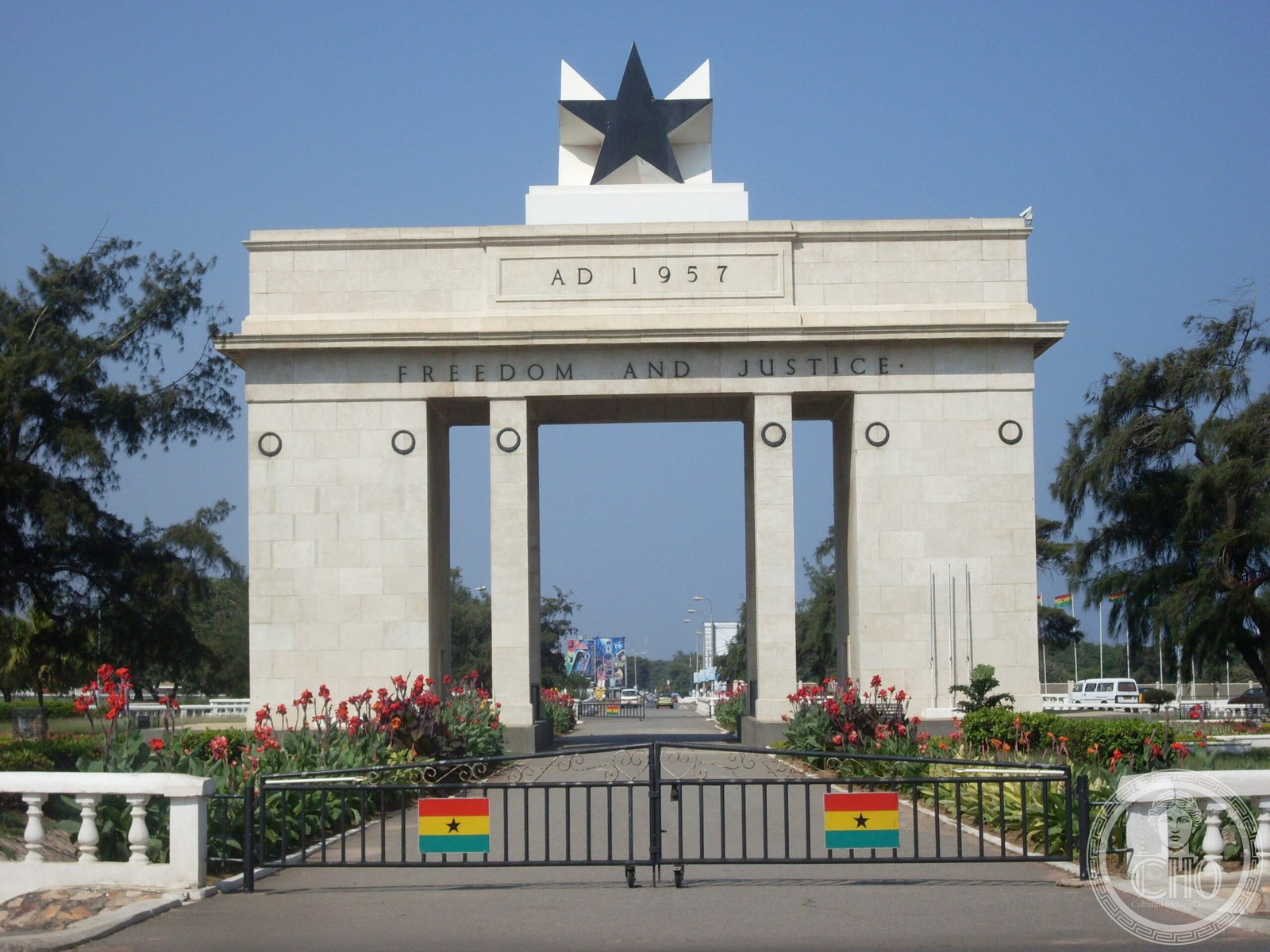
Rising at the southern end of Independence Square, the Independence Arch — known locally as the Black Star Gate — is Ghana’s most resonant national monument. A concrete triumphal arch approximately 12 metres high, it is crowned by the Black Star of Africa: a five-pointed star that became the universal symbol of pan-African freedom from the moment Kwame Nkrumah hoisted Ghana’s flag on 6 March 1957. The arch frames Independence Square, the largest ceremonial open space in sub-Saharan Africa, where every major state occasion — independence celebrations, military parades, presidential inaugurations — unfolds against the backdrop of the Atlantic. Inscribed with the words “Freedom and Justice,” the arch is at once a gateway, a monument, and a daily reminder to Accra’s citizens of the moment their country changed Africa forever. It has since appeared on Ghanaian currency and inspired independence monuments across West Africa, becoming shorthand for the continent’s liberation arc.
At a glance
- Type
- Triumphal arch / national monument
- Period
- 1961
- Style
- Modernist / African Independence architecture
- Location
- Independence Square, Accra, Ghana
- Coordinates
- 5.5489° N, 0.1928° W
- Architect(s)
- Commissioned under President Kwame Nkrumah; supervised by government engineers
Overview
The Independence Arch stands at the ceremonial heart of Accra, anchoring the vast Independence Square — also called Black Star Square — that opens onto the Gulf of Guinea. Built in 1961, four years after Ghana became the first sub-Saharan African country to gain independence from a European colonial power, the arch embodies the continental stakes of that moment. Its form is deliberate: a stripped-down triumphal arch owing a debt to Paris and Rome, but recast entirely in African symbolism. The Black Star surmounting it references Marcus Garvey’s Black Star Line shipping company and the pan-African movement. The inscription “Freedom and Justice” is Ghana’s national motto.
History
Ghana’s independence on 6 March 1957 — declared by Nkrumah with the words “We are free, and this freedom is ours to treasure and preserve” — sent a shockwave through the colonial world. Within four years, seventeen African nations had followed. The Independence Square and its arch were built in 1961 as a permanent frame for this transformation: a space where Ghana could perform its sovereignty for its own citizens and the world. The square hosted the Non-Aligned Movement summit in 1961, welcoming leaders including Jawaharlal Nehru and Gamal Abdel Nasser. Nkrumah’s government fell in a coup in 1966, but the square and arch outlasted all political changes, serving successive civilian and military governments as the indispensable stage for state ceremony. In 2023 US Vice President Kamala Harris delivered remarks at the monument.
Architecture & Design
The arch is constructed in reinforced concrete, its surfaces finished to read as monumental masonry. The form is a single central arch without flanking bays — simpler and more direct than its European antecedents, making it scale easily to human perception in the vast square. The Black Star cast atop the arch is its visual signature: a five-pointed star approximately two metres in diameter. The approach from the square leads through a colonnaded ceremonial area, with the sea visible through the arch at certain angles. The surrounding Independence Square is paved in a radial pattern accommodating large military and civilian parades; reviewing stands flank the main ceremonial axis. The ensemble is designed as pure civic theatre.
Cultural significance
The Independence Arch is to Ghana what the Arc de Triomphe is to France — the site where national narrative condenses into stone. But its significance extends beyond Ghana: it became the symbolic template for independence monuments across West Africa, and the Black Star became a shorthand for African self-determination worldwide. The arch appeared on Ghanaian currency and is reproduced on stamps, state letterheads, and official seals. It is the first and last image many Ghanaians see at state funerals and inaugurations. For the African diaspora, Accra’s Independence Square has become a pilgrimage site on the “Year of Return” and “Beyond the Return” journeys.
Visiting today
Independence Square and the arch are freely accessible. The square is liveliest during national celebrations, especially Independence Day on 6 March, when military parades and cultural displays fill the entire space. Outside of major events, the square is often quiet — a good time for photographs. The adjacent beach and Gulf of Guinea views add to the atmosphere. A small monument to fallen soldiers of the Second World War stands nearby. Accra’s National Museum and Kwame Nkrumah Memorial Park and Mausoleum are both within a short distance, making this a natural circuit for history-focused visitors.
Getting there
Independence Square is centrally located in Accra, south of the Ring Road Central interchange. From Kotoka International Airport, the journey by taxi or ride-hail takes 20–35 minutes depending on traffic. The Accra central bus terminal at Kwame Nkrumah Circle is about 2 km north; trotro routes run along High Street and Ministries Road close to the square. Parking is available around the square perimeter. The Nkrumah Memorial Park and Osu Castle are both within 1 km.
Sources & resources
Find it on the map
See this place and what’s around it →📷 Diventa un fotografo di Cultural Heritage Online
Condividi le tue foto dei luoghi: restano pubblicate con la tua firma come autore. Più vengono viste, più ti fai conoscere — e presto un concorso premierà le foto più apprezzate.
Accedi o registrati gratis per aggiungere una fotoDo you manage this place?
This page is read by travellers and heritage enthusiasts who find it on Google. Keep it accurate — and make it work for you. Free for non-profit heritage institutions.