
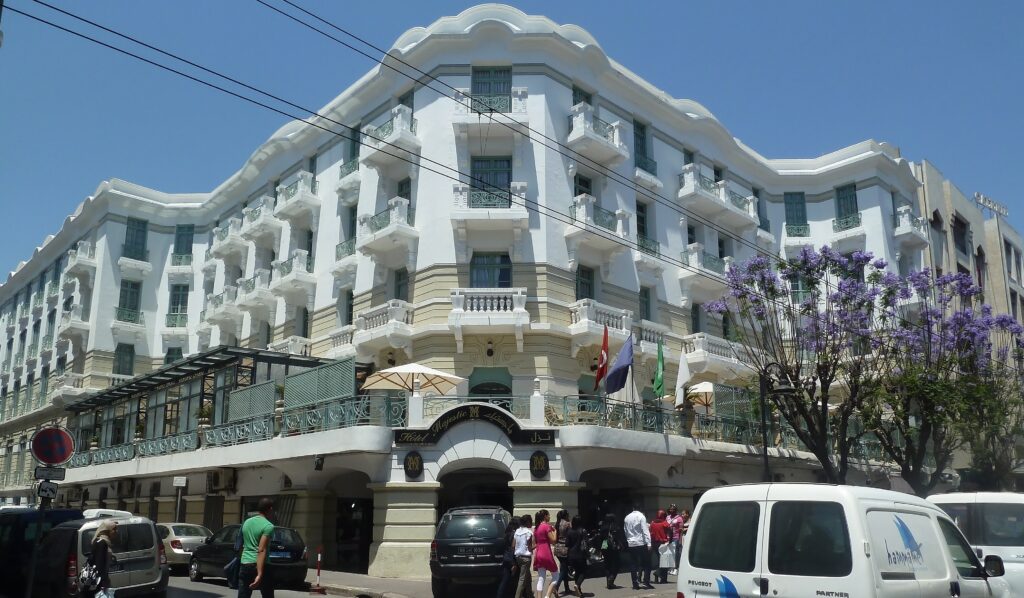

A white, four-storey hotel with a roofline that rises and falls like a wave, built on Avenue de Paris before the First World War by the French architect Paul Baron. It has been a German headquarters, an Allied press base and a state guest house, and it is still a hotel.
At a glance
The Majestic stands on Avenue de Paris, in the grid of streets that the French protectorate laid out between the Medina and the lake of Tunis. The Museum With No Frontiers, in its inventory of the monuments of the Mediterranean, describes it as the first luxury hotel in Tunis and credits it to the architect Paul Baron, in the Art Nouveau style. What makes it stand out on the avenue is the facade: pure white, with curved corners, balconies stacked in columns and a scalloped roofline. Its twentieth-century history is unusually full for a hotel, from the German occupation of 1942–1943 to the receptions of Habib Bourguiba after independence.
Key facts
- Where: 36 Avenue de Paris, Tunis, at the corner facing the Jardin Habib Thameur
- Architect: Paul Baron (Paul-Auguste Baron), French
- Built: 1912 according to the Museum With No Frontiers inventory; other accounts give 1912–1914
- Style: Art Nouveau
- Storeys: four, with a terrace at first-floor level
- Current use: hotel
- Coordinates: 36.804277, 10.180440 · open in Google Maps
History
By the early 1900s the European quarter of Tunis had its avenues, its cathedral and its theatre, but no hotel on the scale of those in Algiers or Cairo. The Majestic filled that gap. The Museum With No Frontiers entry, written by the historian Saloua Khadhar Zangar, calls it the first luxury or grand hotel in the city and notes what was new about it: the sunny facade and terrace, and an interior of modern furniture, woodwork and lighting in which the rooms opened onto one another. The inventory dates the building to 1912; the French and English Wikipedia articles give 1912 and 1914, and a 2026 historical blog gives 1912–1914, so the construction most likely ran across those years.
The same blog quotes the 1913 Thomas Cook guide, which advertised the hotel as the “latest and finest Hotel De Luxe on the African Coast”, with central heating, electricity and running water. We have not seen the guide itself, and report the quotation as given there.
In November 1942 German forces occupied Tunis and took over the Majestic as a headquarters; they held it until May 1943. After the liberation of the city the building was used by the American army. After Tunisian independence in 1956, and until the mid-1960s, President Habib Bourguiba used the hotel to receive foreign heads of state and official guests, and the inventory adds that the hotel received performers such as Charles Aznavour and Gilbert Bécaud.
What you see
The photograph shows the building from the corner. The whole facade is painted white, with the window frames and the ironwork picked out in pale green. The roofline is the signature: instead of a straight cornice it rises in a series of rounded crests over each group of balconies, so that the top of the building reads as a wave running along the avenue. The corner is not a sharp angle but a broad, softly rounded bay.
Balconies are stacked one above the other in vertical columns. Some have green wrought-iron railings with flowing, curved patterns; others, on the lower floors, have stone balustrades. They rest on moulded brackets. At first-floor level a long terrace runs along the front, with a glazed veranda on the left and railings in the same green. The entrance, at the corner, is a round-headed arch with the hotel name in raised letters above it and a pair of medallions carrying the monogram MH. The ground floor is rendered in a warmer, sand-coloured tone, with banded courses, which sets off the white above.
Practical information
- The Majestic is a working hotel; the facade can be seen from Avenue de Paris and from the garden opposite at any time.
- The best view of the roofline is from the far side of the avenue, where the curves can be read against the sky.
- Allow ten minutes for the exterior, more if combined with a walk through the Ville Nouvelle.
Getting there
Avenue de Paris runs north from Avenue Habib Bourguiba, the main axis of the Ville Nouvelle; the hotel is a few minutes’ walk up it. The Tunis Marine light-rail and TGM stations are at the east end of Avenue Habib Bourguiba, about fifteen minutes on foot. Tunis–Carthage airport is about eight kilometres away.
Nearby
- The Jardin Habib Thameur, directly opposite the hotel.
- The Ville Nouvelle and Avenue Bourguiba, the protectorate-era quarter the hotel belongs to.
- The Cathedral of St Vincent de Paul, about ten minutes on foot to the south-west.
- The Medina of Tunis, beyond the Bab el Bhar gate.
Sources
- Museum With No Frontiers, Sharing History: Hôtel Majestic (TN 036), entry by Saloua Khadhar Zangar: 1912, Paul Baron, Art Nouveau, first grand hotel, German occupation, Allied use, Bourguiba.
- Europe Between East and West (blog), “Vacancy Rates: Wartime Tunis Without Reservations”: 1912–1914, Paul-Auguste Baron, the 1913 Thomas Cook quotation. A secondary source; used only for the points stated.
- Hôtel Majestic, official site: address, 36 Avenue de Paris, and the hotel’s description of its Art Nouveau style.
- Wikipedia (fr) and Wikipedia (en): dates of 1912 and 1914, the position facing the Jardin Habib Thameur.
- OpenStreetMap / Nominatim: position returned as Hôtel Majestic, Bab Bhar, Tunis.
Find it on the map
See this place and what’s around it →📷 Become a Cultural Heritage Online photographer
Share your photos of places: they stay published under your name as the author. The more they're seen, the more you get noticed — and soon a contest will reward the most appreciated photos.
Log in or sign up free to add a photoIs this page about you?
This page is read by travellers and heritage enthusiasts who find it on Google. Tell us how you are connected to this place and we will take it from there.