
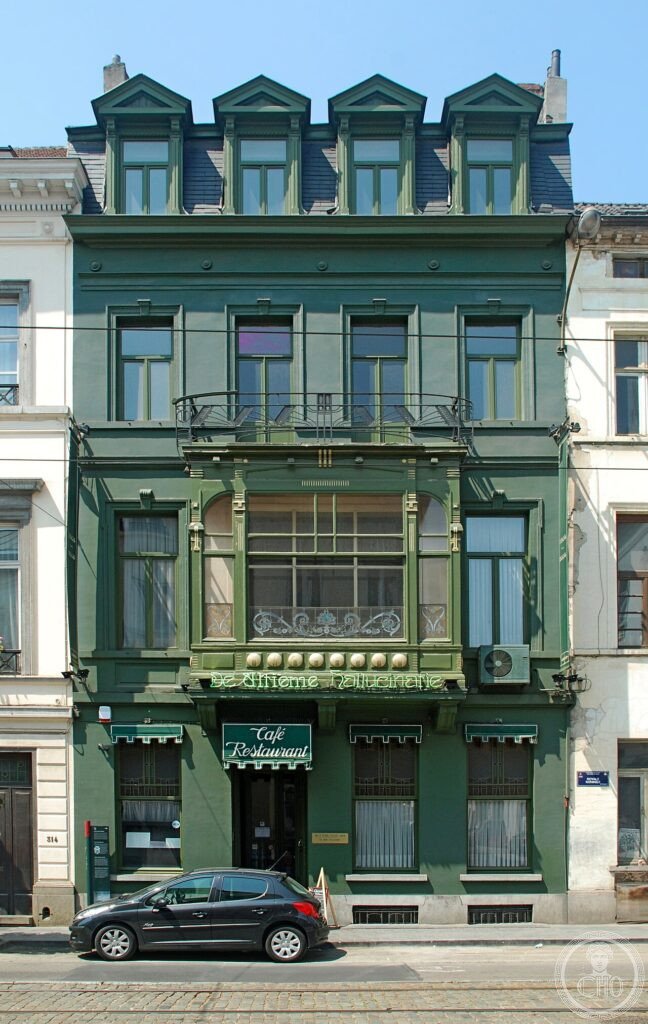

From the street it is a sober neoclassical house; push the door and 1904 takes over — Paul Hamesse’s room-by-room Art Nouveau fantasy, which a later century knew as the café De Ultieme Hallucinatie, “the ultimate hallucination.”
At a glance
The house at Rue Royale 316, in the commune of Saint-Josse-ten-Noode, began life in the first half of the nineteenth century as a neoclassical maison de maître — the regional heritage inventory dates it to 1841. In 1904 the Cohn-Donnay family, owners of large department stores on the Rue Neuve, had it completely redesigned by Paul Hamesse, a pupil of Paul Hankar. Hamesse left the classical street front almost untouched, adding only an imposing Art Nouveau loggia, and poured his invention into the interiors — a different atmosphere for every room. Since 1981 the address has been better known by the name of the celebrated café-restaurant that occupied it: De Ultieme Hallucinatie.
Key facts
- Original house: 1841 (neoclassical; regional heritage inventory)
- Transformation: 1904, by Paul Hamesse for the Cohn-Donnay family
- Facade: Neoclassical, with Hamesse’s Art Nouveau loggia the only addition
- Interiors: Room-by-room Art Nouveau — Viennese Secession, Mackintosh, “Egyptian” and neo-Greek registers
- Café era: De Ultieme Hallucinatie opened 18 December 1981, closed December 2009; revived since 2019 as brasserie and event venue
- Address: Rue Royale 316, Saint-Josse-ten-Noode, Brussels
- GPS: 50.857489, 4.367708 — View on Google Maps
History
The nineteenth-century house welcomed notable residents — the venue’s own history names the animal painter Eugène Verboeckhoven and the pianist Marie Pleyel among them — before the Cohn-Donnay family bought it and, in 1904, handed it to Paul Hamesse. Where his teacher Hankar had died young, Hamesse carried the second generation of Brussels Art Nouveau toward the geometric refinement of Vienna: at Rue Royale he designed room after room in shifting registers, from Secessionist rigour to Mackintosh-like verticality to playful “Egyptian” and neo-Greek details.
The twentieth century treated the house kindly by neglect: a wine merchant’s family, then cellars used for nightlife, kept the shell intact. On 18 December 1981, after restoration, the café-restaurant De Ultieme Hallucinatie opened and became a Brussels institution — the place where you drank a beer inside a complete Art Nouveau interior, tram-style banquettes and all. It closed in December 2009 after the owner’s death; since 2019 the house has been revived as a brasserie and event venue under the same name, once again open to anyone curious enough to walk in.
What you see
The contrast is the point. Outside: a disciplined neoclassical elevation on the busy Rue Royale, betrayed only by Hamesse’s metal-and-glass loggia projecting where a balcony once sat. Inside: one of the most complete secondary-generation Art Nouveau interiors in Brussels — stained glass, joinery and light fittings composed room by room, each in its own key. The former garden room and the long café hall with its tram-style banquettes (attributed by the house to a Van de Velde design) are the celebrated set pieces. Because the building operates as a brasserie and events house, this is that rarity in Brussels: a protected Art Nouveau interior you can simply sit down in.
Practical information
- Operating brasserie and event venue — typically open Wednesday to Saturday for lunch and dinner; check current hours on ultiemehallucinatie.be before visiting
- No ticket needed — order at the bar or book a table to see the interiors
- Private events may close parts of the house; evenings are the safest bet for atmosphere
Getting there
Rue Royale 316 sits on the long straight axis that links the Royal Palace quarter to Schaerbeek, just short of the Botanique gardens. From the Botanique metro station it is five minutes on foot along Rue Royale; trams along the same axis stop almost at the door.
Nearby
- Maison Autrique — Horta’s first town house, 15 minutes into Schaerbeek, restored as a museum
- Saint-Cyr House — Gustave Strauven’s exuberant narrow facade near the Squares district
- Botanique — the former botanical garden glasshouses, now a cultural centre, five minutes away
- Brussels — Victor Horta and Art Nouveau — the CHO city guide
Sources
- Brussels regional heritage inventory (irismonument.be, Saint-Josse-ten-Noode, Rue Royale 316) — 1841 house, 1904 Hamesse transformation, café history
- admirable-artnouveau.brussels (official regional programme) — facade loggia, interior registers
- ultiemehallucinatie.be — residents, revival since 2019, current operation
- Wikidata Q3145453 — coordinates
Find it on the map
See this place and what’s around it →Record researched and written by Luigi De Marchi for Cultural Heritage Online, 2026.
📷 Become a Cultural Heritage Online photographer
Share your photos of places: they stay published under your name as the author. The more they're seen, the more you get noticed — and soon a contest will reward the most appreciated photos.
Log in or sign up free to add a photoIs this page about you?
This page is read by travellers and heritage enthusiasts who find it on Google. Tell us how you are connected to this place and we will take it from there.