
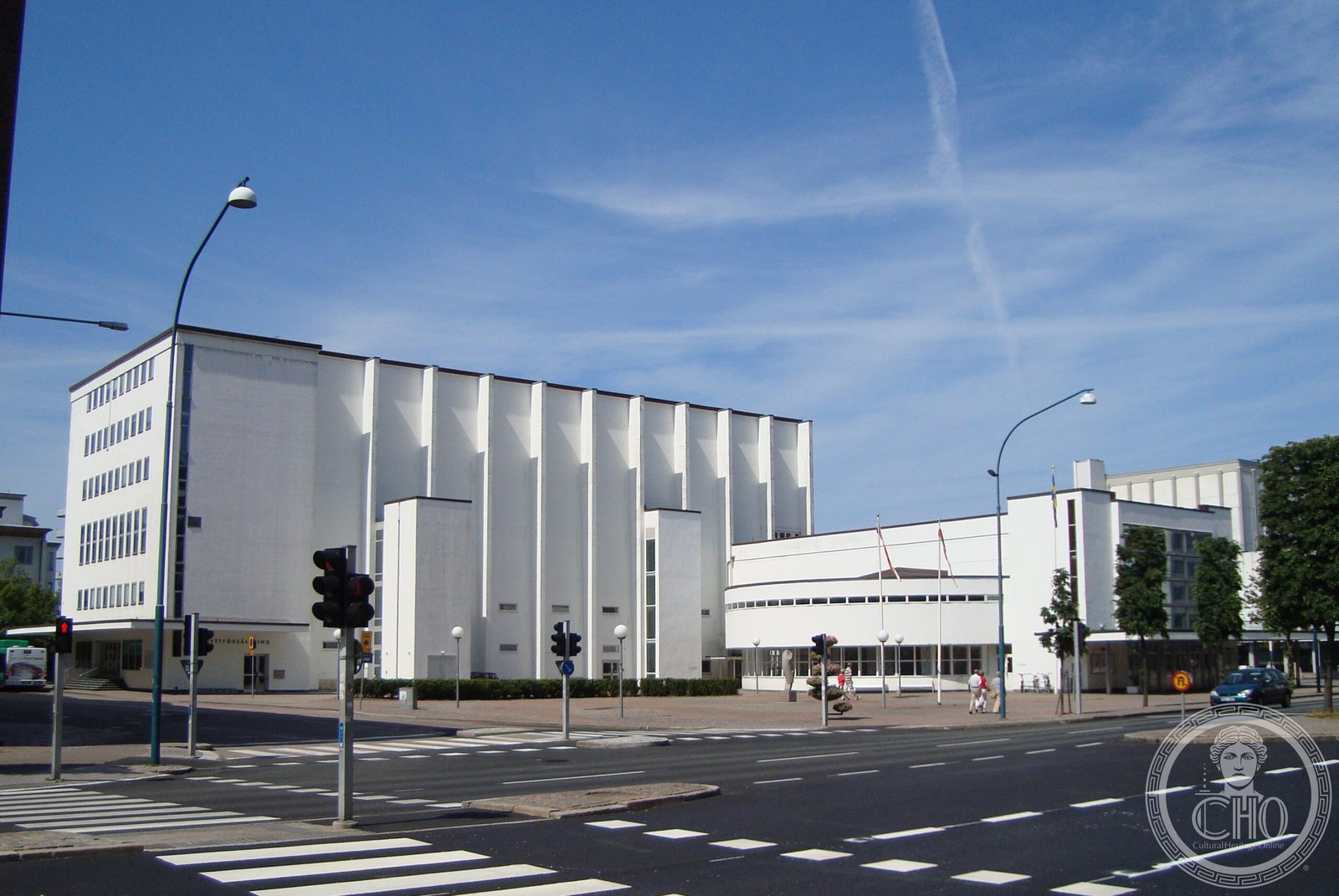
Standing at the heart of Helsingborg on Drottninggatan, the Konserthuset is one of the pivotal buildings of Scandinavian modernism: the first major functionalist civic monument in Sweden. Designed by Sven Markelius and completed in 1934, the concert hall was born of a lengthy design competition begun in 1925. An early iteration placed Markelius third behind the established masters Lars Israel Wahlman and Ragnar Östberg, but when economic pressures forced a revised competition in 1926 Markelius won first prize. After several further revisions the final design was settled in 1930 and construction proceeded. The result was a building of spare, rational elegance — a white-rendered volume with a disciplined rhythm of windows and a precisely detailed interior conceived in close collaboration with the French acoustics expert Gustave Lyon. The great hall’s mahogany-lined walls and perfectly calibrated geometry have made Helsingborg’s acoustic standard a benchmark for Scandinavian concert hall design. Home to the Helsingborg Symphony Orchestra, the building remains in active use and is protected as a cultural monument of national significance.
At a glance
- Type
- Concert hall
- Period
- 1932–1934
- Style
- Swedish Modernism / Functionalism (Funkis)
- Location
- Drottninggatan 19, 252 21 Helsingborg, Sweden
- Coordinates
- 56.0496° N, 12.6889° E
- Architect(s)
- Sven Markelius; acoustics by Gustave Lyon
Overview
Helsingborg Concert Hall — Helsingborgs Konserthuset — is the permanent home of the Helsingborg Symphony Orchestra and the principal venue for classical music in north-western Scania. Designed by Sven Markelius, a leading figure of Swedish interwar modernism, the building opened in 1934 after nearly a decade of planning, competition, and revision. The main auditorium seats around 800 and is internationally regarded for acoustics developed with French specialist Gustave Lyon. The hall’s interior is characterised by warm mahogany wall linings, elegant proportions, and a carefully engineered geometry that focuses sound with precision. Beyond its musical function the building is a landmark of Swedish Funkis — the local strand of European functionalism — and is listed as a building of national cultural heritage significance.
History
The civic ambition to give Helsingborg a dedicated concert hall crystallised in 1925 when the city launched an architectural competition. The first round produced no outright winner: Lars Israel Wahlman placed first, Ragnar Östberg second, and Sven Markelius third. Financial constraints ruled out all three proposals and in 1926 a revised competition was held on a tighter budget, which Markelius won. His design was subsequently revised several times — in response to shifting programme requirements and economic conditions — before the final disposition was settled in 1930. Construction began and the hall opened in 1934. Markelius went on to become one of the most influential architects and urban planners of twentieth-century Sweden, later contributing to the design of the United Nations Secretariat Building interior and to the master plan for the Norrmalm redevelopment in Stockholm. Helsingborg Concert Hall remains an early and emblematic example of his synthesis of social idealism, technical precision, and Scandinavian restraint.
Architecture & Design
Markelius conceived the concert hall as a building of disciplined modernist clarity, avoiding the historicist ornament of his competition rivals in favour of smooth rendered surfaces, a regular window rhythm, and precise massing. The exterior presents a calm, symmetrical facade appropriate to a civic institution, with functionalist detailing that places it firmly within the European Neue Sachlichkeit tradition while retaining a warmth of proportion characteristic of Swedish design of the period. The interior is the building’s greatest achievement: the main auditorium was designed in close partnership with Gustave Lyon, the French acoustic engineer who also advised on the design of the Salle Pleyel in Paris. Lyon’s system of curved reflective surfaces and the mahogany wall linings were calibrated to ensure even sound distribution throughout the hall. The result has been praised consistently for almost a century as one of the finest acoustic environments in Scandinavia.
Cultural significance
The Helsingborg Concert Hall holds a unique position in the history of Scandinavian architecture as the first monumental functionalist civic building in Sweden. Its completion in 1934 signalled the definitive arrival of Funkis — Swedish functionalism — as a legitimate language for public buildings, not merely private houses or utilitarian structures. The building demonstrates that modernist principles of honest construction, rational planning, and social accessibility could produce spaces of genuine beauty and cultural dignity. Markelius’s achievement here influenced a generation of Scandinavian architects and helped establish the Nordic functionalist tradition that would later shape the postwar built environment across the region. The building is classified as a national cultural heritage monument by Riksantikvarieämbetet.
Visiting today
Helsingborgs Konserthuset is the active home of the Helsingborg Symphony Orchestra and hosts a full season of classical, chamber, and popular concerts from September through May. Tickets are available through the orchestra’s website and at the box office on Drottninggatan. The foyer and public areas of the building can be visited on concert evenings and during special open-house events. Guided architectural tours can be arranged by appointment through the concert hall administration. The building is located in the heart of Helsingborg’s pedestrian city centre, within easy walking distance of the Kärnan medieval tower and the waterfront promenade overlooking the Öresund strait toward Elsinore in Denmark.
Getting there
The concert hall is at Drottninggatan 19, under ten minutes on foot from Helsingborg Central Station (Helsingborg C), which is served by regional trains (Pågatågen) from Malmö, Lund, and Gothenburg, and by the HH Ferry connection from Helsingør, Denmark. Multiple bus lines stop at Sundstorget, one block from the entrance. The building is accessible by bicycle via Helsingborg’s city-centre cycle network. Street and car park parking is available in the surrounding streets.
Sources & resources
Find it on the map
See this place and what’s around it →Record researched and written by Luigi De Marchi for Cultural Heritage Online, 2026.
📷 Become a Cultural Heritage Online photographer
Share your photos of places: they stay published under your name as the author. The more they're seen, the more you get noticed — and soon a contest will reward the most appreciated photos.
Log in or sign up free to add a photoIs this page about you?
This page is read by travellers and heritage enthusiasts who find it on Google. Tell us how you are connected to this place and we will take it from there.