
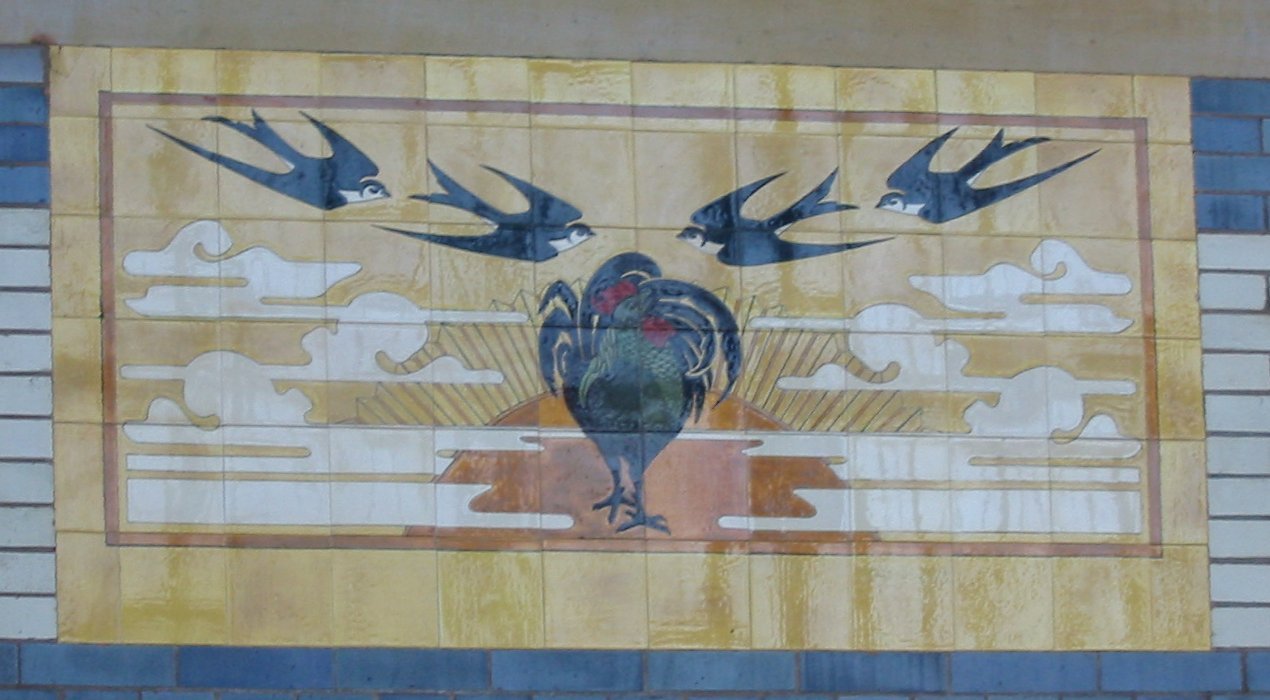

The only Art Nouveau railway station in the Netherlands, rebuilt in 1906–08 by architect Dirk Margadant — its tile-lined waiting rooms have survived a century of modernisation intact.
At a glance
Haarlem station is a working intercity hub on the Amsterdam–Zandvoort line, and also one of the most architecturally intact Art Nouveau public buildings in the Netherlands. The 1906–08 rebuilding by Dirk Margadant gave the station a decorated stone facade and, more importantly, waiting rooms whose tile panels, painted ceilings, and ironwork details have remained largely untouched. The tiles — roosters, sunbursts, foliage in muted ochres and greens — represent the Jugendstil inflection of Dutch Art Nouveau, a design language that Haarlem embraced alongside Amsterdam in the first decade of the twentieth century. Since the turn of the twenty-first century, the station has also housed MuTEK, a museum dedicated to 150 years of European applied design and decorative objects, occupying the former second-class waiting room on platforms 3 and 6.
Key facts
- Architect: Dirk Margadant (1849–1915)
- Construction: 1906–1908
- Address: Stationsplein 1, 2011 LR Haarlem, Netherlands
- GPS: 52.3881° N, 4.6386° E — Google Maps
- Style: Art Nouveau (Dutch Jugendstil)
- Status: Active NS railway station; Rijksmonument no. 19786
- Operator: Nederlandse Spoorwegen (NS); 6 platforms
History
Haarlem holds a place of particular significance in Dutch railway history: on 24 September 1839 it was the terminus of the first steam railway line in the Netherlands, the Amsterdam–Haarlem route. That inaugural wooden station was replaced in 1842 by a neo-classical building designed by Frederick Willem Conrad, then modified in 1867 when P. J. Mouthaan added a storey and enclosed the front elevation.
By the early 1900s, the combination of rising passenger volumes and the city’s ambition to modernise its infrastructure prompted a more radical intervention. The tracks were elevated on an embankment to eliminate at-grade crossings through the city, and the station building was entirely rebuilt. The commission went to Dirk Margadant, whose design — completed and opened in 1908 — placed the station firmly in the Art Nouveau current then circulating through the Netherlands from Belgium and Germany. The choice of style was not merely fashionable: Haarlem’s civic identity in this period was closely tied to the arts, and the decorative programme of the new station was understood as a public monument as much as a transport node.
Through the mid-twentieth century, when most Dutch stations were stripped of ornament or demolished outright, Haarlem’s interiors survived. The tile panels depicting the Amsterdam–Haarlem route’s locomotive history, the painted plaster ceilings, and the cast-iron structural elements were preserved — partly through institutional inertia, partly through local advocacy. The building was granted Rijksmonument status (no. 19786), giving the interiors legal protection.
The Art Nouveau interiors
The tile work is the defining element of the station’s interior. Flat ceramic panels in the Jugendstil manner — stylised animals, botanical motifs, sun discs — run along the wainscoting of the main hall and the former waiting rooms. One particularly well-documented tableau shows roosters and radiating sun forms in ochre, moss green, and off-white, a palette typical of Dutch Art Nouveau tilework of the 1900s. The tiles were produced in the period of the station’s construction and remain in their original setting. Above the tile dado, painted plaster ceilings carry further decorative work: foliate borders and geometric banding that integrate the upper volume of the hall with the tile programme below.
The ironwork — brackets, column capitals, balustrade panels — follows the same organic vocabulary, with curving plant-form profiles replacing the rectilinear detailing of the station’s Victorian predecessor. The main facade facing Stationsplein is executed in brick and natural stone with applied terracotta ornament: the exterior signals the building’s style to the city, but the interior is where the programme achieves its full density. Waiting rooms that once served first-, second-, and third-class passengers retain differentiated levels of finish, with the more elaborate tile and ceiling work concentrated in the higher-class rooms — a social hierarchy now legible only as architectural history.
MuTEK — design museum in the station
MuTEK (Museum voor Tegels en Keramiek) occupies the former second-class waiting room on platforms 3 and 6. The museum is dedicated to 150 years of European applied design and decorative objects, with a particular emphasis on tiles and ceramics as cultural artefacts. Its location inside a working Art Nouveau station gives the collection an unusually direct context: the tile panels visible through the waiting-room windows are contemporaries of the objects on display inside.
- Opening hours: Wednesday–Sunday, 11:00–17:00
- Location within station: Former second-class waiting room, platforms 3 and 6
- Website: mutekmuseum.nl
Visiting
- The station concourse and platforms are accessible at all hours as a working NS station — no ticket or admission required to see the main hall tile work.
- MuTEK museum: Wednesday–Sunday, 11:00–17:00. Check mutekmuseum.nl for current admission fees and any temporary closures.
- Allow 30–45 minutes to walk the main hall, examine the tile panels at close range, and visit the museum.
- Photography of the interior is possible from the public concourse at any time.
Getting there
Haarlem station is served by NS Intercity and Sprinter services. From Amsterdam Centraal the journey takes approximately 15 minutes (Intercity direct, hourly; Sprinter, every 15–30 minutes). From Amsterdam Schiphol Airport the Sprinter to Haarlem runs approximately every 15 minutes and takes around 20 minutes. The station is the western terminus of the Amsterdam–Zandvoort aan Zee line and also connects to Leiden, The Hague, and Rotterdam via Intercity services. The station building is at Stationsplein 1; trams and buses depart from the square immediately in front.
Nearby heritage
- Frans Hals Museum (~800 m) — the city’s principal fine-art museum, housed in a seventeenth-century almshouse; focus on the Golden Age Haarlem school.
- Teylers Museum (~600 m) — the oldest museum in the Netherlands (founded 1784), with collections of fossils, minerals, scientific instruments, and drawings.
- Grote Kerk van Haarlem (St Bavo) (~1 km) — late-Gothic cathedral whose Müller organ was played by Mozart in 1766; burial place of Frans Hals.
- Historisch Museum Haarlem (~850 m) — city history collections in the Verweyhal on the Groot Heiligland.
Sources
- Wikipedia, Haarlem railway station — architect, dates, Rijksmonument number, tile description.
- Wikimedia Commons, 2004 Jugendstil tegeltableau station Haarlem — hero image, CC BY-SA 3.0, photo Ellywa, 2004.
- OpenStreetMap / Nominatim — GPS coordinates verified: 52.3881° N, 4.6386° E, display name confirmed as Stationsplein 1, Haarlem.
- MuTEK Museum, mutekmuseum.nl — museum location (platforms 3 and 6, former second-class waiting room), opening hours (Wed–Sun 11:00–17:00), collection focus.
- Rijksdienst voor het Cultureel Erfgoed — Rijksmonument no. 19786.
Find it on the map
See this place and what’s around it →Record researched and written by Luigi De Marchi for Cultural Heritage Online, 2026.
📷 Become a Cultural Heritage Online photographer
Share your photos of places: they stay published under your name as the author. The more they're seen, the more you get noticed — and soon a contest will reward the most appreciated photos.
Log in or sign up free to add a photoIs this page about you?
This page is read by travellers and heritage enthusiasts who find it on Google. Tell us how you are connected to this place and we will take it from there.