
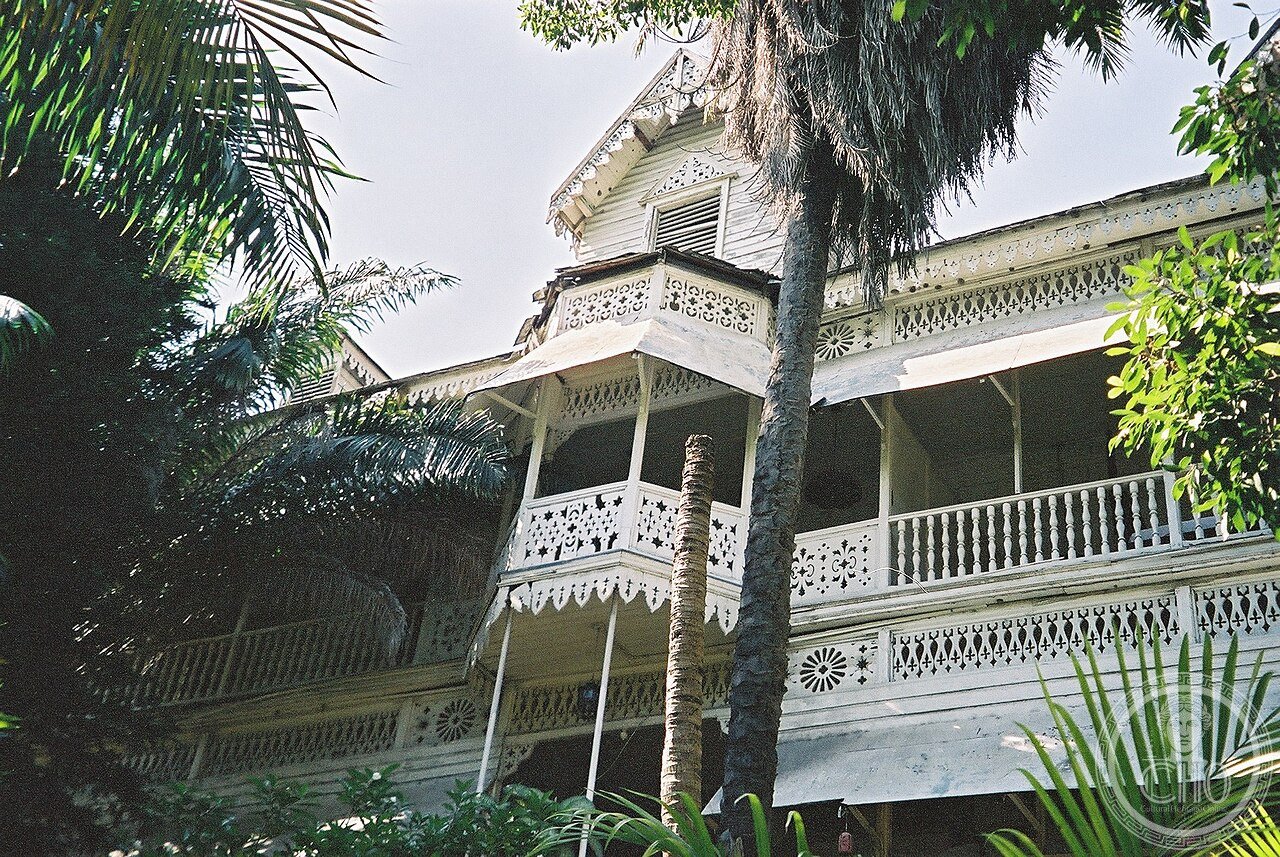
Rising above the tumult of Port-au-Prince on a low hill, the Grand Hotel Oloffson is one of the most extraordinary buildings in the Caribbean — a carpenter-Gothic fantasy of turrets, verandas, fretwork, and pointed arches that has survived revolution, dictatorship, and earthquake for nearly 140 years. Built in 1887 as the private residence of Sam Generaux, Secretary of State under President Florvil Hyppolite, the gingerbread mansion became a hotel in 1935 and immediately drew a procession of writers, artists, diplomats, and adventurers. Graham Greene stayed here repeatedly, sleeping in the room that bears his name, while researching the novel that would make the Oloffson world-famous: The Comedians (1966), whose fictional Hotel Trianon is an unmistakable portrait of this place. The rolling cast of guests — the Kennedys, Mick Jagger, Jackson Browne, John Gielgud, Anne Bancroft — reads like a dispatch from the twentieth centurys most improbable salon.
At a glance
- Type
- Historic hotel / heritage mansion
- Period
- 1887 (hotel from 1935)
- Style
- Gingerbread Victorian / Caribbean Gothic Revival
- Location
- Rue Capois, Bois Verna, Port-au-Prince, Haiti
- Coordinates
- 18.5419° N, 72.3392° W
- Architect(s)
- Unknown (Haitian carpenter-craftsmen, original commission for Sam Generaux)
Overview
The Oloffson occupies a compound of mature tropical gardens just off the main boulevard of Bois Verna, one of Port-au-Prince oldest residential neighborhoods. The main building is a masterwork of Haitian gingerbread — a vernacular architectural tradition that fused Victorian carpenter-Gothic motifs with local hardwoods, adapting the style to Haiti climate through deep wraparound verandas, louvred shutters, and high ceilings that funnel Caribbean breezes. The hotel has operated nearly continuously since 1935 and is today run by musician and hotelier Richard Morse, who plays there with his RAM band every Thursday night. A heritage monument of Haiti, it stands as both a living inn and a museum of a century of Caribbean cultural life.
History
Sam Generaux built the mansion in 1887 during a period of relative prosperity under President Hyppolite, when Haitian elites were constructing ornate residences in the gingerbread style. After Generaux, the property passed through several owners before being converted into a hotel in the 1930s. The Oloffson takes its name from a Norwegian family that owned it for a time. Under the Duvalier dictatorships (Papa Doc 1957–71; Baby Doc 1971–86), the hotel became a refuge and observation post for foreign correspondents and writers — Graham Greene visits produced The Comedians, the novel that defined Western perceptions of Haiti under tyranny. The January 2010 earthquake, magnitude 7.0, killed over 200,000 people in the Port-au-Prince region; the Oloffson sustained structural damage but survived. Richard Morse, who has managed the hotel since 1987, oversaw repairs and kept it open as a symbol of Haitian resilience.
Architecture & Design
Haitian gingerbread architecture is one of the Americas most distinctive building traditions, and the Oloffson is its supreme surviving example. The structure is built almost entirely of local hardwoods — primarily Caribbean mahogany — with elaborate fretwork decorating every eave, balcony railing, and window surround. Pointed Gothic arches frame doorways and upper-story windows, giving the building an ecclesiastical verticality that contrasts with the tropical horizontality of the broad verandas wrapping all four sides. Multiple turrets and a prominent corner tower recall Victorian resort hotels of the American South. The interiors preserve original woodwork, period furniture, and the legendary rooms named for literary and artistic guests. The whole compound reads as an organic accumulation held together by the unifying language of carved wood and white paint.
Cultural significance
The Oloffson is more than a hotel: it is a primary source document for Haitian history. Greene The Comedians projected it into global consciousness as a metaphor for the island tortured politics. The hotel Thursday-night RAM concerts have for four decades been a gathering point for Haitian artists, musicians, and intellectuals — as well as foreign journalists covering the country repeated crises. As the finest surviving example of gingerbread architecture, it anchors Haiti claim to a unique and valuable architectural heritage. The UNESCO-adjacent discourse around preserving Port-au-Prince gingerbread district cites the Oloffson as its most emblematic building.
Visiting today
The Grand Hotel Oloffson operates as a working boutique hotel with approximately 25 rooms, each individually decorated and several named for famous guests. The Thursday-night RAM concert on the veranda is the hotel signature event and is open to non-guests for a cover charge. The bar and restaurant serve Haitian cuisine and rum cocktails. Visitors should check current security advisories before traveling to Haiti; the Oloffson staff are experienced at helping guests navigate Port-au-Prince safely. Advance reservation is strongly recommended.
Getting there
The Oloffson is located on Rue Capois in the Bois Verna district, roughly 1.5 km south of the Champ de Mars central plaza. Toussaint Louverture International Airport (PAP) is approximately 12 km north of the hotel; authorized hotel taxis or pre-arranged airport transfers are the recommended option. The hotel can arrange transport. Walking from the airport or downtown is not advised; use only vetted drivers or hotel transport.
Sources & resources
Do you know more?
On this page we have published what we were able to verify. If you know Grand Hotel Oloffson first-hand — you work there, have studied it, or remember how it used to be — and can add a detail, a date, a story or an old photograph, write to Sofia, who looks after these pages. Photographs of the place are welcome too: you can send them with the form at the bottom of this page.
Write to Sofia
or send a message on WhatsApp
Please start your message with the title of this page, so it reaches the right file. Every contribution is checked against independent sources before it goes on the page, and we always say where a piece of information came from.
Find it on the map
See this place and what’s around it →Record researched and written by Luigi De Marchi for Cultural Heritage Online, 2026.
📷 Become a Cultural Heritage Online photographer
Share your photos of places: they stay published under your name as the author. The more they're seen, the more you get noticed — and soon a contest will reward the most appreciated photos.
Log in or sign up free to add a photoIs this page about you?
This page is read by travellers and heritage enthusiasts who find it on Google. Tell us how you are connected to this place and we will take it from there.