

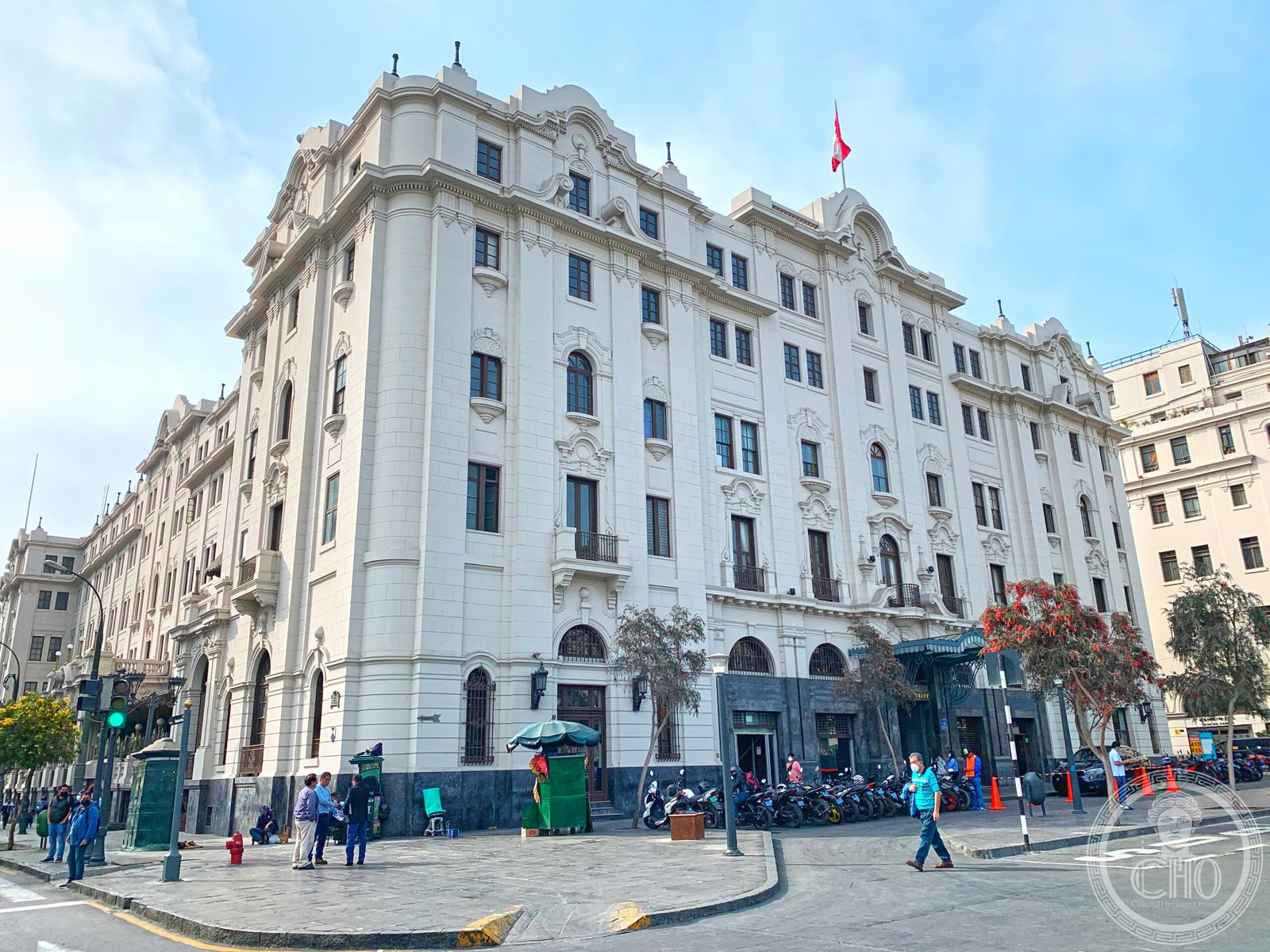
Standing on the south-western corner of Plaza San Martín in the historic centre of Lima, the Gran Hotel Bolívar has been the ceremonial hotel of Peru since its inauguration on 6 December 1924. Designed by architect Rafael Marquina y Bueno and built to host the foreign delegations attending the centennial celebrations of the Battle of Ayacucho — the decisive engagement that sealed South American independence from Spain — it was the first large modern hotel in Lima and instantly became the social and diplomatic nexus of the Peruvian capital. Its Beaux-Arts facades, articulated by pilasters, cornices, and Juliet balconies overlooking the plaza, gave way inside to an Art Deco interior of particular refinement: a domed lobby of stained glass and polished marble, tea rooms, and bars where, in the 1940s and 1950s, guests including Orson Welles, Ava Gardner, John Wayne, and the Duke of Windsor encountered the city’s famous Pisco Sour — a cocktail the hotel’s bar claims to have popularised internationally.
At a glance
- Type
- Historic hotel / heritage landmark
- Period
- 1924 (inaugurated); 1938 renovation to five floors
- Style
- Beaux-Arts / Art Deco
- Location
- Jirón de la Unión 958, Lima, Peru
- Coordinates
- 12.053° S, 77.033° W
- Architect(s)
- Rafael Marquina y Bueno
Overview
The Gran Hotel Bolívar occupies the entire south-western block facing Plaza San Martín, one of Lima’s grandest urban spaces, created in 1921 for the centennial of Peruvian independence. The hotel’s principal facade presents five floors of Beaux-Arts severity: rusticated base, piano nobile with tall arched windows framed by pilasters, and a balustraded roofline interrupted by corner towers. The interior is organised around a spectacular oval vestibule crowned by a stained-glass dome illuminating a marble-floored lobby of considerable grandeur. The Bar Bolívar — ground-floor, wood-panelled, and perpetually lit by afternoon light filtered through gauze curtains — has been pouring Pisco Sours since the 1920s and remains one of the storied cocktail destinations of South America.
History
President Augusto B. Leguía commissioned the hotel as part of a broader programme to modernise Lima in anticipation of two centennial celebrations: the independence centenary of 1921 and the Battle of Ayacucho centenary of 1924. Architect Rafael Marquina y Bueno, trained in Europe, delivered a building that matched the grandeur of the best hotels in Buenos Aires and Rio de Janeiro. Inaugurated on 6 December 1924 by Leguía himself, it welcomed its first foreign heads of state within weeks. A 1938 renovation added two additional floors and updated interior spaces in Art Deco style. Through the 1940s and 1950s it was the undisputed address of Lima’s elite and of every visiting international celebrity. Decades of economic turbulence brought periods of decline, but the building’s landmark status and its association with Peruvian cultural identity ensured its survival as a working hotel into the twenty-first century.
Architecture & Design
Marquina y Bueno synthesised the academic Beaux-Arts tradition, which he had studied in Europe, with the emerging Art Deco sensibility of the 1920s. The exterior follows classical tripartite composition — base, shaft, capital — with Ionic pilasters framing arched windows on the principal storey and a cornice line of sculptural dentils and modillions. The interior reveals the Art Deco hand more clearly: the stained-glass dome of the oval vestibule, its ribs of wrought iron gilded and picked out against translucent panels, fills the lobby with a warm amber light. The grand staircase, ballrooms, and Bar Bolívar retain original woodwork, terrazzo floors, and plaster friezes that survived successive refurbishments. The building’s corner tower, visible from across Plaza San Martín, is a Lima landmark comparable in civic presence to the Gran Hotel itself.
Cultural significance
The Gran Hotel Bolívar is, in the fullest sense, a social archive of twentieth-century Lima. Its guest registers read as a roster of hemispheric and global power: presidents, Nobel laureates, film stars, and royalty all passed through its marble lobby. It hosted the diplomatic receptions that shaped Peruvian foreign policy between the world wars and provided a neutral meeting ground through the political turbulences of subsequent decades. The hotel is inseparable from the mythology of the Pisco Sour, the contested national cocktail of Peru, and from the broader project of Lima’s self-presentation as a modern Latin American capital. Its Beaux-Arts facade, facing Plaza San Martín, anchors the visual identity of one of UNESCO’s Historic Centre World Heritage Sites.
Visiting today
The Gran Hotel Bolívar operates as a three-star hotel with 180 rooms, retaining its historic common areas for guests and walk-in visitors. The Bar Bolívar is open to non-guests and is the essential experience: a Pisco Sour served in the original 1920s bar is one of Lima’s culinary rites of passage. The oval lobby and stained-glass dome can be admired from the entrance hall. Guided heritage tours of the interior can be arranged through the concierge. The hotel faces Plaza San Martín directly, which is freely accessible and contains the equestrian statue of José de San Martín. The surrounding Jirón de la Unión pedestrian street connects to Plaza Mayor and the Cathedral.
Getting there
Plaza San Martín and the Gran Hotel Bolívar sit at the heart of Lima’s historic centre (Cercado de Lima), approximately 12 km west of Jorge Chávez International Airport. The easiest connection from the airport is by taxi or Uber (30–60 minutes depending on traffic). The Metropolitano rapid bus service, Line A, stops at Jirón de la Unión a short walk from the plaza. City buses serving the historic centre are numerous but routes require local knowledge; taxis remain the most practical option for visitors. The hotel offers valet parking for arriving guests.
Sources & resources
Find it on the map
See this place and what’s around it →Record researched and written by Luigi De Marchi for Cultural Heritage Online, 2026.
📷 Become a Cultural Heritage Online photographer
Share your photos of places: they stay published under your name as the author. The more they're seen, the more you get noticed — and soon a contest will reward the most appreciated photos.
Log in or sign up free to add a photoIs this page about you?
This page is read by travellers and heritage enthusiasts who find it on Google. Tell us how you are connected to this place and we will take it from there.