

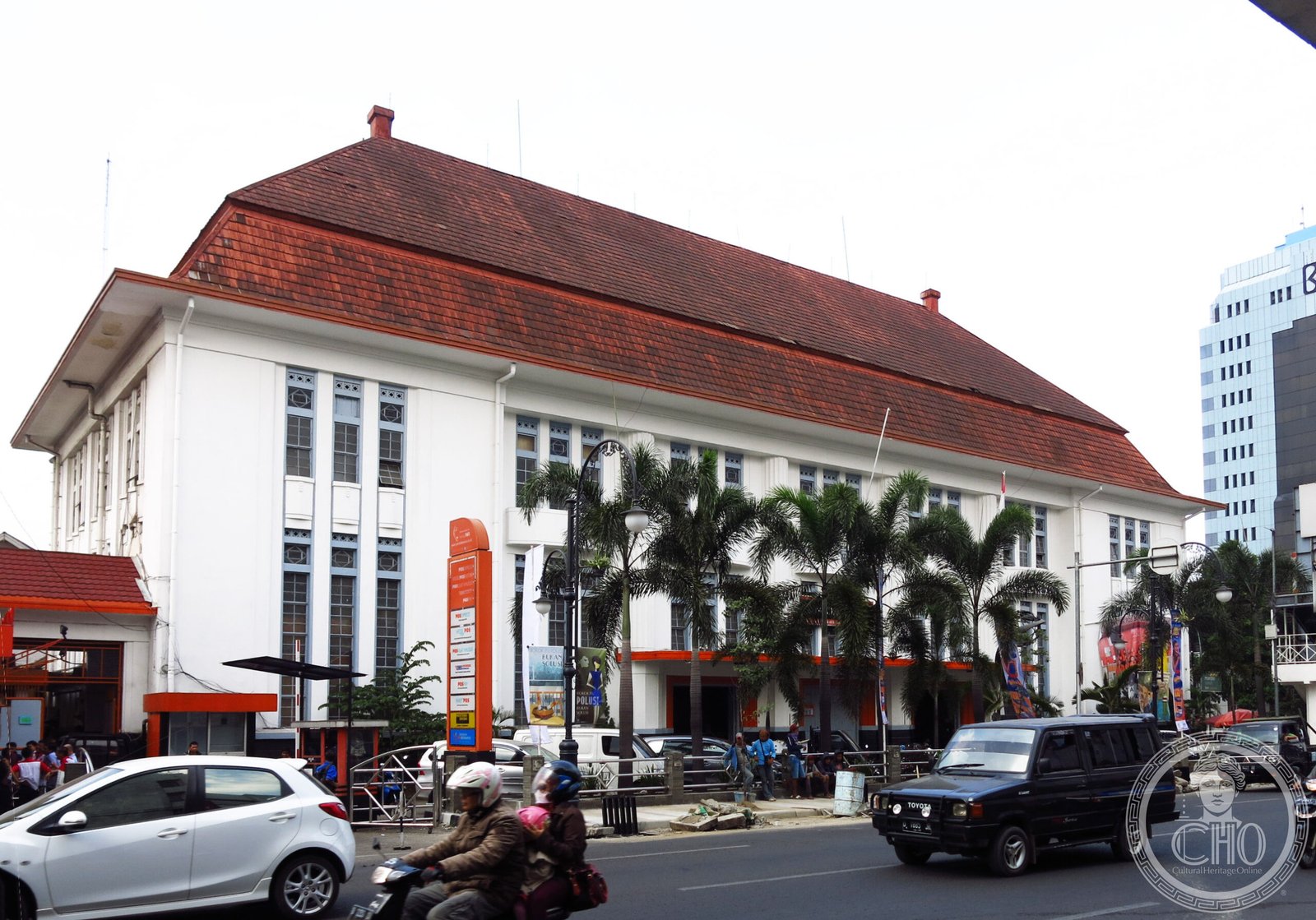
The Bandung Central Post Office — Gedung Pos Besar — is one of the finest surviving examples of Dutch colonial modernist architecture in Southeast Asia. Designed by J. van Gennep for the PTT (Netherlands Indies Post, Telegraph and Telephone Service) and completed in 1929, the building exemplifies the “Nieuwe Zakelijkheid” (New Objectivity) that Dutch architects brought to colonial Indonesia in the interwar period: clean horizontal banding, large windows for natural illumination, rational floor plans, and a complete rejection of the Neo-Classical ornament of the previous generation. The building served as communications hub for all of West Java, processing telegrams, postal parcels, and correspondence for a region of millions. It stands on Jalan Asia-Afrika — the same storied avenue that later hosted the 1955 Bandung Conference — as part of the remarkable concentration of Art Deco and modernist buildings that earned Bandung the nickname “the Paris of Java.” Today it operates as a functioning post office and is recognised as a heritage monument by the Indonesian government.
At a glance
- Type
- Post Office / Government Building
- Period
- 1929
- Style
- Dutch Functionalism / Art Deco (Nieuwe Zakelijkheid)
- Location
- Jalan Asia-Afrika, Bandung, West Java, Indonesia
- Coordinates
- 6.9166° S, 107.6097° E
- Architect(s)
- J. van Gennep (PTT Netherlands Indies)
Overview
The Bandung Central Post Office sits on Jalan Asia-Afrika, the ceremonial avenue that runs through the heart of Bandung’s historic colonial district. The building is a key landmark in one of Asia’s most intact interwar modernist streetscapes, alongside the Savoy Homann Hotel, the Grand Hotel Preanger, and Bandung City Hall. Its construction in 1929 reflected the rapid expansion of Dutch colonial infrastructure as Bandung grew into the de facto administrative capital of the Netherlands Indies — a city whose temperate highland climate made it the preferred base for European administrators, businesses, and military headquarters. The post office handled the communications lifeline connecting the colony to the Netherlands and the world.
History
The Netherlands Indies PTT commissioned a new central office for Bandung as part of a wider programme of public building modernisation in the 1920s. The previous post office was an older colonial structure inadequate for the explosive growth in postal and telegraphic traffic. Van Gennep’s design was selected for its modernity and efficiency. Completed in 1929, the building became an immediate fixture of Bandung’s civic identity. During the Japanese occupation of 1942-45 it continued operating under military control. At independence in 1945 it was absorbed into the Indonesian postal service (Pos Indonesia). The building survived intact through the upheavals of the independence struggle and subsequent decades, and was formally listed as a heritage monument under Indonesian law in the 1990s.
Architecture & Design
The building’s facade is a textbook demonstration of Dutch Nieuwe Zakelijkheid principles transplanted to the tropics. Horizontal white render bands alternate with deep-set window rows, creating strong light-and-shadow rhythms suited to Bandung’s bright equatorial sun. A prominent clock tower on the corner anchors the street intersection and provides a vertical accent to an otherwise horizontal composition. The ground floor features a generous public hall with high ceilings designed for customer traffic — an expression of the PTT’s public-service mandate. The structure is reinforced concrete throughout, a material choice that both signalled modernity and provided durability in a seismically active region. Decorative metalwork on doors and grilles employs restrained geometric Art Deco motifs consistent with the building’s period.
Cultural significance
The Bandung Central Post Office is significant as both an architectural monument and a symbol of the communications infrastructure that connected colonial Indonesia to the wider world. Jalan Asia-Afrika, where it stands, became globally famous as the venue of the 1955 Asian-African Conference — a street that now carries the memory of the Non-Aligned Movement. The post office is part of the official “Bandung Heritage Trail,” recognised by UNESCO’s Asia-Pacific Heritage programme as a component of the city’s exceptional interwar architectural legacy. For architectural historians, it represents the moment when Dutch colonial building practices shed their historicist references and embraced modernism fully.
Visiting today
The building operates as a functioning branch of Pos Indonesia and is freely accessible during business hours. The public hall interior retains many original features. Bandung’s Jalan Asia-Afrika is a major tourist circuit; the post office can be combined with visits to the Savoy Homann Hotel (50 m east), Gedung Merdeka (the 1955 Conference venue across the street), and the Grand Hotel Preanger. Guided heritage walks of the Asia-Afrika corridor are available through local tourism operators and the Bandung Heritage Society.
Getting there
Jalan Asia-Afrika runs through central Bandung, approximately 3 km from Bandung Railway Station (Stasiun Bandung). Angkot (shared minibus) routes serve the city centre from the station. The street is navigable on foot or by becak (cycle rickshaw) from nearby hotels. From Jakarta, Bandung is reachable by Argo Parahyangan or Argo Wilis express trains in approximately 3 hours, or by Trans-Java toll road (approximately 3.5 hours by car).
Sources & resources
Find it on the map
See this place and what’s around it →Record researched and written by Luigi De Marchi for Cultural Heritage Online, 2026.
📷 Become a Cultural Heritage Online photographer
Share your photos of places: they stay published under your name as the author. The more they're seen, the more you get noticed — and soon a contest will reward the most appreciated photos.
Log in or sign up free to add a photoIs this page about you?
This page is read by travellers and heritage enthusiasts who find it on Google. Tell us how you are connected to this place and we will take it from there.