
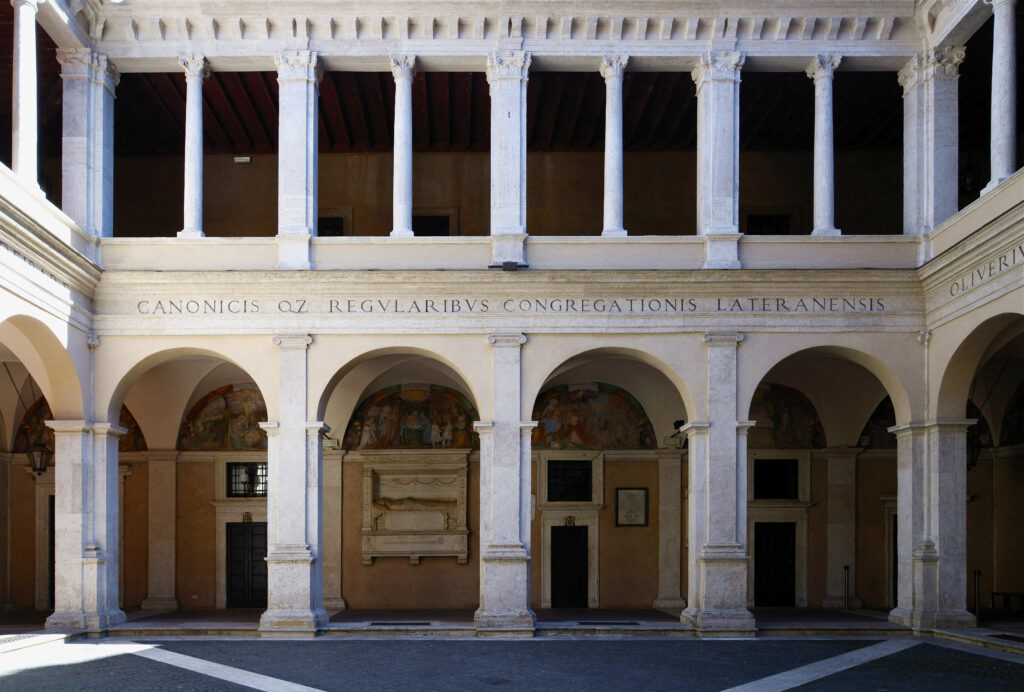
Bramante came down from Milan and built this cloister first. Everything he did afterwards in Rome, including the new Saint Peter’s, starts from the problem he set himself here.
At a glance
The cloister adjoins the church of Santa Maria della Pace, in the Parione district between Piazza Navona and the Tiber. Cardinal Oliviero Carafa commissioned it around 1500 and Donato Bramante finished it in 1504. It was his first work in Rome, after his Milanese years, and it is one of the essential buildings of the High Renaissance. The plan is square, with sixteen columns forming the portico; the ground floor carries Ionic pilasters supporting an entablature with a frieze, and two superimposed orders of loggias, Doric and Ionic, surround the central court. It is used today for exhibitions, concerts and meetings, with a café and bookshop.
Key facts
- Commissioned: around 1500, by Cardinal Oliviero Carafa
- Architect: Donato Bramante
- Completed: 1504
- Significance: Bramante’s first work in Rome, after his period in Milan
- Plan: square, sixteen columns forming the portico
- Orders: two superimposed loggias, Doric below and Ionic above; Ionic pilasters and an entablature with frieze at ground level
- Adjoins: the church of Santa Maria della Pace, which holds Raphael’s Sibyls
- GPS: 41.900022, 12.471503 — View on Google Maps
History
Bramante arrived in Rome around 1499, after the French took Milan and his patron Ludovico Sforza fell. He was in his fifties, with a substantial Lombard career behind him, and what he did in Rome over the next fifteen years reset European architecture. This cloister is where it starts.
Oliviero Carafa, a Neapolitan cardinal and a serious patron, gave him the commission around 1500. The work was done by 1504, which is fast for the period and suggests a design without hesitation in it. The next year Bramante built the Tempietto at San Pietro in Montorio; within another year he had the commission for the new Saint Peter’s.
The cloister passed through the usual Roman afterlives and is now run as an exhibition venue, which means that unlike most buildings of its rank it is open, heated, and in continuous public use. The church next door holds Raphael’s frescoes of the Sibyls, painted a few years after the cloister was finished.
What you see
A square court, the ground floor an arcade on piers with Ionic pilasters, the upper level a loggia in which a column is set over the centre of each arch below. That upper column is the thing to look at. It breaks the medieval rule that a support should sit over a support, and it was criticised at the time; Bramante did it to keep the rhythm of the two storeys in proportion, and it is the earliest clear statement of his willingness to argue with inherited practice on grounds of design.
Stand in the middle of the court and count. Sixteen columns, two orders, an entablature that runs unbroken. The whole thing is small, and it is deliberately, almost austerely, legible — which is why architects have come to look at it for five centuries.
Practical information
- Exhibition venue with regular opening; the cloister itself can be seen from the upper loggia café without an exhibition ticket
- The church of Santa Maria della Pace next door has its own, shorter, opening hours — check both
- A window from the upper loggia looks into the church, onto Raphael’s Sibyls
Getting there
The entrance is on Arco della Pace, a lane off Via della Pace, two minutes west of Piazza Navona in the historic centre of Rome. There is no metro nearby; walk from Corso Vittorio Emanuele II, which is served by many bus routes.
Nearby
- Tomb of Cecilia Metella — on the Appian Way, Roman rather than Renaissance
- Museo Nazionale Romano, Palazzo Massimo — the city’s ancient collections
Sources
- Wikipedia, « Chiostro del Bramante » — the commission by Cardinal Oliviero Carafa around 1500, Bramante’s authorship, the completion in 1504, the square plan and sixteen columns, the two superimposed orders, and the present use
- Chiostro del Bramante, own history pages — the building and its programme
- Wikipedia (Italian), « Chiesa di Santa Maria della Pace (Roma) » — the church and Raphael’s Sibyls
- OpenStreetMap Nominatim — coordinates verified against Arco della Pace
Find it on the map
See this place and what’s around it →

📷 Become a Cultural Heritage Online photographer
Share your photos of places: they stay published under your name as the author. The more they're seen, the more you get noticed — and soon a contest will reward the most appreciated photos.
Log in or sign up free to add a photoIs this page about you?
This page is read by travellers and heritage enthusiasts who find it on Google. Tell us how you are connected to this place and we will take it from there.