

,_actual_Hotel_Ohla.jpg)
Built in 1926 on the new Via Laietana, this rounded corner block has been a family house of offices, a celebrated department store and a police building. Today it is a hotel, and dozens of ceramic eyes look out from its facade.
At a glance
Casa Vilardell, also called the Casa Salas-Bulbena, stands at Via Laietana 49, at the corner of Carrer Comtal. The City of Barcelona records it as an office building of 1926 by the architect Juan A. Roig, in an eclectic style, protected at level C. Its ground floor housed the Vilardell department store from 1928. Since 2012 the building, gutted behind its facades, has been the Ohla Barcelona hotel.
Key facts
- Where: Via Laietana 49, corner of Carrer Comtal 37, Ciutat Vella, Barcelona
- Architect: Juan A. (Joan A.) Roig
- Date: 1926
- Clients: Heribert Salas and Glòria Bulbena (named in the municipal catalogue)
- Protection: bé amb elements d’interès, level C of the Barcelona heritage catalogue, record 1246
- Current use: Ohla Barcelona hotel, opened 2012 (Viquipèdia)
- Coordinates: 41.386939, 2.174281 · open in Google Maps
History
The municipal catalogue names this one after Heribert Salas and Glòria Bulbena and records it as a 1926 project by the architect Juan A. Roig, filed in the city archive.
According to the Catalan Wikipedia, the Casa Vilardell department store, founded in 1911, moved into the ground floor and mezzanine in 1928 and became one of the most popular in the city; after it closed in the 1970s its space was taken by the national police. The municipal catalogue still gives the building’s later name as the Dirección General de la Policía.
In the twenty-first century the building was bought by a hotel company. The Catalan Wikipedia records that the interior was demolished in 2008, keeping only the facades, to build a five-star hotel by Alonso, Balaguer i Arquitectes Associats, opened in February 2012. The artist Frederic Amat added the ceramic eyes that gave it its nickname.
What you see
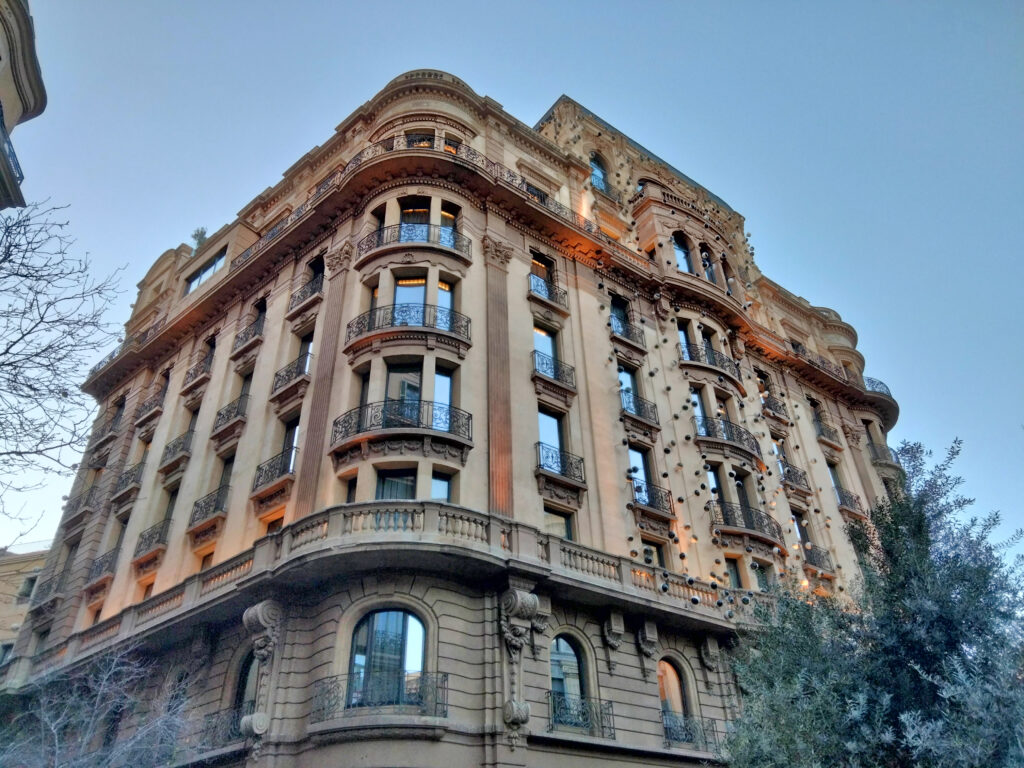
The photograph looks up at the rounded corner. The facade is in stone-coloured stucco, laid in horizontal bands on the lower floors as the catalogue describes. A balustrade runs along the first floor; above it the windows open onto individual balconies with iron railings, and on the curved central bay the balconies are stacked one above another.
The building ends in a heavy cornice and a curved attic storey above the corner. On the right-hand front, dozens of small round objects are scattered across the wall between the windows: these are Frederic Amat’s ceramic eyes, attached to the historic facade when the hotel was built.
Practical information
- The building is a working hotel; the facades can be seen from Via Laietana and Carrer Comtal at any time.
- The ceramic eyes are easiest to see from the opposite pavement of Via Laietana.
Getting there
Urquinaona metro station (lines L1 and L4) is about three minutes’ walk up Via Laietana. Plaça de Catalunya is about seven minutes away on foot.
Nearby
- Palau de la Música Catalana, about 100 m away across Via Laietana.
- Barcelona Cathedral, about 400 m south.
- Plaça Nova and the Roman gate of Bàrcino, about 350 m away.
Sources
- Ajuntament de Barcelona, Catàleg de Patrimoni, record 1246 — Casa Heriberto Salas i Glòria Bulbena: architect, date, level C and the description of the facades.
- Viquipèdia, Casa Vilardell: the department store, the police and the hotel conversion.
- Ohla Barcelona — current use.
- Wikimedia Commons, category Ohla Hotel: the building as Casa Salas-Bulbena, Via Laietana 49 – Carrer Comtal 37.
- OpenStreetMap / Nominatim — position and address, returned as 49, Via Laietana, la Catedral, el Gòtic, Ciutat Vella, Barcelona.
- The history of the department store and of the conversion rests on the Catalan Wikipedia, which cites the Barcelofília blog; we have not found a second independent source.
Find it on the map
See this place and what’s around it →📷 Become a Cultural Heritage Online photographer
Share your photos of places: they stay published under your name as the author. The more they're seen, the more you get noticed — and soon a contest will reward the most appreciated photos.
Log in or sign up free to add a photoIs this page about you?
This page is read by travellers and heritage enthusiasts who find it on Google. Tell us how you are connected to this place and we will take it from there.