

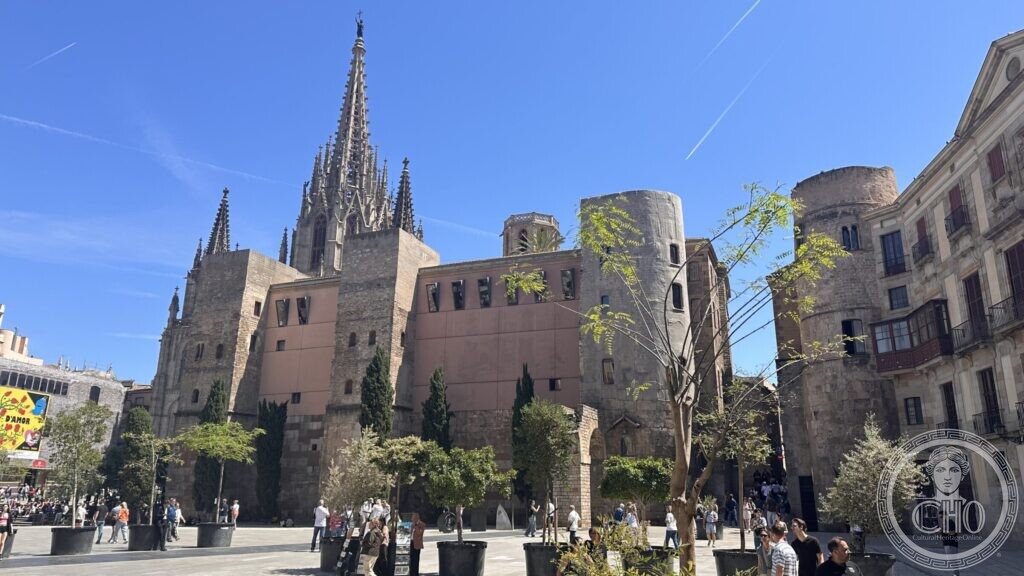
Barcelona, Catalonia · 1st century BC · Roman city gate
At a glance
Two round towers stand at the eastern end of Plaça Nova, one built into the Casa de l’Ardiaca, the other into the Bishop’s Palace. They flanked the north-west gate of Bàrcino, the Roman colony founded under Augustus, and the street that runs between them — Carrer del Bisbe — is still the line of the ancient decumanus maximus. The gate itself had three passages. Only the towers survive.
Key facts
- Built: 1st century BC, at the foundation of Bàrcino; reinforced in the 4th century AD
- Masonry: opus quadratum, large squared blocks, dismantled and reused in the Middle Ages
- The gate: originally three passages; the two semicircular flanking towers remain
- Popular name: Portal del Bisbe, from the tower attached to the Bishop’s Palace
- Later work: windows cut in the 17th century, the towers joined by an arch that stood until the 19th
- Aqueduct: the arcade attached to one tower was reconstructed in 1958 on foundations found in the subsoil
- The houses built against the towers were cleared in 1955–58, when Plaça Nova took its present shape
- Coordinates: 41.3840035, 2.1754340
What you see
The towers read as two different buildings from two different centuries, because that is what they are. The lower courses are Roman, the big blocks laid dry and square. Above them the medieval city went on building in rougher stone, and cut windows where it wanted light. On the flank of one tower the reconstructed aqueduct arcade steps up towards the square, and a 16th-century shrine to Saint Roch, protector against epidemics, is set into the wall.
Turn round and the whole of Plaça Nova is a cleared space: benches, planted trees, a crowd. That openness is recent. Until the 1950s, houses stood against the Roman stone, and the towers were something you walked past without seeing.
Photographs

Practical information
- The towers stand on the public square and can be seen at any hour.
- Carrer del Bisbe, the street between them, is the Roman decumanus and leads to Plaça de Sant Jaume.
Sources
- Pobles de Catalunya — Portal del Bisbe (Porta Praetoria), Barcelona: the three-passage gate, the surviving towers, the 17th-century windows and connecting arch, the aqueduct arcade reconstructed in 1958, the shrine of Saint Roch
- Pobles de Catalunya — Torres romanes de la plaça Nova: 1st-century BC construction, 4th-century AD reinforcement, opus quadratum, medieval reuse, and the 1955–58 clearance of the square
Record researched and written by Luigi De Marchi for Cultural Heritage Online, 2026.
Find it on the map
See this place and what’s around it →📷 Become a Cultural Heritage Online photographer
Share your photos of places: they stay published under your name as the author. The more they're seen, the more you get noticed — and soon a contest will reward the most appreciated photos.
Log in or sign up free to add a photoIs this page about you?
This page is read by travellers and heritage enthusiasts who find it on Google. Tell us how you are connected to this place and we will take it from there.