

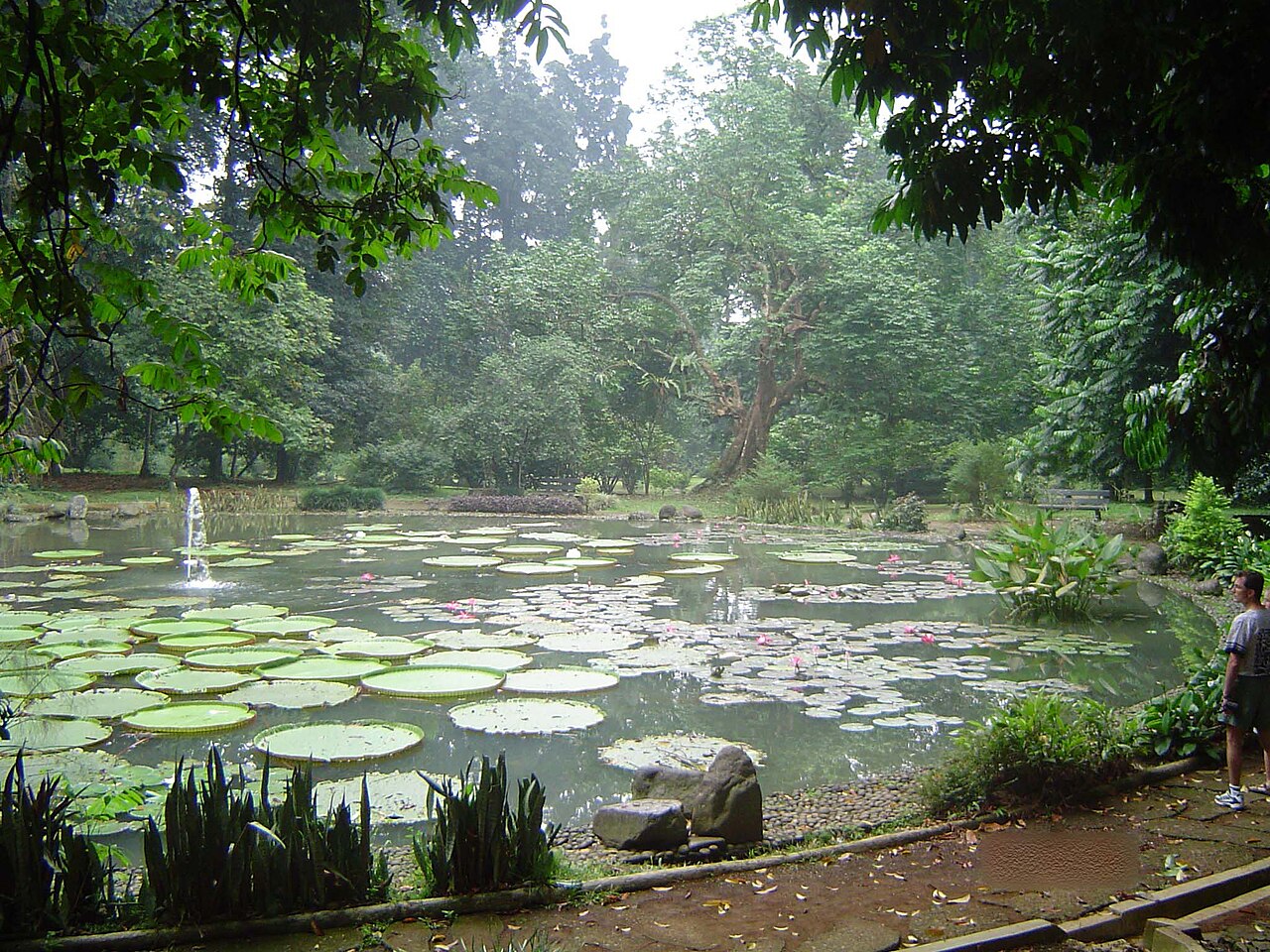
The rain-city’s great garden – 87 hectares where colonial botany bred an empire’s crops and the corpse flower first bloomed in cultivation.
At a glance
- Type
- Botanical garden
- Period
- 1817
- Style
- Tropical scientific garden
- Location
- Bogor, West Java, Indonesia
- Coordinates
- -6.5972, 106.7997
- Founder
- C. G. C. Reinwardt under Dutch administration
Overview
Kebun Raya Bogor spreads 87 hectares around the presidential palace in Java’s thunder-capital (the world’s most lightning-struck city by repute) – founded 1817 as the Dutch Indies’ scientific engine: oil palm’s African seedlings trialled here seeded Southeast Asia’s industry; tea, cinchona, and rubber passed through its beds to remake the tropics’ economies.
History
Reinwardt’s garden grew under Treub’s direction into the tropics’ premier research station – the buitenzorg of botany’s literature; Amorphophallus titanum, the corpse flower, first bloomed in cultivation here in 1889, scandalizing and delighting. Independence kept science’s continuity; the herbarium and LIPI institutes ring the lawns where deer crop beneath 175-year canarium avenues.
Architecture and Design
The palace’s white porticoes (Sukarno’s residence of choice) face the great pond’s Victoria lilies; Lady Raffles’ memorial – Stamford’s wife died at Bogor – gleams among heliconias. Orchid houses and the old mutinied-upon laboratories thread the collections’ 13,000 specimens.
Cultural significance
Bogor wrote economic botany’s tropical chapter – for better and империи worse – and remains Indonesia’s scientific garden-heart, weekend lung of Jakarta’s millions.
Visiting today
Open daily; weekdays escape the crowds, mornings the rain. The palace viewable from the lawns; corpse-flower blooms make national news – check the calendar.
Getting there
Commuter rail from Jakarta reaches Bogor in an hour; the garden gates open beside the station’s angkot swarm.
Sources and resources
Find it on the map
See this place and what’s around it →Record researched and written by Luigi De Marchi for Cultural Heritage Online, 2026.
📷 Become a Cultural Heritage Online photographer
Share your photos of places: they stay published under your name as the author. The more they're seen, the more you get noticed — and soon a contest will reward the most appreciated photos.
Log in or sign up free to add a photoIs this page about you?
This page is read by travellers and heritage enthusiasts who find it on Google. Tell us how you are connected to this place and we will take it from there.