
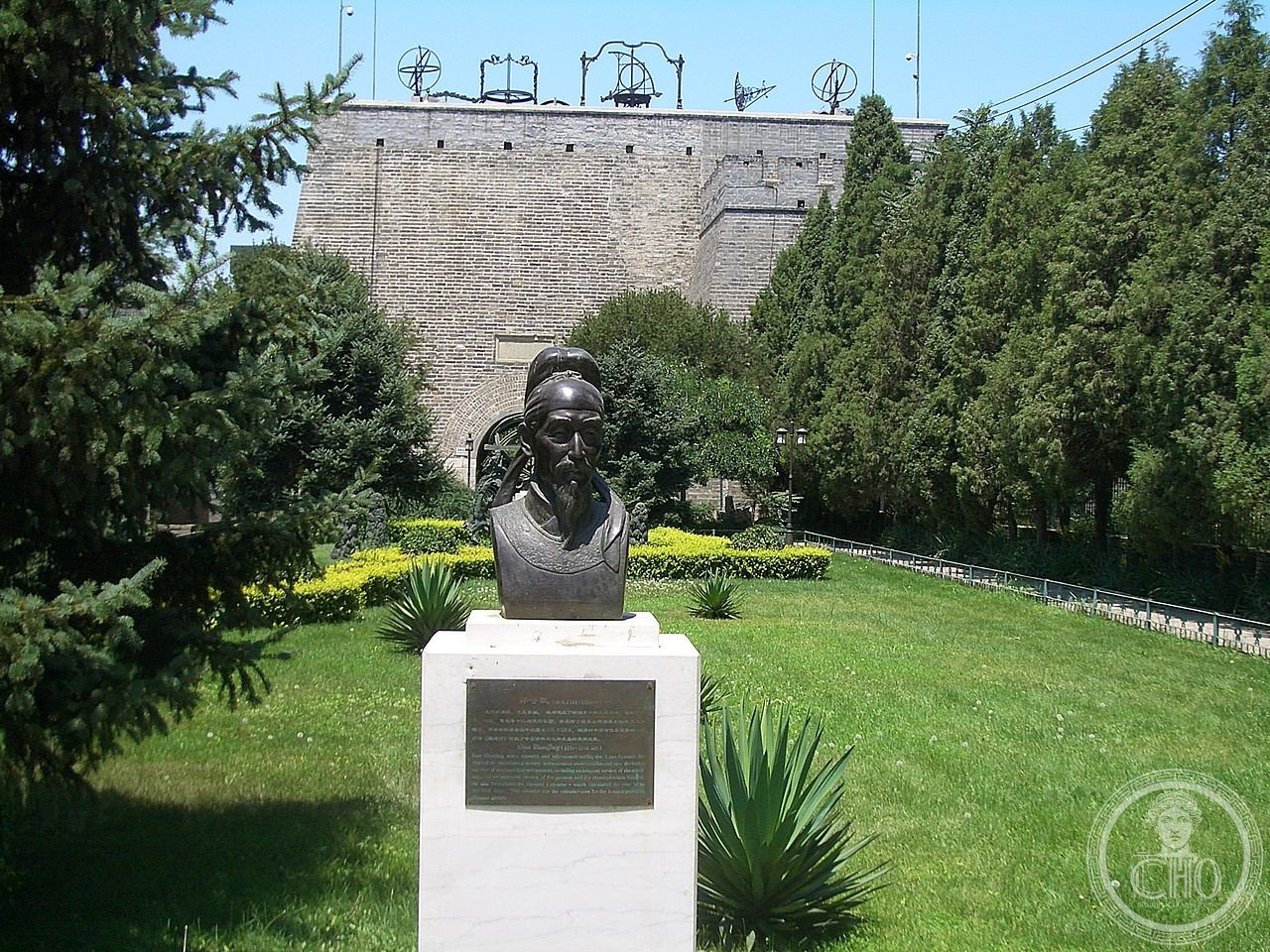
Bronze dragons holding the sky – the Ming wall-tower where Jesuit and Chinese astronomers shared instruments for 500 years of unbroken observation.
At a glance
- Type
- Historic observatory
- Period
- 1442; Jesuit instruments 1670s
- Style
- Ming platform with bronze instrument terrace
- Location
- Jianguomen, Beijing, China
- Coordinates
- 39.9061, 116.4288
- Keepers
- Imperial Astronomical Bureau; Jesuit directors Verbiest, Schall
Overview
On a Ming city-wall platform of 1442 stand eight bronze instruments – armillary spheres, quadrants, a celestial globe – cast under Jesuit directors Ferdinand Verbiest and his successors for the Qing court: dragons coil the mountings where Chinese and European astronomy merged in the emperor’s service. Five centuries’ continuous observations ran from this terrace – the world’s longest such record from one site.
History
Kublai’s observatory preceded; the Ming bureau fixed calendars – heaven’s mandate’s mathematics – and the calendar contest of 1668 made Jesuit science the bureau’s law. The instruments’ 1900 looting to Berlin and Paris (returned by Versailles’ treaty clause) wrote imperialism’s footnote; the terrace reopened as museum among Jianguomen’s traffic, dragons against glass towers.
Architecture and Design
The 14-metre platform carries the bronze garden’s baroque-Chinese hybrids – Verbiest’s sextant’s European geometry on lion-and-cloud feet; ground courtyards display Ming originals and the bureau’s halls’ exhibitions on calendar science.
Cultural significance
The observatory embodies the Jesuit-Chinese exchange – science as diplomacy’s currency – and imperial cosmology’s working office; historians of astronomy rank the terrace with Maragha and Samarkand.
Visiting today
Open Tuesday-Sunday, modest fee; the instruments photograph best against morning sky. The Ming wall relics park continues the fortification’s line east.
Getting there
Jianguomen station (lines 1-2) exits at the platform’s foot.
Sources and resources
Find it on the map
See this place and what’s around it →Record researched and written by Luigi De Marchi for Cultural Heritage Online, 2026.
📷 Become a Cultural Heritage Online photographer
Share your photos of places: they stay published under your name as the author. The more they're seen, the more you get noticed — and soon a contest will reward the most appreciated photos.
Log in or sign up free to add a photoIs this page about you?
This page is read by travellers and heritage enthusiasts who find it on Google. Tell us how you are connected to this place and we will take it from there.