
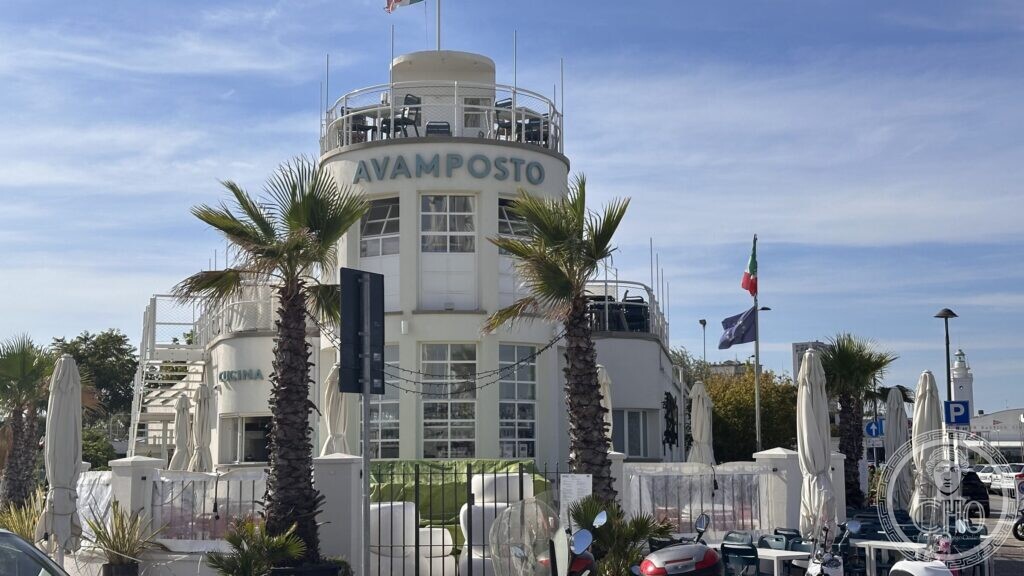
A small white building shaped like a ship, moored at the end of the port canal with its bow to the sea, watching the boats come home.
At a glance
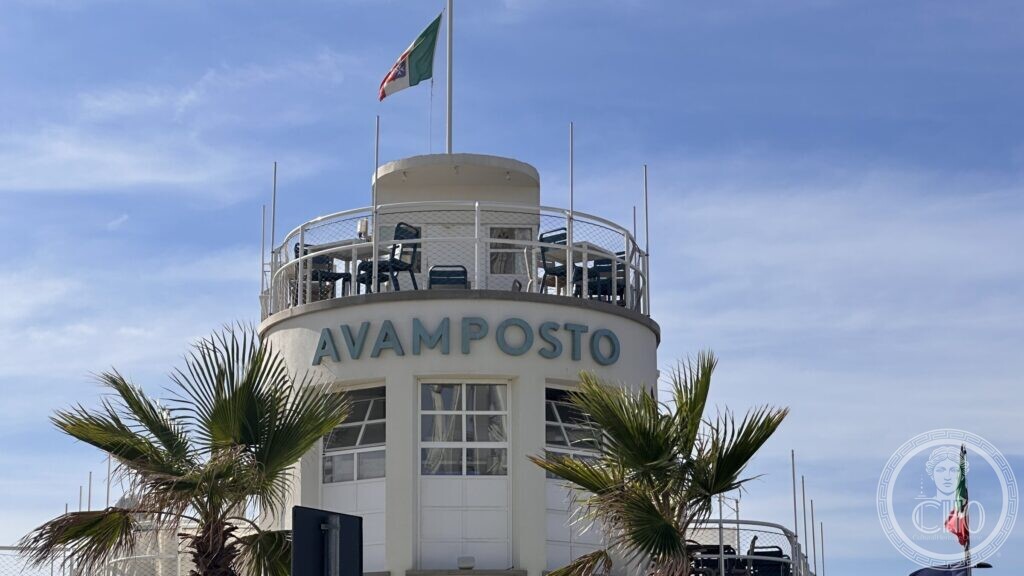
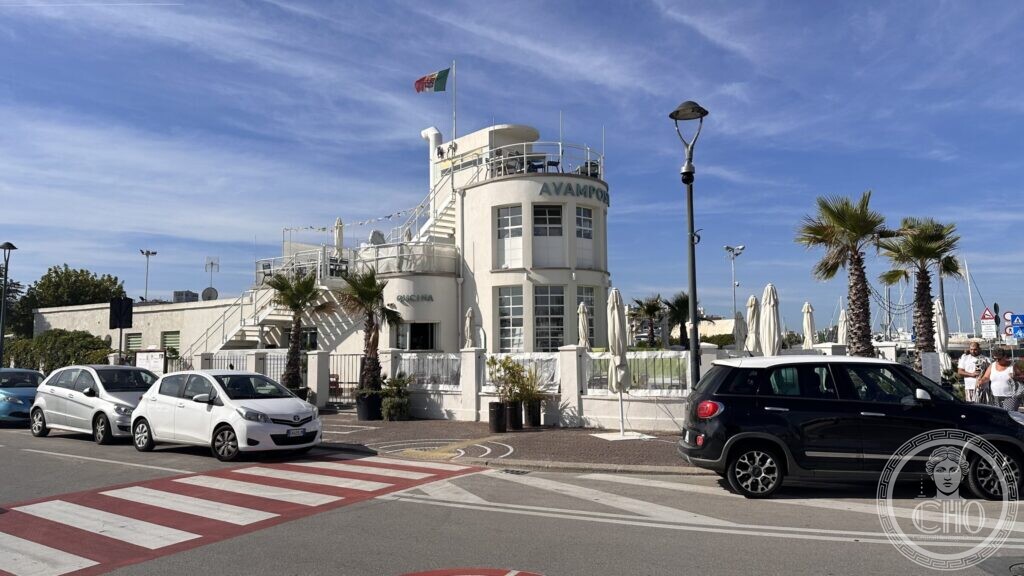
At Largo Boscovich, where Rimini’s port canal opens to the Adriatic, stands a low white building built to look like a ship: a curved prow towards the water, portholes and rounded corners, an outside stair like a companionway, and a round lookout turret on top with a railed deck. Its name, cut in relief round the turret, is AVAMPOSTO — the outpost. It is the seat of the Rimini group of the Associazione Nazionale Marinai d’Italia, the national association of Italian sailors, and in season a restaurant works in it. It stands a few steps from the lighthouse, the fishing quays and the palata, the raised walkway out into the sea.
Key facts
- What it is: a lookout building in the form of a ship, at the sea end of the port canal
- Address: Largo Ruggero Boscovich 2, Rimini
- Occupant: the Rimini group of the Associazione Nazionale Marinai d’Italia, whose registered seat is at this address
- Date: not documented in the sources we could check. The operator dates the place to 1934; Rimini’s tourist listing calls it a lookout post of the 1940s. See the note below.
- Architect: not established
- Next to: the lighthouse, activated 1862, over 27 m high, range 15 nautical miles
- Coordinates: 44.076930, 12.575250 — Google Maps
History
Rimini’s port canal was, until the twentieth century, the last stretch of the river Marecchia: the river came down through the town and emptied here. The Comune dates the final diversion of the river to a new channel further north to 1972, the end of a work begun in the 1920s. The moles were being lengthened from the eighteenth century onwards, which is one reason the beach grew as it did, and the white lighthouse that the Comune calls eighteenth-century was given its rotating optic and lit in 1862. It is over twenty-seven metres tall and its light carries fifteen nautical miles.
This is working water, not scenery. Boats still go out from these quays for poveracce, the small clams of the Adriatic, and come back at dusk with the gulls behind them. The palata, the raised timber and stone walkway that runs out past the mole-head, is the walk people from Rimini take on a Sunday — and it is where Federico Fellini set the night in Amarcord when the whole town rows out to see the liner Rex pass. On the tip of the eastern mole stands the Sposa del marinaio, the sailor’s bride, by the sculptor Umberto Corsucci, for the women who waited on these quays and for the fishermen who did not come back.
The ship-shaped building belongs to that world rather than to the seaside-resort one a kilometre south. On its date the sources disagree, and we have not been able to settle it. The business that runs the restaurant in it dates the place to 1934 and calls it “the most famous lookout station in Rimini”; Rimini’s own tourist promotion describes it as a structure of the 1940s that served as a lookout post, with its bow pointing at the open sea. We have found no municipal, superintendency or catalogue record that gives a date or names a designer. What is certain is the address, the form, and the fact that the sailors’ association has its seat here.
What you see
Everything about the building is a ship except that it is made of masonry. The plan is rounded at the seaward end like a bow; the walls are white and the corners are curved; the windows of the upper floor are set in a continuous band; a steel stair with tubular rails climbs the outside like a companionway, and the railings are pipe, not wrought iron. On the roof, a round turret with a railed deck around it stands where a bridge would be, and a flagstaff rises from the middle of it.
Round the turret, in raised letters the colour of sea-green, is the single word AVAMPOSTO. Below, on the lower body, the word CUCINA has been added where the kitchen is. In front, palms and awnings; behind, the masts of the fishing boats and, at night, the lit wheel of the Ferris wheel on the quay.
The style is the rationalist nautical manner of the 1930s, the same architectural language as the colonie on the coast south of the city — ships made of concrete, built ashore. Here it is used at the smallest possible scale, on a building that really does keep watch on a port.
The building today

Practical information
- The building is in use as the seat of a sailors’ association and as a restaurant; the outside is freely visible from the public quay.
- The lighthouse alongside is opened to the public only on particular occasions, such as the Giornata del Mare on 11 April. Groups can request guided visits from the Navy: urp@marina.difesa.it
- Piazzale Boscovich is the departure point for boat trips along the coast, and the start of the palata walk.
- Can you date this building? If you hold documents, drawings or photographs of it, please write to us: we will correct this page and credit you.
Getting there
Largo Boscovich is at the north end of the port canal, reached on foot or by bicycle along viale Vespucci or over the Ponte della Resistenza, by car from viale Colombo or viale Tintori, and by bus on the urban lines that stop at “Porto”. Marina Centro and the Grand Hotel are ten minutes’ walk south along the sea.
Nearby
- The lighthouse and the old port canal, immediately alongside
- The palata and the Sposa del marinaio by Umberto Corsucci, at the mole-head
- The Deviatore Marecchia, the channel that took the river away from this canal
- The ex Scuole Marittime «Navicare Necesse», the school whose pupils sat their examinations at the Capitaneria here
- Grand Hotel Rimini, with a 360° virtual tour
Sources
- Comune di Rimini, Il Faro e l’antico porto canale and Piazzale Boscovich — for the lighthouse, the palata, the Rex, the Sposa del marinaio and the diversion of the river in 1972.
- Associazione Nazionale Marinai d’Italia — the Rimini group’s registered address, Piazzale Boscovich 2.
- Avamposto dei Marinai, the operator’s own site — for the date of 1934 and the description of the building as a lookout station.
- Visit Rimini (Rimini Welcome / Destination Services) — for the description of the building as a lookout post of the 1940s. The two datings are given here as what they are: claims that do not agree.
- On-site observation and photography, 7 September 2025.
Find it on the map
See this place and what’s around it →Record researched and written by Luigi De Marchi for Cultural Heritage Online, 2026.
📷 Become a Cultural Heritage Online photographer
Share your photos of places: they stay published under your name as the author. The more they're seen, the more you get noticed — and soon a contest will reward the most appreciated photos.
Log in or sign up free to add a photoIs this page about you?
This page is read by travellers and heritage enthusiasts who find it on Google. Tell us how you are connected to this place and we will take it from there.