

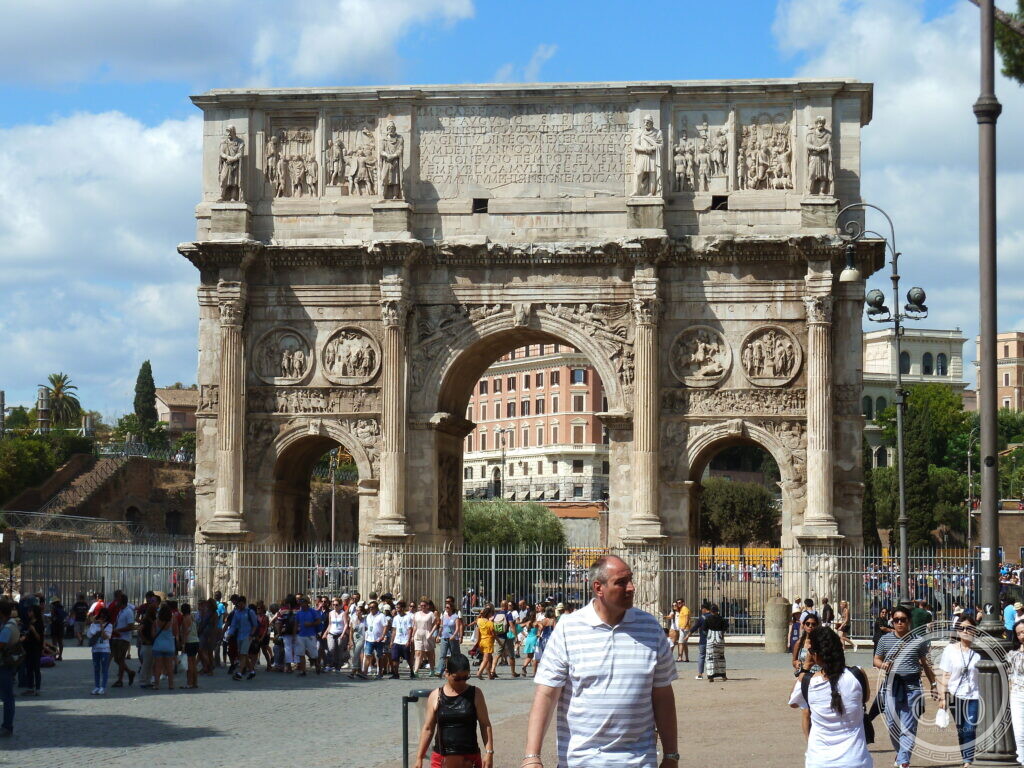
The largest surviving Roman triumphal arch, standing between the Colosseum and the Palatine. It was dedicated in 315 to Constantine’s victory at the Milvian Bridge, and it reuses reliefs and statues from monuments of three earlier emperors.
At a glance
Along the ancient route of triumphal processions, between the Circus Maximus and the Arch of Titus, the Arch of Constantine rises about 25 metres high. Built partly from spolia taken from monuments of Trajan, Hadrian and Marcus Aurelius, it was later incorporated into a medieval fortress of the Frangipane family and restored repeatedly from the late fifteenth century onward.
Key facts
- Where: Via di San Gregorio, Rome
- What: Monument
- When: Dedicated 25 July 315 AD
- GPS: 41.8898, 12.4907 · Open in Google Maps
History
The arch commemorates the triumph of Constantine over Maxentius after the battle at Ponte Milvio on 28 October 312 AD. According to the inscription on the central passage, the Senate and the People of Rome solemnly dedicated the monument in memory of that victory and on the occasion of the emperor’s decennalia, at the start of his tenth year of rule, on 25 July 315 AD. Its marble relief decoration was planned and executed in the Constantinian period as a single project, but it made extensive use of spoliated material from earlier imperial monuments. The portraits of rulers in the reused reliefs were recut to resemble Constantine, with a nimbus indicating imperial majesty. In the mid-twelfth century the arch was enclosed within the Frangipane stronghold. Renovations began at the end of the fifteenth century, continued through the sixteenth, and substantial additions were made to the missing parts in 1733. Near the arch stood the Meta Sudans, a monumental fountain built in the Flavian age and still in use until the fifth century AD; its ruins were later demolished in the 1930s to create Via dei Trionfi.
What you see
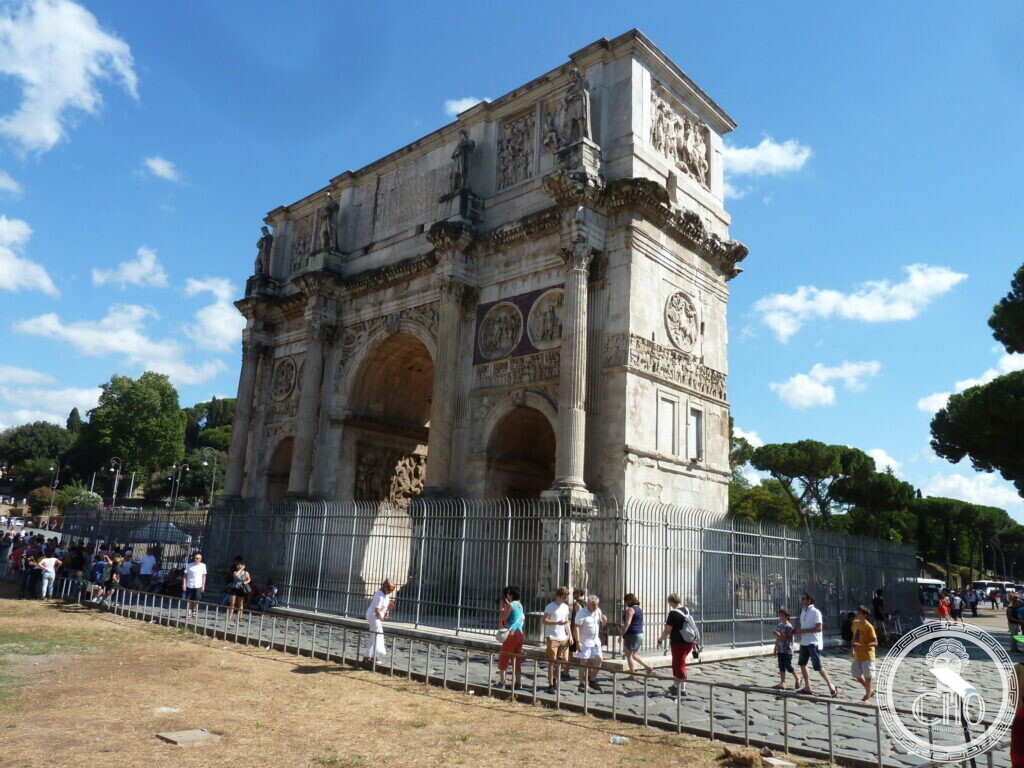
The photographs show a triple arch with eight detached columns and a long attic inscription above the central opening. The inscription reads SENATVS POPVLVSQVE ROMANVS IMP CAESARI FL CONSTANTINO MAXIMO P F AVGVSTO S P Q R. Eight statues of Dacian captives from Trajan’s Forum stand on the attic, framing the inscription and large panels of the Marcus Aurelius period with episodes from the Germanic war. Above the minor arches are round reliefs of the Hadrianic age showing hunts and sacrifices. A narrow frieze from the Constantinian era runs around the monument above the small arches, with scenes of Constantine’s campaign against Maxentius. The column bases are decorated with allegorical figures. In the photographs, visitors appear as small figures behind the metal fence that surrounds the monument.
Do you know more about this place?
If you know a date, a name, a document, a plaque or a photograph that tells its story, write to Sofia through the contact page. What arrives with a source goes into this page, with your name as the contributor.
Nearby
- Colosseum — Rome – Virtual Tour 360° — the amphitheatre immediately to the west of the arch
- Arch of Constantine — the Triumphal Arch of 315 Built from the Monuments of Thre — another card for the same monument
- The Palatine and the Roman Forum — the Heart of Ancient Rome — the ancient centre beyond the arch along the triumphal route
- Historic Centre of Rome – Virtual Tour 360° — the wider historic district that contains the monument
Gallery
Sources
- Turismo Roma, Arch of Costantine | Turismo Roma: dimensions, battle date, reused materials, later fortification and restorations
- Parco archeologico del Colosseo, Arco di Costantino e Meta Sudans – Parco archeologico del Colosseo: dedication date, decorative programme, spolia, Meta Sudans
- The Byzantine Legacy, Arch of Constantine: inscription text and translation, identification of reliefs and their original contexts
- OpenStreetMap, Arco di Costantino, Piazza dell’Arco di Costantino, Campitelli, Municipio Roma I, Roma, Roma Capitale, Lazio, 00184, Italia: address and coordinates
- Stefano Vigolo, photographs and notes to the editorial staff (2026): identification of the subject and the photographs. Not a published source
Find it on the map
See this place and what’s around it →📷 Become a Cultural Heritage Online photographer
Share your photos of places: they stay published under your name as the author. The more they're seen, the more you get noticed — and soon a contest will reward the most appreciated photos.
Log in or sign up free to add a photoIs this page about you?
This page is read by travellers and heritage enthusiasts who find it on Google. Tell us how you are connected to this place and we will take it from there.
This entry stays online and free either way — and a free account lets you add to it yourself.