

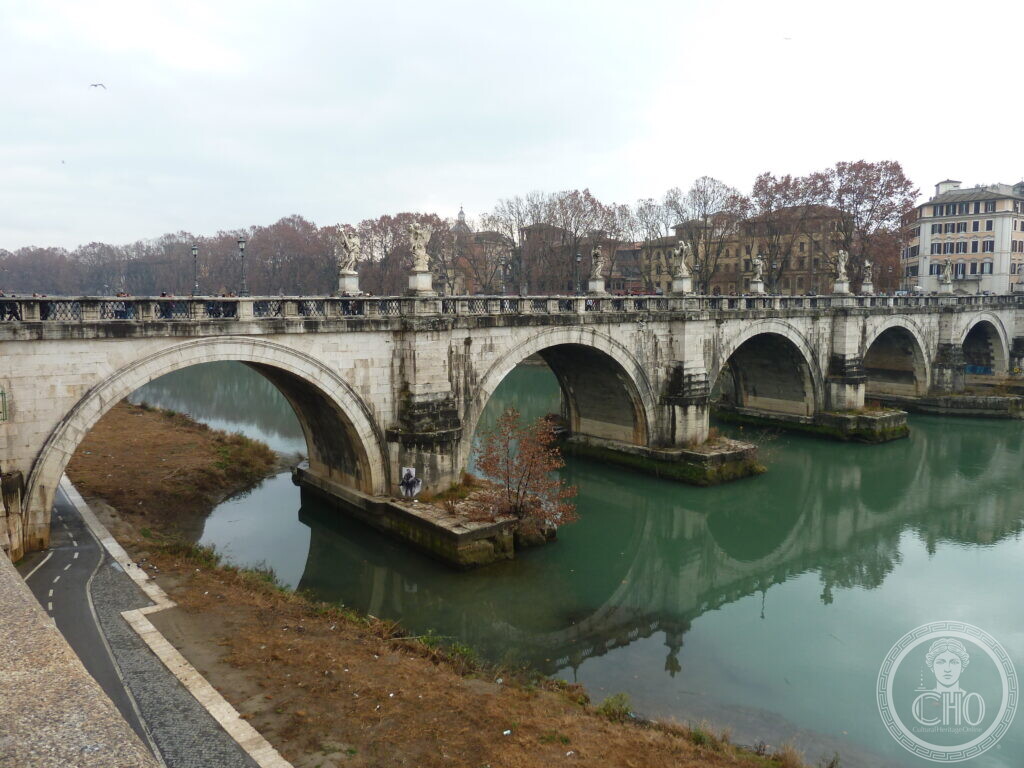
A Roman bridge across the Tiber, begun under Hadrian and completed in 134 AD, which now carries a series of angel statues along the pedestrian route between the city centre and Castel Sant’Angelo.
At a glance
Ponte Sant’Angelo connects the districts of Ponte and Borgo in Rome, linking the left bank of the Tiber with the Mausoleum of Hadrian, now Castel Sant’Angelo. The structure has five arches, three of which survive from the Roman period, and is lined with statues of angels designed under Gian Lorenzo Bernini.
Key facts
- Where: Ponte Sant’Angelo, Borgo, Rome
- What: Bridge
- When: completed in 134 AD
- GPS: 41.9019, 12.4665 · Open in Google Maps
History
The bridge was completed in 134 AD under the emperor Publius Aelius Hadrianus, from whom it took its first name, Pons Aelius. It was built as a grand approach to the Mausoleum of Hadrian on the right bank of the Tiber. In the Middle Ages, after the collapse of the nearby Pons Neronianus, it remained the only direct link between the city centre and the Vatican, and was known as Ponte San Pietro. The current name dates from 590, when Pope Gregory the Great is said to have seen the Archangel Michael sheathing his sword atop the mausoleum during a penitential procession, a sign that a plague had passed. During the Holy Year of 1450, the balustrades gave way under the pressure of crowds crossing the bridge, and around 200 people died. In 1533, Pope Clement VII had the chapels built after that disaster demolished and replaced with two marble statues of Saint Peter and Saint Paul, by Lorenzetto and Paolo Taccone. The appearance the bridge has today, however, comes mostly from a commission given to Gian Lorenzo Bernini by Pope Clement IX in the 1660s: the closed parapets were replaced with stone balustrades and iron railings, and ten new angel sculptures carrying the instruments of Christ’s Passion were added to the structure.
What you see
The photograph shows the stone bridge crossing the Tiber, with the solid masonry of its Roman spans and the parapet lined with angel statues. The upper part of the bridge holds the statues, while the lower stonework meets the green water. The image is taken from the riverbank and also shows buildings and bare trees behind the bridge.
Do you know more about this place?
If you know a date, a name, a document, a plaque or a photograph that tells its story, write to Sofia through the contact page. What arrives with a source goes into this page, with your name as the contributor.
Nearby
- National Museum of Castel Sant’Angelo — at the northern end of the bridge, inside Hadrian’s mausoleum
- Mausoleum Tomb of Hadrian – Castel Sant’Angelo — the monument the bridge was built to serve
Sources
- Castel Sant’Angelo Rome, Ponte Sant’Angelo Rome: History, Statues of Angels, Curiosities: history, construction date, papal interventions, Bernini’s role.
- Apple Maps, Ponte Sant’Angelo in Rome, Italy: coordinates and basic identification.
- Turismo Roma, Sant’Angelo bridge: original name, construction date, historical events, 17th-century transformation.
- Vivere in Italien, The Ponte Sant’Angelo in Rome: Ten Angels and the History of the Ponte Sant’Angelo: details of the 1450 tragedy and Bernini’s commission.
- Stefano Vigolo, photographs and notes to the editorial staff (2026): identification of the subject. Not a published source.
Find it on the map
See this place and what’s around it →📷 Become a Cultural Heritage Online photographer
Share your photos of places: they stay published under your name as the author. The more they're seen, the more you get noticed — and soon a contest will reward the most appreciated photos.
Log in or sign up free to add a photo